Quick answer: This glossary explains the mutual fund terms you’ll see on factsheets, statements and investing apps, grouped by what you’d use them for: returns, costs, transactions, plans, fund types, risk, and your account. Each term has a one- or two-line definition. Where we’ve written a detailed guide, the term links to it.
Last updated: 18 November 2026
Jump to: Returns · Costs and charges · Buying, selling and SIPs · Plans and options · Fund types · Risk · Your account and documents
Returns and performance
NAV (Net Asset Value): The price of one unit of a fund, calculated at the end of every business day. It’s the fund’s total assets minus its liabilities, divided by the number of units. A low NAV doesn’t make a fund “cheap”.
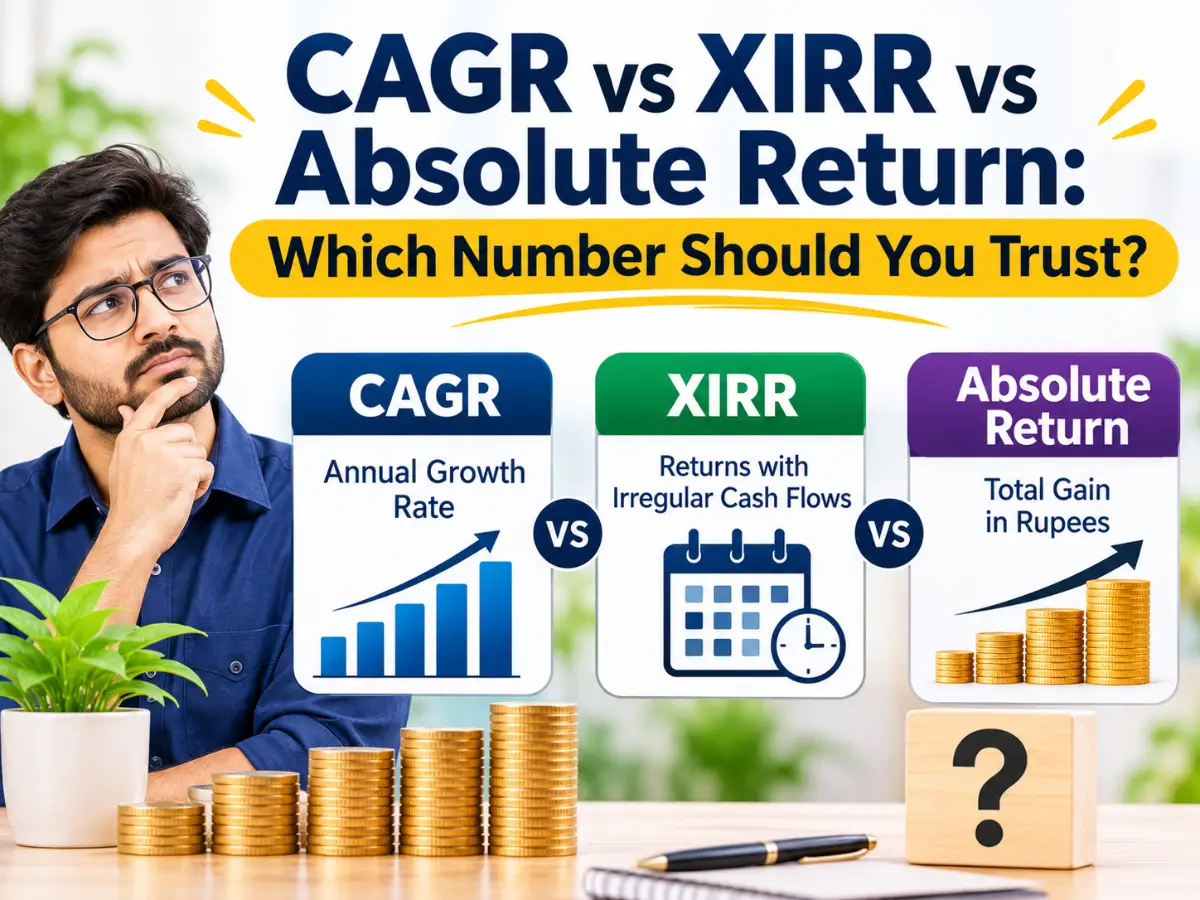
Absolute return: The total percentage gain or loss on your investment, without considering how long it took. Best for holdings of under a year. See CAGR vs XIRR vs Absolute Return.
CAGR (Compound Annual Growth Rate): The steady yearly rate that turns one starting amount into one ending amount. The 1, 3 and 5-year returns on factsheets are CAGRs.
XIRR (Extended Internal Rate of Return): Your yearly return when money goes in or out on different dates, such as SIPs, top-ups and withdrawals. It’s the right way to measure SIP returns. See What Is XIRR in Mutual Funds?
Trailing returns: Returns for a fixed period ending today, such as the last 3 years. They depend heavily on where the market is right now.
Rolling returns: Returns over every 3-year (or 5-year) window in a long history, showing the average, best and worst. They show how consistent a fund has been.
Benchmark: The index a fund measures itself against, such as the Nifty 500 TRI for a flexi cap fund.
TRI (Total Return Index): A version of an index that includes dividends reinvested. It’s the fair benchmark for a mutual fund, because funds also keep their dividends.
Alpha: The return a fund earned above what its benchmark and risk level would predict. Positive alpha suggests the manager added value.
Beta: How much a fund moves when its benchmark moves. A beta of 1.1 means it has tended to rise or fall about 10% more than the index.
Standard deviation: How much a fund’s returns swing around their average. Higher means a bumpier ride. See Sharpe Ratio & Standard Deviation.
Sharpe ratio: Return above a risk-free rate, divided by standard deviation. It shows how well a fund was paid for the volatility it took. Only compare it between similar funds.
Sortino ratio: Like the Sharpe ratio, but it counts only downward swings as risk.
Costs and charges
Expense ratio (TER): The yearly fee for running a fund, taken out of the NAV daily. Since April 2026, it’s shown as a Base Expense Ratio plus brokerage and statutory levies. See Expense Ratio in Mutual Funds.
Base Expense Ratio (BER): The core running cost of a fund under SEBI’s 2026 rules: the management fee, distributor commission and operating costs. It excludes taxes and brokerage. See SEBI’s New Mutual Fund Rules 2026.
Exit load: A fee for redeeming units before a set period, commonly 1% within 12 months for equity funds. Each SIP instalment has its own clock. See Exit Load in Mutual Funds.
Stamp duty: A small government levy (0.005%) on mutual fund purchases, including each SIP instalment.
LTCG and STCG: Long-term and short-term capital gains tax on your profits when you redeem. For equity funds, gains on units held over 12 months are taxed at 12.5% above ₹1.25 lakh a year, and gains on units held 12 months or less at 20%. See LTCG on Mutual Funds and Mutual Fund Taxation in India.
Buying, selling and SIPs
Units: What you own in a fund. Your investment ÷ NAV = units allotted.
SIP (Systematic Investment Plan): A fixed amount invested automatically every month (or week). See What Is SIP in Mutual Funds?
Step-up SIP: A SIP that increases by a set amount or percentage every year. See Step-Up SIP vs Regular SIP.
Lumpsum: A one-time investment of a larger amount. See SIP vs Lumpsum.
STP (Systematic Transfer Plan): Moving money in fixed amounts from one fund (usually a liquid fund) into another (usually equity) over time. It’s a way to invest a lump sum gradually.
SWP (Systematic Withdrawal Plan): Withdrawing a fixed amount every month from a fund, often used for retirement income. See What Is a Systematic Withdrawal Plan?
Redemption: Selling your units. Money usually reaches your bank in 1–3 working days, depending on the fund type.
Switch: Moving money from one scheme to another within the same fund house. For tax and exit load, it counts as a redemption and a fresh purchase.
Cut-off time: The time by which your transaction must be received (and, for purchases, the money credited) to get that day’s NAV.
FIFO (First In, First Out): The rule that your oldest units are redeemed first. It matters for exit load and tax.
Lock-in period: A period during which you can’t redeem, such as 3 years for each ELSS instalment.
NFO (New Fund Offer): The launch period of a new fund, usually at ₹10 per unit. See our live NFO list.
Plans and options
Direct plan: A version of the fund with no distributor commission, so it has a lower expense ratio.
Regular plan: A version that includes a commission paid to the distributor or advisor who helps you. See Direct vs Regular Mutual Funds.
Growth option: Profits stay invested and compound. The NAV rises over time.
IDCW (Income Distribution cum Capital Withdrawal): Formerly called the “dividend” option. Payouts come out of your own investment’s value and are taxed at your slab rate. See Dividend Reinvestment vs Growth Option.
Fund types
Equity fund: Invests mainly in shares. Higher long-term growth potential with bigger swings. See Equity Funds.
Debt fund: Invests in bonds and money market instruments. Lower risk than equity, but not risk-free. See Debt Mutual Funds.
Hybrid fund: Mixes equity and debt (and sometimes gold). See Hybrid Mutual Funds.
Liquid fund: A debt fund holding instruments maturing within 91 days. Often used for emergency money. See Liquid Funds vs Savings Account.
Index fund / ETF: A fund that copies an index such as the Nifty 50. ETFs trade on the stock exchange, while index funds are bought from the fund house. See Flexi Cap vs Index Fund.
ELSS (Equity Linked Savings Scheme): A tax-saving equity fund with a 3-year lock-in, eligible for Section 80C under the old tax regime.
Life Cycle Fund: A target-date fund, new in 2026, that automatically shifts from equity to debt as its maturity year approaches. See Life Cycle Funds.
Risk
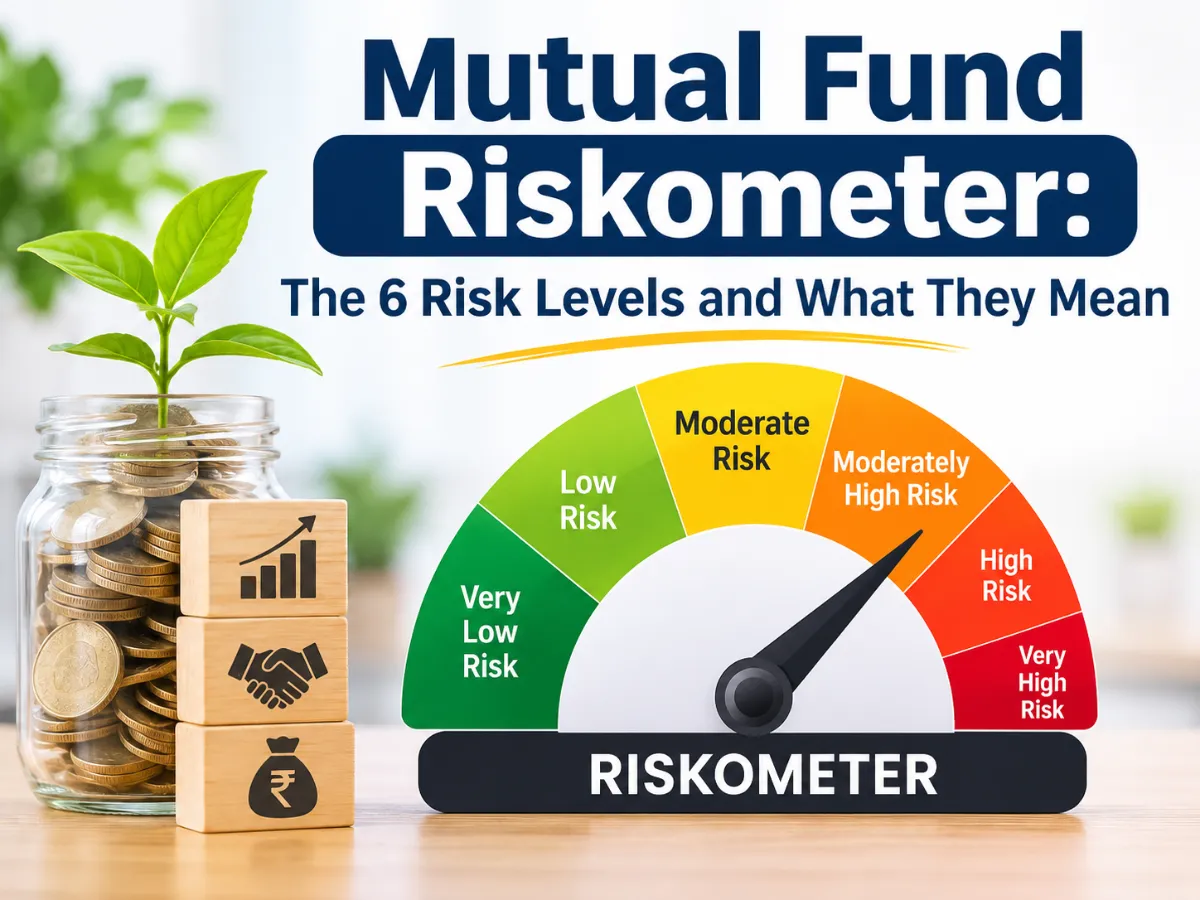
Riskometer: SEBI’s six-level dial (Low to Very High) showing a fund’s risk, recalculated monthly from its portfolio. See Mutual Fund Riskometer.
PRC matrix (Potential Risk Class): A 3×3 grid on debt funds showing the maximum credit and interest-rate risk the fund is allowed to take.
Portfolio overlap: How many of the same stocks two of your funds hold. High overlap means less diversification than you think. See Mutual Fund Overlap.
AUM (Assets Under Management): The total money a fund manages. Larger funds must charge lower expense ratios under SEBI’s caps.
Your account and documents
AMC (Asset Management Company): The fund house that runs the scheme, such as HDFC AMC or SBI Funds.
RTA (Registrar and Transfer Agent): The company that keeps investor records for fund houses. In India, mainly CAMS and KFintech.
Folio number: Your account number with a fund house. One folio can hold several schemes from that AMC.
CAS (Consolidated Account Statement): One statement listing every mutual fund you hold across all fund houses under your PAN. See How to Check All Your Mutual Funds by PAN.
KYC (Know Your Customer): One-time identity verification needed before you invest. See How to Complete Mutual Fund KYC Online.
Nominee: The person who receives your units if you die. Every folio should have one. See How to Change Nominee in a Mutual Fund.
SID and KIM: The Scheme Information Document and the shorter Key Information Memorandum. They’re the official documents describing a fund’s strategy, costs and risks.
Factsheet: The monthly report each fund house publishes, showing NAV, returns, portfolio, expense ratio, risk ratios and the riskometer.
ARN (AMFI Registration Number): The registration number of a mutual fund distributor. RingMoney’s is ARN-320453.
FAQs
What are the most important mutual fund terms for a beginner?
NAV, SIP, expense ratio, exit load, direct vs regular plan, growth vs IDCW, and the riskometer. Understand these seven and you can read most fund pages.
Is NAV the same as the price of a share?
It’s the price of one unit of the fund, but unlike a share price it isn’t set by trading. It’s calculated from the value of everything the fund holds.
What is the difference between XIRR and CAGR?
CAGR measures one lump sum from one date to another. XIRR handles many investments on different dates, like SIPs.
What does IDCW mean in mutual funds?
Income Distribution cum Capital Withdrawal, the new name for the dividend option. Payouts come from your own investment’s value.
Mutual fund investments are subject to market risks. Read all scheme-related documents carefully. RingMoney is an AMFI-registered mutual fund distributor (ARN-320453). Definitions are simplified for clarity. Refer to SEBI, AMFI and scheme documents for formal definitions.
Try it: SIP Calculator · Start here: What Is SIP in Mutual Funds? · Types of Mutual Funds in India