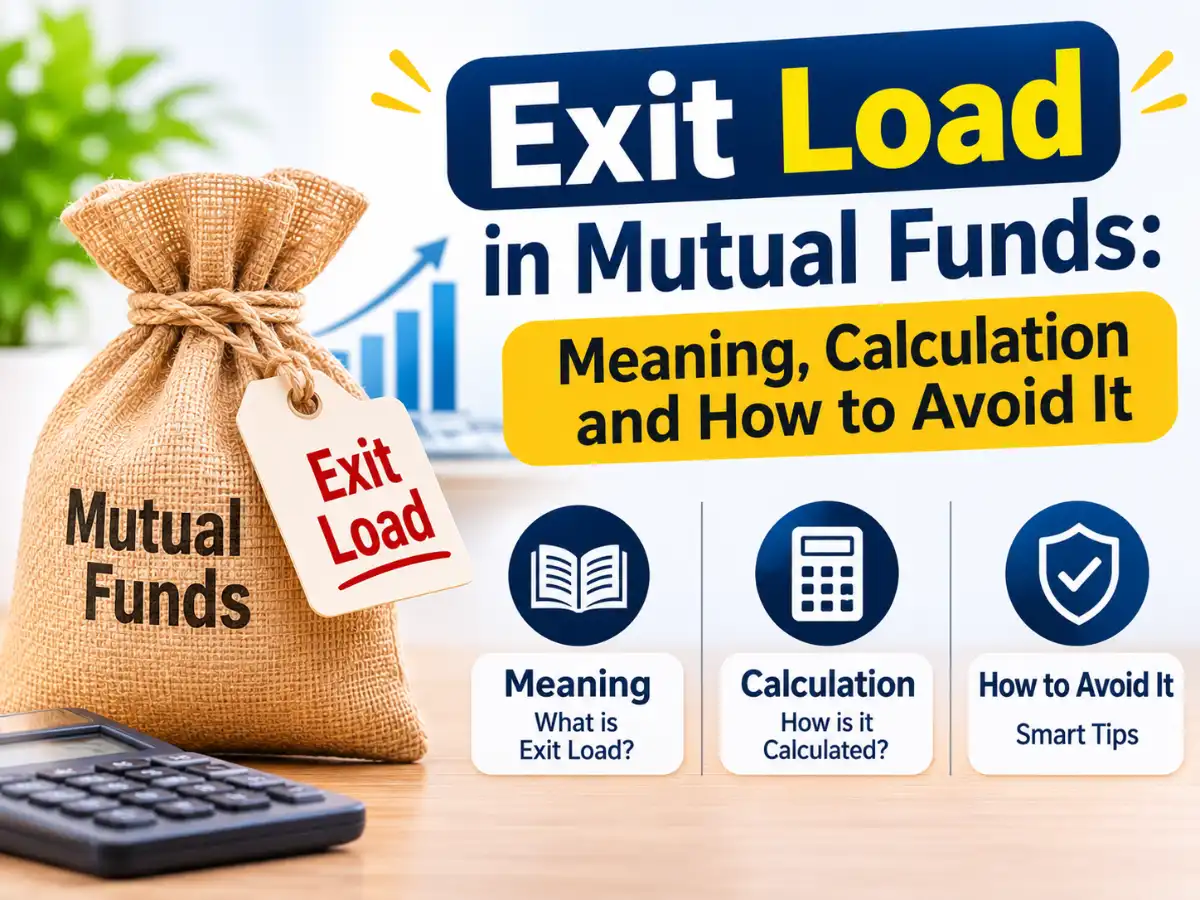
Quick answer: An exit load is a small fee charged when you sell (redeem) mutual fund units before a set holding period. A common example is 1% if redeemed within 12 months for many equity funds. It’s calculated on the value you redeem and deducted from what you receive. For SIPs, each instalment has its own clock, and units are sold oldest-first (FIFO). So after a SIP has run for a year, you can often withdraw a part without paying any exit load.
Last updated: 11 November 2026
What is exit load?
When you redeem units, the fund house may keep a small percentage of the redemption value if you exit early. It does this for two reasons:
- It discourages short-term in-and-out money. Frequent redemptions force the fund manager to keep extra cash or sell holdings at bad times, which hurts long-term investors.
- The money goes back to the scheme. Exit load is credited to the fund itself, not kept as profit by the AMC. Investors who stay benefit slightly.
Exit load is different from the expense ratio:
| Expense ratio | Exit load | |
|---|---|---|
| When charged | Every day you stay invested | Only when you redeem early |
| How you pay | Built into the NAV | Deducted from your redemption amount |
| Can you avoid it? | Only by choosing a cheaper fund or plan | Yes, by holding past the exit load period |
More on the first in Expense Ratio in Mutual Funds.
How exit load is calculated on a lump sum
Exit load = Units redeemed × NAV on redemption date × Exit load %
Example: You invested ₹1,00,000 in an equity fund with a 1% exit load if redeemed within 12 months. Eight months later you redeem all 1,000 units at an NAV of ₹120.
- Redemption value: 1,000 × ₹120 = ₹1,20,000
- Exit load: 1% × ₹1,20,000 = ₹1,200
- You receive: ₹1,18,800 (before any tax)
The load is charged on the current value, not on what you originally invested.
How exit load works on a SIP
This is where most people get confused. Each SIP instalment is a separate purchase with its own holding period. When you redeem, the oldest units are sold first. This is called FIFO, or first in, first out.
Example: You’ve invested ₹5,000 on the 1st of every month from January 2025 to February 2026 (14 instalments, ₹70,000 in total). The fund has a 1% exit load within 12 months. You redeem on 15 March 2026.
| Instalments | Held for | Exit load? | Current value (illustrative) |
|---|---|---|---|
| Jan, Feb, Mar 2025 | More than 365 days | No | ₹17,500 |
| Apr 2025 – Feb 2026 (11 instalments) | Less than 365 days | Yes, 1% | ₹58,500 |
| Total | ₹76,000 |
- If you redeem everything: exit load = 1% × ₹58,500 = ₹585.
- If you redeem only ₹15,000: FIFO sells the January–March 2025 units first. They’re past 12 months, so you pay no exit load.
So the way to avoid exit load on a SIP isn’t to wait 12 months after your last instalment. You just need to redeem no more than the value of the units that are already past the exit load period.
Typical exit loads by fund type
| Fund type | Typical exit load (check each scheme) |
|---|---|
| Equity funds (large, mid, small, flexi cap) | Often 1% within 12 months; some funds use 6 months or 15–18 months, or a sliding scale |
| ELSS (tax-saving) | None, but a 3-year lock-in means you can’t redeem early at all |
| Index funds and ETFs | Often nil or very low |
| Liquid funds | Small graded load for the first 6 days, nil from day 7 onward |
| Overnight funds | Usually nil |
| Arbitrage funds | Often a small load within 15–30 days |
| Hybrid funds | Often 1% within 12 months, sometimes with part of the units free |
| Life Cycle Funds (new in 2026) | 3% in year 1, 2% in year 2, 1% in year 3 |
The liquid fund load is tiny. It starts at about 0.007% on day 1 and falls each day until it reaches zero on day 7. On ₹1 lakh, that’s well under ₹10. It only exists to stop people using liquid funds as overnight parking.
Sources: scheme documents, and the Life Cycle Fund structure from SEBI’s 2026 categorisation framework. See our SEBI 2026 rules summary.
Do you pay exit load when switching funds?
Usually, yes. A switch from one scheme to another is treated as a redemption from the first scheme. Exit load and capital gains tax can both apply. Switching from a regular plan to a direct plan of the same scheme is also a redemption, so check the scheme’s terms before you switch.
5 ways to avoid paying exit load
- Know the exit load period before you invest. It’s on the fund’s page, factsheet and KIM. Some funds use 6 months, others 15 or 18.
- Match the fund to your timeline. Money you might need within a year shouldn’t go into an equity fund with a 12-month load. Use a liquid fund or short-duration debt fund instead.
- For SIPs, redeem from the oldest units. Partial withdrawals after the first year can often be load-free (see the example above).
- Plan SWPs after the load period. If you’re setting up monthly withdrawals, check whether the fund lets a share of units go load-free. Otherwise, start the SWP after the exit load period. See Best SWP Mutual Funds.
- Don’t let a small load stop a necessary exit. If a fund is no longer right for you, paying a 1% load can still be better than staying in the wrong fund.
Exit load and tax
They’re separate. Exit load is a fee. Capital gains tax applies to your profit. For equity funds, gains on units held over 12 months are taxed at 12.5% above ₹1.25 lakh a year, and gains on units held 12 months or less at 20%. Redeeming early can therefore cost you twice: once in exit load, and again in short-term capital gains tax. See LTCG on Mutual Funds.
FAQs
What is exit load in simple words?
It’s a fee you pay if you sell mutual fund units before a set period, for example 1% within one year.
Is exit load charged on profit or on the full amount?
On the full redemption value (units × current NAV), not just the profit.
Does exit load apply to every SIP instalment?
Yes. Each instalment has its own holding period, counted from its own purchase date.
Is there an exit load on ELSS?
No, but ELSS has a 3-year lock-in, so each instalment can’t be redeemed for 3 years from its purchase date.
Do liquid funds have an exit load?
Yes, a very small graded one for redemptions within the first 6 days. From day 7 onward, it’s nil.
Where can I check a fund’s exit load?
On the scheme’s factsheet, Key Information Memorandum (KIM), the AMC’s website, or the fund’s page on your investing app.
Mutual fund investments are subject to market risks. Read all scheme-related documents carefully. RingMoney is an AMFI-registered mutual fund distributor (ARN-320453). Exit loads vary by scheme and can change. Check the latest scheme documents before investing or redeeming. Examples are illustrative.
Related reading: Expense Ratio in Mutual Funds · SIP vs Lumpsum · Liquid Funds vs Savings Account · Best SWP Mutual Funds