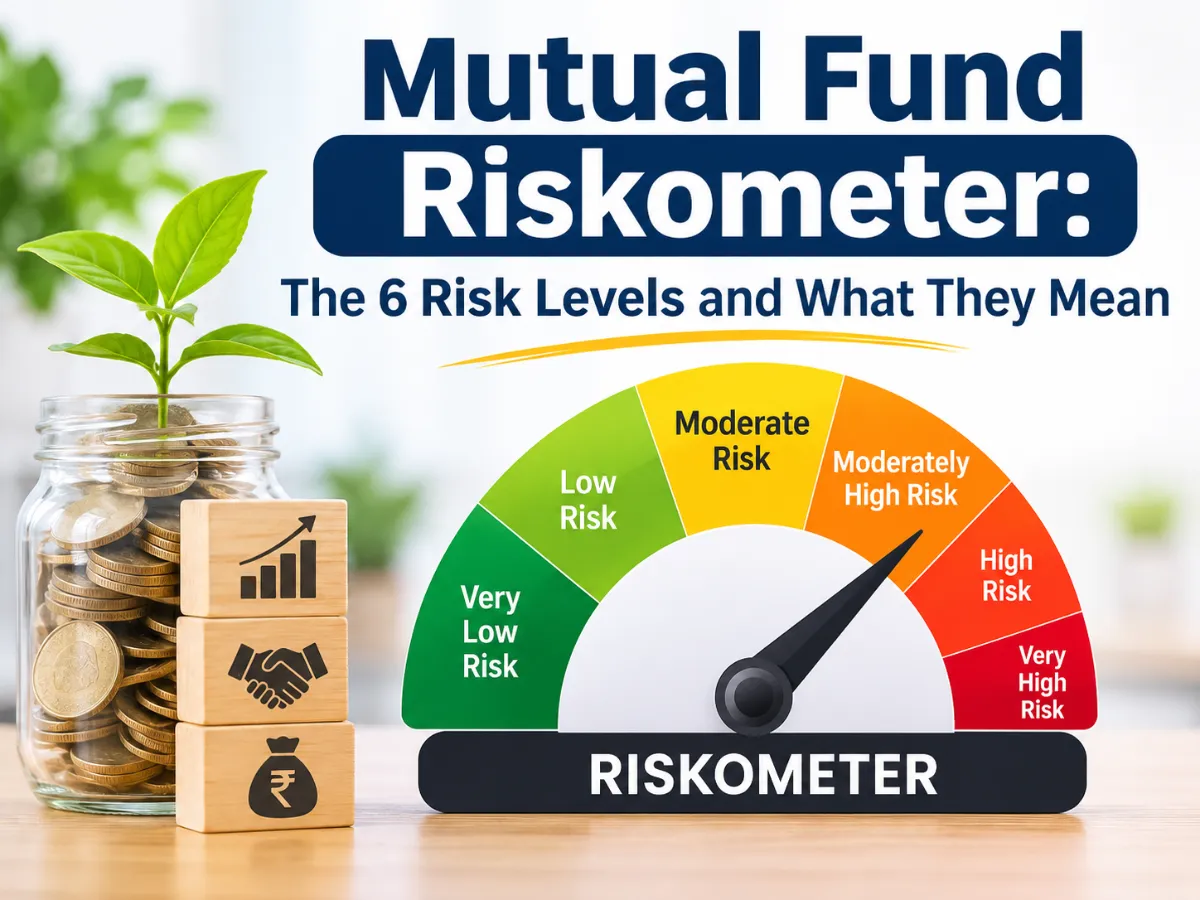
Quick answer: The riskometer is a dial that SEBI requires on every mutual fund scheme. It shows the risk to your principal on one of six levels: Low, Low to Moderate, Moderate, Moderately High, High and Very High. It’s calculated from the fund’s actual portfolio every month, not just its category. One thing most guides miss: because of how the scoring works, almost every equity fund lands on “Very High”, including large cap and index funds. So the riskometer is good at separating safe funds from risky ones, but not at comparing two equity funds.
Last updated: 12 November 2026
The six risk levels
| Level | Risk score | What it means for your principal | Funds you’ll often see here* |
|---|---|---|---|
| Low | Up to 1 | Very little chance of a fall in value | Overnight funds, many liquid funds |
| Low to Moderate | Above 1 to 2 | Small, short-lived dips possible | Money market and ultra-short duration funds |
| Moderate | Above 2 to 3 | Some ups and downs, usually modest | Corporate bond, banking & PSU debt funds |
| Moderately High | Above 3 to 4 | Noticeable swings possible | Some longer-duration debt, conservative hybrid funds |
| High | Above 4 to 5 | Meaningful falls possible | Some hybrid and balanced advantage funds |
| Very High | Above 5 | Large falls possible | Most equity funds: large, mid, small, flexi cap, index, sectoral, international |
*Typical placements, not rules. A fund’s level depends on what it holds that month, so always check the current factsheet.
How the riskometer is calculated
Since January 2021, AMCs can’t pick a label themselves. SEBI sets the method:
- Every security in the portfolio gets a risk score.
- Equity is scored on three things: market size (large cap 5, mid cap 7, small cap 9), volatility, and liquidity (impact cost).
- Debt is scored on credit risk (the issuer’s rating), interest-rate risk (the portfolio’s duration) and liquidity risk.
- Other assets, such as gold, have their own set values.
- The scores are weighted by how much of the portfolio each holding makes up.
- The fund’s total score is mapped to one of the six levels (see the table above).
- This is redone every month. AMCs must publish the updated riskometer within 10 days of the month end, alongside the portfolio. If the level changes, they must inform existing investors.
Since December 2024, SEBI also requires the same set colours for each level on every document, from green for Low to red for Very High. That way a “Very High” label looks the same whichever fund house shows it.
Sources: SEBI circular SEBI/HO/IMD/DF3/CIR/P/2020/197 (5 October 2020) and circular SEBI/HO/IMD/PoD1/CIR/P/2024/150 (5 November 2024).
Why nearly every equity fund says “Very High”
The “Very High” level starts at a score above 5. The lowest possible score for any listed share is 5, which is what the largest, most liquid large cap stocks get. Add any volatility or mid and small cap exposure, and the average quickly goes above 5.
The result:
- A Nifty 50 index fund and a small cap fund can carry the same “Very High” label.
- The label doesn’t tell you that the small cap fund might fall twice as far in a bad year.
What to do about it: use the riskometer to decide between asset classes (equity vs hybrid vs debt). To compare two equity funds, use other tools:
- Standard deviation and the Sharpe ratio (our guide)
- The fund’s worst fall in 2020 and in 2024–25, compared with its benchmark
- The fund’s category. Large cap, flexi cap, mid cap and small cap funds behave very differently, even with the same label.
The riskometer for debt funds and the PRC matrix
Debt funds also carry a second label, the Potential Risk Class (PRC) matrix. It shows the maximum credit risk and interest-rate risk the fund is allowed to take, in a 3×3 grid from A-I (lowest) to C-III (highest).
| Riskometer | PRC matrix | |
|---|---|---|
| Shows | Risk the fund is taking now | The most risk the fund can take |
| Changes | Monthly | Only if the fund changes its strategy |
| Applies to | All funds | Debt funds |
For a safe home for emergency money, look for a fund that sits at Low or Low to Moderate today and has a PRC limit with low credit risk.
How to actually use the riskometer
- Start with your goal, not the fund.
- Money needed within 1 year: stick to Low or Low to Moderate.
- 1–3 years: Moderate or lower, mostly debt.
- 3–5 years: up to High, for example hybrid funds.
- 5+ years: Very High (equity) is reasonable for part of the money.
- Check that the label fits what you were told. If a fund was described to you as “safe” or “like an FD” and the dial says High or Very High, ask why. This is one of the main reasons SEBI introduced the riskometer.
- Read the change notices. If you get a letter or email saying a fund’s risk level has moved up, look at what changed in the portfolio. Then decide whether it still fits your goal.
- Don’t stop at the label. Two “Very High” funds can be very different. Two “Moderate” debt funds can hold very different bonds. Look at the portfolio and the category too.
Where to find a fund’s riskometer
- In the monthly factsheet, on each scheme’s page
- In the Scheme Information Document (SID) and Key Information Memorandum (KIM)
- In advertisements, which must show it
- On the AMC’s website, and on the fund page of your investing app
Factsheets also show the benchmark’s riskometer next to the fund’s, so you can see whether the fund is taking more or less risk than its index.
Common myths about the riskometer
“Very High risk means I’ll probably lose money.” No. It means the value can fall a lot along the way. Over long periods, equity funds have historically recovered from falls, but nothing is guaranteed, and the label is a warning to take seriously for short goals.
“Low risk means no risk.” No. Even Low-rated funds carry some credit and interest-rate risk.
“The label never changes.” It can change every month as the portfolio changes.
“It tells me about returns.” It doesn’t. It’s only about risk.
FAQs
What is a riskometer in mutual funds?
A SEBI-mandated dial showing a scheme’s risk to your principal on six levels, from Low to Very High, recalculated monthly from the actual portfolio.
How many levels does the riskometer have?
Six: Low, Low to Moderate, Moderate, Moderately High, High and Very High.
Why is my large cap or index fund “Very High risk”?
Under SEBI’s scoring, even the safest listed shares score 5, and “Very High” starts above 5. So most equity funds, including large cap and index funds, land at Very High.
How often is the riskometer updated?
Every month. It’s published within 10 days of the month end along with the portfolio disclosure.
Is a Very High risk fund bad?
Not necessarily. It suits long-term goals where you can ride out large falls. It’s unsuitable for money you need soon.
What is the difference between the riskometer and the PRC matrix?
The riskometer shows the risk a fund is taking now. The PRC matrix shows the maximum credit and interest-rate risk a debt fund is allowed to take.
Mutual fund investments are subject to market risks. Read all scheme-related documents carefully. RingMoney is an AMFI-registered mutual fund distributor (ARN-320453). Typical fund placements are illustrative. Check each scheme’s latest riskometer before investing.
Related reading: Sharpe Ratio & Standard Deviation · Types of Mutual Funds in India · Liquid Funds vs Savings Account · Flexi Cap vs Index Fund