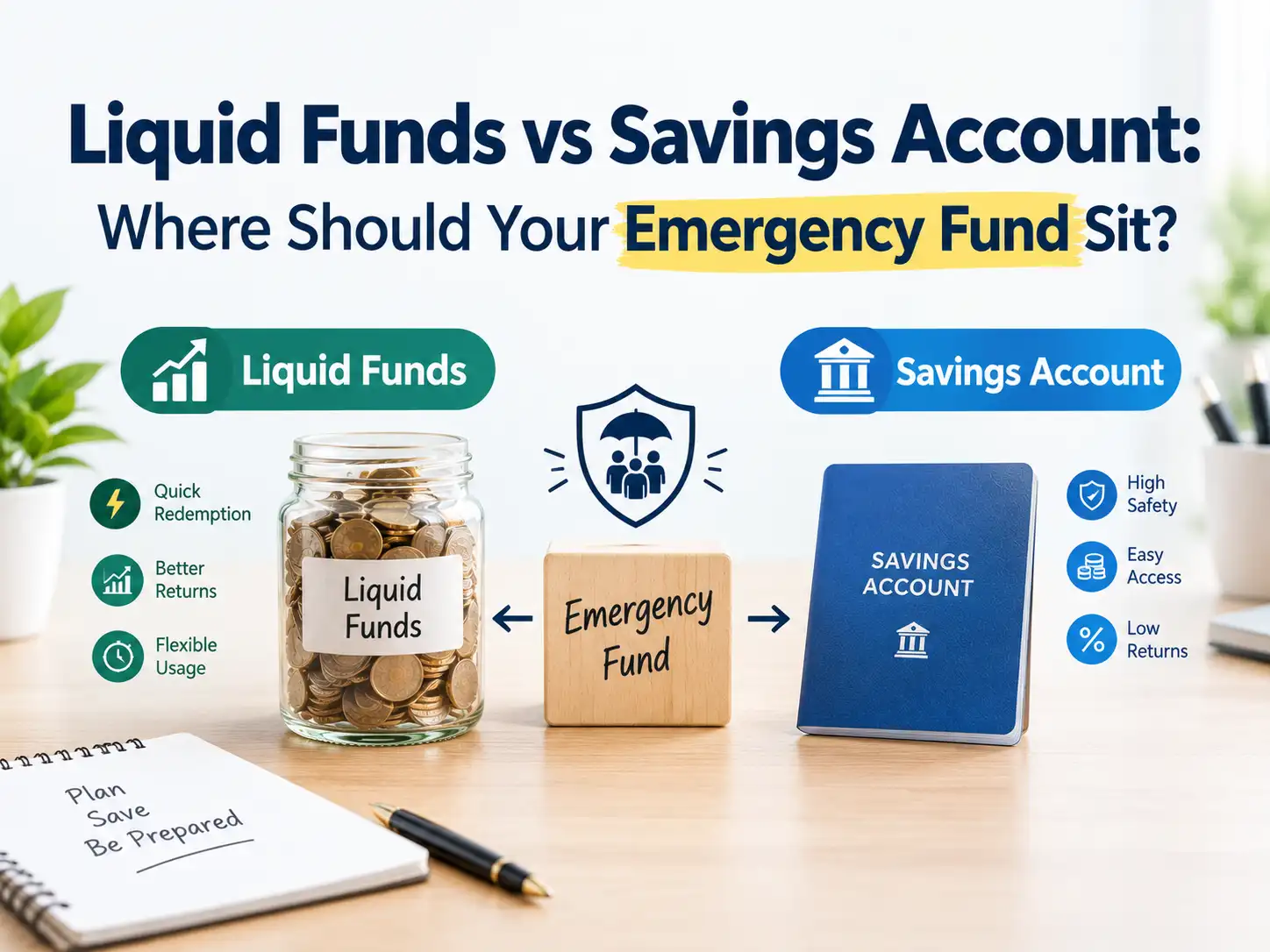
Quick answer: Keep 1 month of expenses in your savings account for instant access and put the rest of your emergency fund (usually 5+ months) in a liquid fund. Liquid funds typically earn more than a savings account’s 2.5–3%, because they track short-term money market rates. You can redeem up to ₹50,000 (or 90% of your holding, whichever is lower) instantly, and the rest arrives the next working day.
It’s 11 pm, and a hospital wants a ₹40,000 deposit before admitting your father. That’s the job an emergency fund has to do. Earning a little more on it matters, but getting the money in time matters more.
How big should your emergency fund be?
Your situation | Emergency fund target |
|---|---|
Salaried, stable job, dual income | 3–4 months of expenses |
Salaried, single income | 6 months |
Self-employed, freelancer, commission income | 9–12 months |
Retired | 12 months, plus health insurance |
Count expenses, not salary: rent or EMI, groceries, school fees, insurance premiums, utilities. Health insurance is separate. An emergency fund isn’t a replacement for it.
Liquid fund vs savings account: side-by-side
| Feature | Savings Account | Liquid Fund |
|---|---|---|
| Typical Return | Often around 2.5–3% at large banks; some small banks offer higher rates. | Market-linked returns based on short-term money-market and debt instruments. Returns are not guaranteed. |
| Access | Generally available instantly, 24/7 through UPI, ATMs and online banking, subject to bank limits and service availability. | Eligible instant-redemption facilities may allow up to ₹50,000 or 90% of the investment, whichever is lower, per scheme per day. The balance usually follows the applicable redemption settlement timeline. |
| Risk | Eligible bank deposits are insured by DICGC up to ₹5 lakh per depositor per bank, including principal and interest. | Relatively low risk, but not risk-free. Credit, interest-rate and liquidity risks can affect returns. |
| Tax | Interest is generally taxable at your applicable slab rate. Under the old tax regime, eligible savings-account interest may qualify for a deduction of up to ₹10,000 under Section 80TTA. | For investments covered by Section 50AA, gains are generally taxed at the applicable slab rate. Tax treatment depends on the fund and acquisition date. |
| Exit Load | No exit load for withdrawing your own savings. | Liquid funds may charge a graded exit load for redemptions within the first 7 days; generally nil from day 7 onward, subject to scheme terms. |
← Swipe or scroll horizontally to compare →
Note: Returns, redemption limits and tax rules can change. Check the bank’s latest rate card and the mutual fund scheme’s current SID before investing.
What are liquid funds?
Liquid funds are debt mutual funds that invest in very short-term instruments, such as treasury bills, commercial paper and certificates of deposit, maturing in up to 91 days. Because everything matures so quickly, the NAV barely moves day to day. They’re among the lowest-risk mutual funds you can buy.
They’re not risk-free. In a few rare credit events in the past, some debt funds holding weaker papers took sharp hits. That’s why the fund you pick matters.
How to pick a liquid fund for your emergency fund
- Stick with large, established AMCs. Fund size and the fund house’s track record matter here.
- Check credit quality. Prefer funds holding mostly sovereign (T-bills) and top-rated (A1+) papers.
- Look at the expense ratio. With modest returns, a high expense ratio eats a big share. Direct plans or low-cost options make sense here.
- Confirm the instant redemption facility is available on your platform.
- Ignore small differences in recent returns. Safety comes first.
How does instant redemption work?
SEBI allows instant redemption in liquid and overnight funds of ₹50,000 or 90% of your folio value, whichever is lower, per scheme per day. It’s credited to your bank account within minutes, even on weekends.
Anything above that follows normal settlement and lands the next working day.
Practical tip: hold your emergency money in two liquid funds from different AMCs. That doubles your instant access to ₹1 lakh a day.
The exit load to know about
Liquid funds charge a tiny graded exit load if you redeem within 7 days of investing (from about 0.007% on day 1 down to 0.0045% on day 6, then nil). On ₹1 lakh, that’s ₹7 at most. It’s there to stop short-term parking by big institutions. For an emergency fund it rarely matters.
How are liquid funds taxed?
Gains on liquid funds (bought after 1 April 2023) are added to your income and taxed at your slab rate, but only when you redeem. A savings account’s interest is taxed every year.
So if you redeem only in an actual emergency, the tax gets deferred, sometimes for years.
A simple emergency fund setup
Say your monthly expenses are ₹60,000 and your target is 6 months (₹3.6 lakh):
- ₹60,000 in your savings account. Instant access for anything at 11 pm.
- ₹1.5 lakh in Liquid Fund A.
- ₹1.5 lakh in Liquid Fund B (different AMC). That gives ₹1 lakh+ a day in instant redemptions.
You can track it as its own goal in the RingMoney app so it never mixes with your investments. Set up a custom goal.
When not to use a liquid fund
- For money you’ll spend this week. Keep it in your bank account.
- For goals 3+ years away. A short-duration debt or hybrid fund usually fits better.
- As a long-term investment. After tax, liquid fund returns barely beat inflation.
Frequently Asked Questions
Are liquid funds safe for an emergency fund?
They’re among the lowest-risk mutual funds, holding short-term high-quality instruments. They aren’t guaranteed like bank deposits, so choose funds with strong credit quality from large AMCs.
Can I withdraw from a liquid fund at night or on a Sunday?
Yes, up to the instant redemption limit (₹50,000 or 90%, whichever is lower, per scheme per day), if your platform supports it.
Is a liquid fund better than an FD for an emergency fund?
Liquid funds are more flexible because you can withdraw any amount without breaking the whole deposit. A sweep-in FD is a good alternative if you prefer guaranteed rates.
How much return does a liquid fund give?
Liquid fund returns track short-term money market rates, which move with the RBI’s policy rate. They’re typically higher than savings account interest, but not fixed.
Can I start a SIP in a liquid fund?
Yes. It’s a disciplined way to build an emergency fund over a few months.