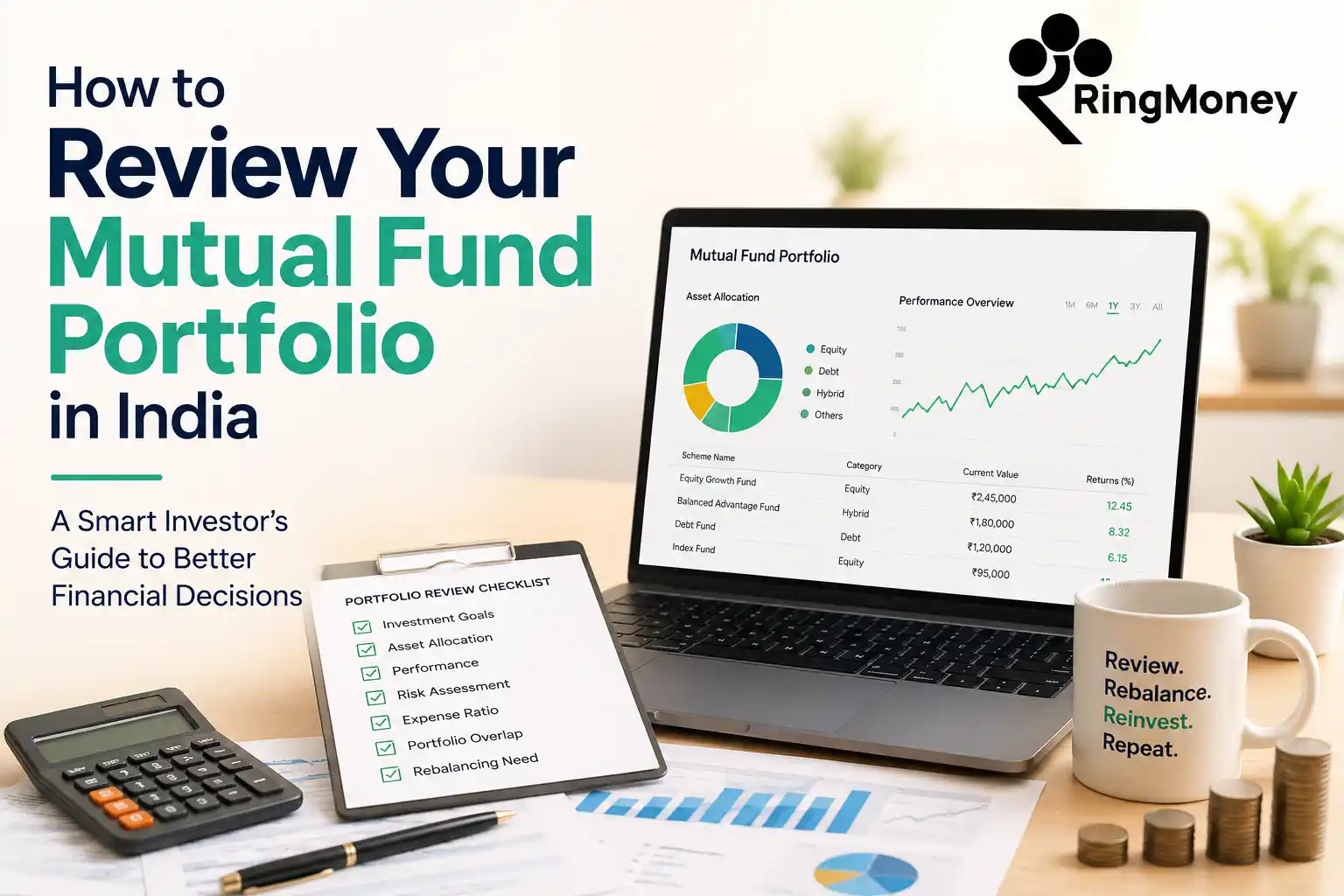
Reviewing your mutual fund portfolio means checking whether your investments are still helping you achieve your financial goals, delivering reasonable returns, and matching the level of risk you’re comfortable taking. It isn’t about finding the best-performing mutual fund every year—it’s about making sure every fund still deserves a place in your portfolio.
Many investors start SIPs and let them run for years without looking back. While staying invested is important, ignoring your portfolio completely isn’t. Markets move, your income grows, and your financial goals change over time. A portfolio that suited you three or four years ago may not be the right fit today.
A good portfolio review helps you answer a few important questions:
- Are your funds performing as expected?
- Is your asset allocation still balanced?
- Do you own too many similar funds?
- Is every investment linked to a financial goal?
- Should you continue, rebalance, or replace any fund?
Reviewing your portfolio once in a while can help you identify small issues before they turn into costly mistakes and keep your investments aligned with the future you’re planning for
Before You Review Your Portfolio, Know What You're Actually Trying to Find
any investors think reviewing a mutual fund portfolio simply means checking returns. They open their investment app, look at the profit or loss, and move on. But that’s only one part of the picture.
A proper portfolio review helps you understand whether your investments are still working for you. Before looking at performance, ask yourself:
- Are the returns reasonable for the risk I’m taking?
- Do I own too many similar mutual funds?
- Is every fund linked to a financial goal?
- Has my asset allocation changed over time?
- Should I continue, rebalance, or replace any fund?
The goal isn’t to chase the highest returns. It’s to check whether your portfolio is balanced, goal-oriented, and still suitable for your financial needs.
Step 1: Gather Every Mutual Fund in One Place—You Can't Review What You Can't See
Before reviewing your portfolio, gather all your mutual fund investments in one place. You can’t review what you can’t see.
Many investors have investments spread across different platforms such as banks, Groww, Zerodha Coin, or directly with AMCs. It’s also common to have old SIPs that are still running but haven’t been reviewed in years.
The easiest way to get a complete view is by downloading your Consolidated Account Statement (CAS) or checking MFCentral, which shows your mutual fund holdings across AMCs using your PAN.
While reviewing, note down:
- Fund name
- Fund category
- Current value
- SIP amount
- Purchase date
- Investment platform
This exercise often reveals hidden issues. You may find duplicate funds bought through different platforms, an old ELSS SIP that’s still active, or investments you had completely forgotten about.
Once you have the complete picture, you can start analysing your portfolio with confidence instead of making decisions based on incomplete information.
Step 2: Don't Judge Your Portfolio by Returns Alone
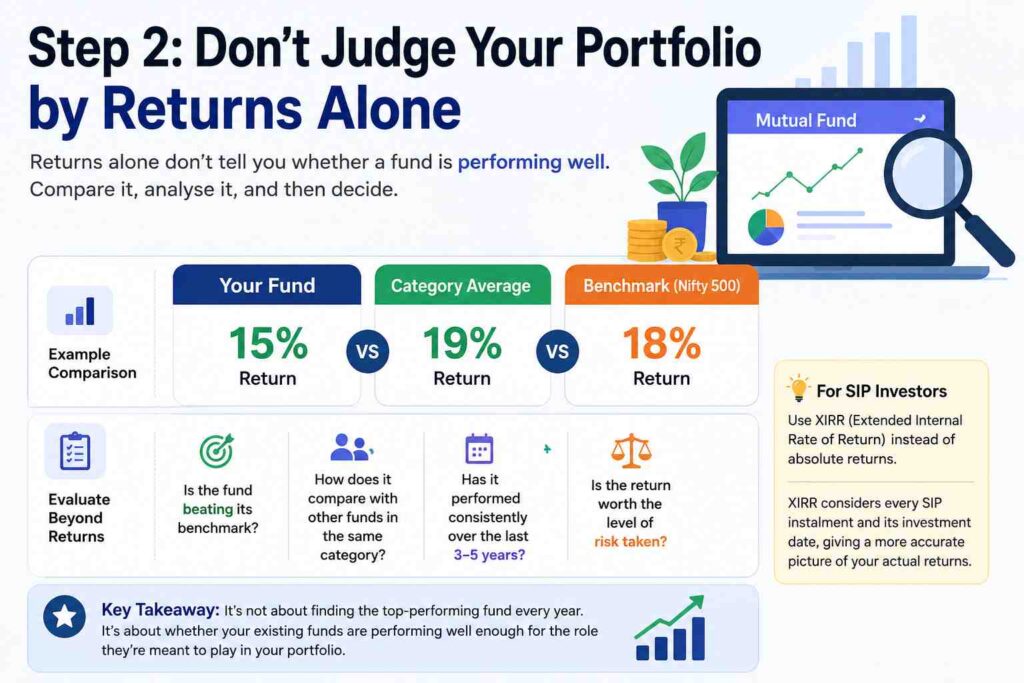
Many investors judge their portfolio only by the profit or return shown in their investment app. But returns alone don’t tell you whether a fund is performing well.
For example, if your fund delivered a 15% return, it may seem impressive. However, if similar funds earned 19% and the benchmark returned 18%, your fund actually underperformed.
Instead of asking, “How much did I earn?”, ask:
- Is the fund beating its benchmark?
- How does it compare with other funds in the same category?
- Has it performed consistently over the last 3–5 years?
- Is the return worth the level of risk taken?
If you invest through SIPs, use XIRR (Extended Internal Rate of Return) instead of absolute returns. Since it considers every SIP instalment and its investment date, XIRR gives a more accurate picture of your actual returns.
Also, avoid judging a fund based on one year’s performance. Some categories, such as mid-cap funds, naturally go through periods of underperformance before bouncing back. Looking at 3–5 years of performance gives a much better idea of whether a fund has consistently delivered value.
The objective isn’t to find the top-performing fund every year. It’s to check whether your existing funds are performing well enough for the role they’re meant to play in your portfolio.
Step 3: Ask One Simple Question—Why Does This Fund Exist in Your Portfolio?
Every mutual fund in your portfolio should have a clear purpose. If you can’t explain why you own a fund, it’s time to review whether it still deserves a place in your portfolio.
Many investors end up buying funds based on recommendations from friends, social media, banks, or because they needed to save tax. Over time, this can lead to a portfolio with several funds but no clear investment strategy.
Instead, assign a role to every fund.
Fund Category | Purpose |
Large Cap Fund | Long-term stability and core equity exposure |
Mid Cap Fund | Higher growth potential |
Flexi Cap Fund | Diversified long-term growth |
Debt Fund | Emergency fund or short-term goals |
ELSS Fund | Tax saving and long-term wealth creation |
Gold Fund | Diversification during market volatility |
After doing this, ask yourself one important question:
If I didn’t already own this fund, would I invest in it today?
If your answer is no, understand the reason. Your financial goals may have changed, another fund may already serve the same purpose, or the fund may no longer be performing as expected.
A good portfolio isn’t one with the most funds—it’s one where every fund has a clear role and continues to add value.
Step 4: Check Whether Your Asset Allocation Has Quietly Changed
One of the biggest portfolio changes often happens without you making a single transaction.
Suppose you originally planned your investments like this:
- Equity: 60%
- Debt: 30%
- Gold: 10%
After a few years of a strong bull market, your equity investments may have grown much faster than your debt or gold allocation. Without investing any extra money, your portfolio could now look like this:
- Equity: 76%
- Debt: 17%
- Gold: 7%
This is known as asset allocation drift.
At first glance, higher equity exposure may feel like a good thing because your portfolio value has increased. But remember why you chose the original allocation in the first place—it matched your risk tolerance and financial goals.
If markets suddenly correct by 20–30%, your portfolio may now experience a much larger fall than you originally intended.
Reviewing your allocation once or twice a year helps you decide whether rebalancing is necessary. Rebalancing doesn’t mean reacting to every market movement. It simply means bringing your investments closer to your planned allocation whenever the gap becomes significant.
Step 5: Look for Hidden Problems Most Investors Miss
A healthy-looking portfolio can still hide several problems beneath the surface.
Fund overlap
Owning five mutual funds doesn’t automatically mean you’re well diversified.
Many large-cap and flexi-cap funds hold similar companies such as HDFC Bank, Reliance Industries, ICICI Bank and Infosys. If multiple funds own largely the same stocks, you may only have the illusion of diversification.
Too many similar funds
More funds don’t always mean better investing.
Managing three or four carefully selected funds is often simpler than tracking ten schemes that perform almost the same role.
Underperforming funds
Every fund can have a weak year. That alone isn’t a reason to exit.
However, if a fund has consistently lagged behind its benchmark and category average for several years while following the same investment strategy, it deserves a detailed review.
Forgotten SIPs
Many investors continue SIPs they started years ago without checking whether they still fit their current priorities.
An ELSS fund started purely for tax saving or a thematic fund purchased during a market trend may no longer deserve regular contributions.
Funds without goals
If a fund isn’t linked to buying a home, retirement, children’s education, wealth creation or another specific objective, ask yourself why it still exists.
Every investment should move you closer to a defined financial destination.
Step 6: Review Your Portfolio Against Your Financial Goals—Not the Market
A common mistake is comparing every mutual fund with the Nifty or discussing returns with friends.
But your investments aren’t competing with someone else’s portfolio. They’re working towards your own life goals.
For example, your portfolio may be helping you:
- Build a retirement corpus.
- Save for your child’s higher education.
- Buy your first home.
- Create wealth over the next 15–20 years.
- Maintain an emergency reserve.
When reviewing your portfolio, check whether every fund contributes to one of these goals.
If you find investments with no clear purpose, consider simplifying your portfolio. A focused portfolio linked to real-life objectives is usually easier to manage than a collection of random schemes.
Finally Decide: Continue, Rebalance or Exit?
Once your review is complete, avoid making emotional decisions. Instead, place every fund into one of these three categories.
Continue
Continue your SIP if the fund still matches its intended purpose, has delivered reasonable long-term performance and fits your asset allocation.
Rebalance
If your overall allocation has drifted significantly because of market movements, consider shifting investments to restore the balance instead of chasing whichever asset class is performing best.
Replace or Exit
Consider replacing or exiting a fund only after evaluating the complete picture.
Before redeeming, check:
- Whether an exit load applies.
- The tax implications of selling.
- Whether another fund genuinely offers a better fit for your goals.
Changing funds too frequently often creates unnecessary costs without improving long-term returns.
How Often Should You Review a Mutual Fund Portfolio?
An annual review is sufficient for most long-term investors.
However, certain life events should also trigger a review, including:
- A significant salary increase.
- Marriage.
- Birth of a child.
- Receiving a large inheritance or bonus.
- Approaching an important financial goal.
- Major changes in your risk appetite.
A review should be driven by meaningful changes in your financial life—not by daily market headlines.
Common Mistakes Investors Make While Reviewing Their Portfolio
Avoid these common mistakes that can do more harm than good:
- Checking your portfolio every day instead of reviewing it periodically.
- Replacing funds after one year of underperformance.
- Chasing whichever mutual fund topped last year’s return chart.
- Ignoring taxes and exit loads before redeeming investments.
- Holding multiple funds with almost identical portfolios.
- Stopping SIPs simply because markets have fallen temporarily.
- Reviewing investments only during market crashes and ignoring them during stable periods.
A disciplined review process focuses on evidence, not emotions.
Green Flags vs. Red Flags During a Portfolio Review
Green Flags | Red Flags |
Every fund has a defined purpose | Random collection of funds bought on tips |
Portfolio linked to financial goals | No clear objective for several investments |
Limited overlap between funds | Multiple schemes holding similar stocks |
Asset allocation matches your plan | Equity exposure has become much higher than intended |
Simple, manageable portfolio | Too many funds creating unnecessary complexity |
Give Your Portfolio a Simple Health Score
You don’t need sophisticated software to judge portfolio quality. Give yourself a score out of 10.
Review Area | Points |
Asset allocation is balanced | 2 |
Every fund supports a goal | 2 |
Limited overlap between funds | 2 |
Long-term performance is satisfactory | 2 |
Portfolio is simple to manage | 2 |
A score of 8–10 suggests your portfolio is in good shape. A lower score doesn’t necessarily mean your investments are poor—it simply highlights areas that deserve attention during your next review.
Seven Questions Every Mutual Fund Should Answer Before It Stays in Your Portfolio
Before you continue investing in any scheme, ask yourself:
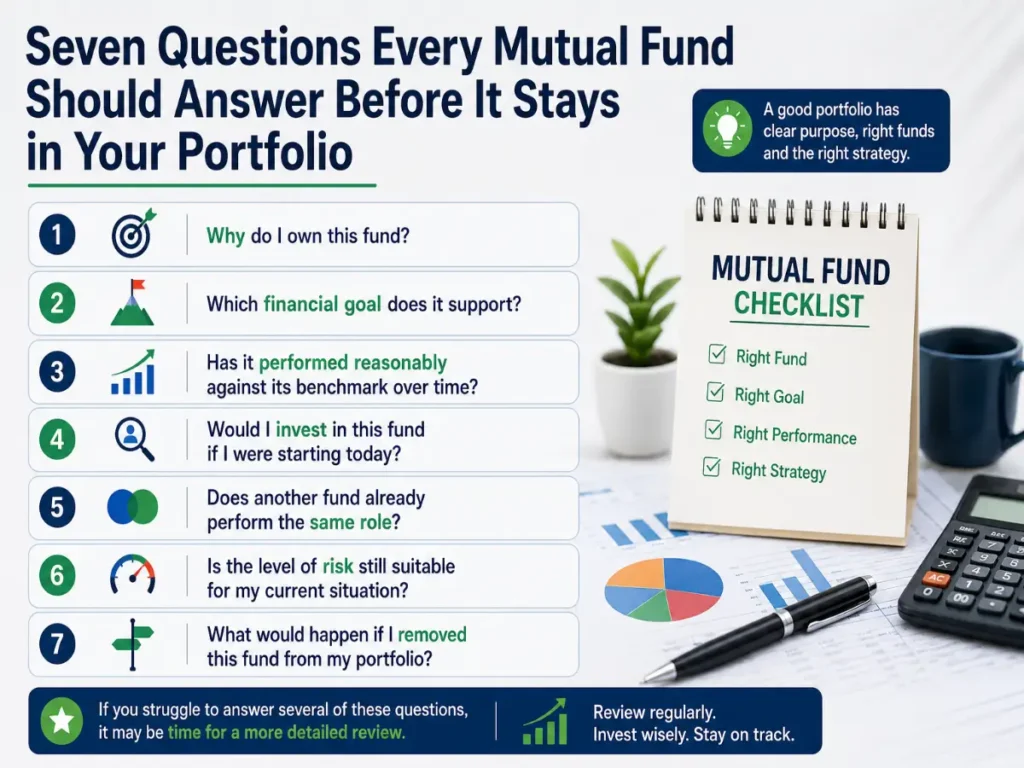
- Why do I own this fund?
- Which financial goal does it support?
- Has it performed reasonably against its benchmark over time?
- Would I invest in this fund if I were starting today?
- Does another fund already perform the same role?
- Is the level of risk still suitable for my current situation?
- What would happen if I removed this fund from my portfolio?
If you struggle to answer several of these questions, it may be time for a more detailed review.
Mutual Fund Portfolio Review Checklist
Use this checklist during every annual review:
- Review your Consolidated Account Statement (CAS) or MFCentral holdings.
- Calculate your XIRR instead of relying only on absolute returns.
- Compare each fund with its benchmark and category average.
- Check for asset allocation drift.
- Identify overlapping funds.
- Remove investments that no longer serve a purpose.
- Verify nominee details and investment records.
- Confirm that every fund is linked to a financial goal.
When Should You Seek Professional Portfolio Review?
Many investors can review their mutual fund portfolios on their own. However, getting expert guidance can be helpful if:
- You own more than 8–10 mutual funds.
- Your investment portfolio has grown into a large corpus.
- You’re investing for multiple financial goals, such as retirement, a house, and your child’s education.
- You’ve inherited mutual fund investments.
- You’re an NRI managing investments from different countries.
- You’re unsure whether to continue, rebalance, or exit certain funds.
If you’re looking for an easier way to review and manage your investments, RingMoney can help. The app lets you invest in mutual funds and SIPs while giving you a clear view of your portfolio, making it easier to track your investments, monitor performance, and stay aligned with your financial goals—all from one place.
A professional portfolio review or the right investment platform isn’t about chasing the highest returns. It’s about making informed decisions and ensuring your investments continue to support your long-term financial goals.
Don't Let Your Portfolio Become That One Cupboard You Never Clean
Many investors treat their mutual fund portfolio like a storage cupboard—keep adding things, close the door, and hope everything inside is fine. But just like that cupboard, things can become messy without you even noticing.
A yearly portfolio review helps you remove what no longer serves a purpose, identify hidden issues, and make sure every fund is still working towards your financial goals. You don’t need to keep changing funds every few months, but you also shouldn’t leave your investments on autopilot for years.
Spend an hour reviewing your portfolio once a year. That small habit can save you from years of investing in the wrong funds, taking unnecessary risks, or missing the goals you started investing for in the first place.