There is no single best investment plan in India. The best investment is the one that matches your financial goal, investment timeline, risk tolerance, liquidity needs, and tax situation.
Many people don’t lose money because they choose a bad investment—they lose money because they choose the right investment for the wrong goal. For example, investing retirement savings in stocks just before retirement or keeping long-term savings only in fixed deposits can both lead to poor financial outcomes.
Choosing an investment based on your needs instead of chasing the highest returns is what leads to better long-term financial decisions.
Before Looking for the Best Investment Plan, Answer These 5 Questions First
Before comparing investment products, take a step back and understand why you’re investing in the first place. Answering these questions can prevent costly mistakes later.

1. What are you investing for?
Every financial goal has a different timeline and risk level.
You might be investing to:
- Buy a house
- Build retirement savings
- Create wealth over the long term
- Fund your child’s education
- Generate monthly income
- Save taxes
Your goal determines which investments deserve your attention and which ones you should avoid.
2. When will you need the money?
Time is one of the biggest factors in investing.
If you’ll need the money within two or three years, preserving your capital should usually take priority over chasing higher returns. On the other hand, if your goal is ten or twenty years away, you can generally afford more short-term market fluctuations in exchange for better long-term growth potential.
3. Can you handle market ups and downs?
Every investment carries some level of risk.
Ask yourself how you would react if your investment temporarily lost 20% of its value during a market correction. If that possibility would cause you to sell immediately, high-risk investments may not suit your personality, regardless of their return potential.
4. Will you need regular income?
Some investments focus on long-term growth, while others are designed to provide periodic income.
If you’re retired or planning to supplement your monthly cash flow, your investment choices will naturally differ from someone investing solely for wealth creation.
5. Do taxes matter for your investment?
Taxes can significantly reduce your actual returns.
Instead of looking only at advertised returns, consider how much you’ll keep after taxes. Also, understand whether your chosen investment qualifies for deductions or tax-efficient treatment under the applicable tax rules.
Remember: The return you actually keep matters more than the return you see advertised. Inflation and taxation together determine your real purchasing power.
Once you’ve answered these five questions honestly, choosing an investment becomes much simpler because you’ll be selecting based on your own needs rather than someone else’s recommendation.
There Is No "Best" Investment Plan—Only the Best One for You
One of the biggest investing myths is believing there’s a universal investment that works for everyone.
Imagine five different investors:
- A college graduate investing ₹2,000 every month
- A salaried professional planning to buy a house in five years
- A business owner managing irregular income
- Parents saving for higher education
- A retired senior citizen looking for stable monthly income
All of them have different priorities, different timelines, and different levels of financial security. Expecting them to invest in the same product simply doesn’t make sense.
Instead of asking, “Which investment gives the highest return?” ask yourself:
“Which investment helps me achieve my financial goal with an acceptable level of risk?”
That small shift in thinking often leads to much better financial decisions.
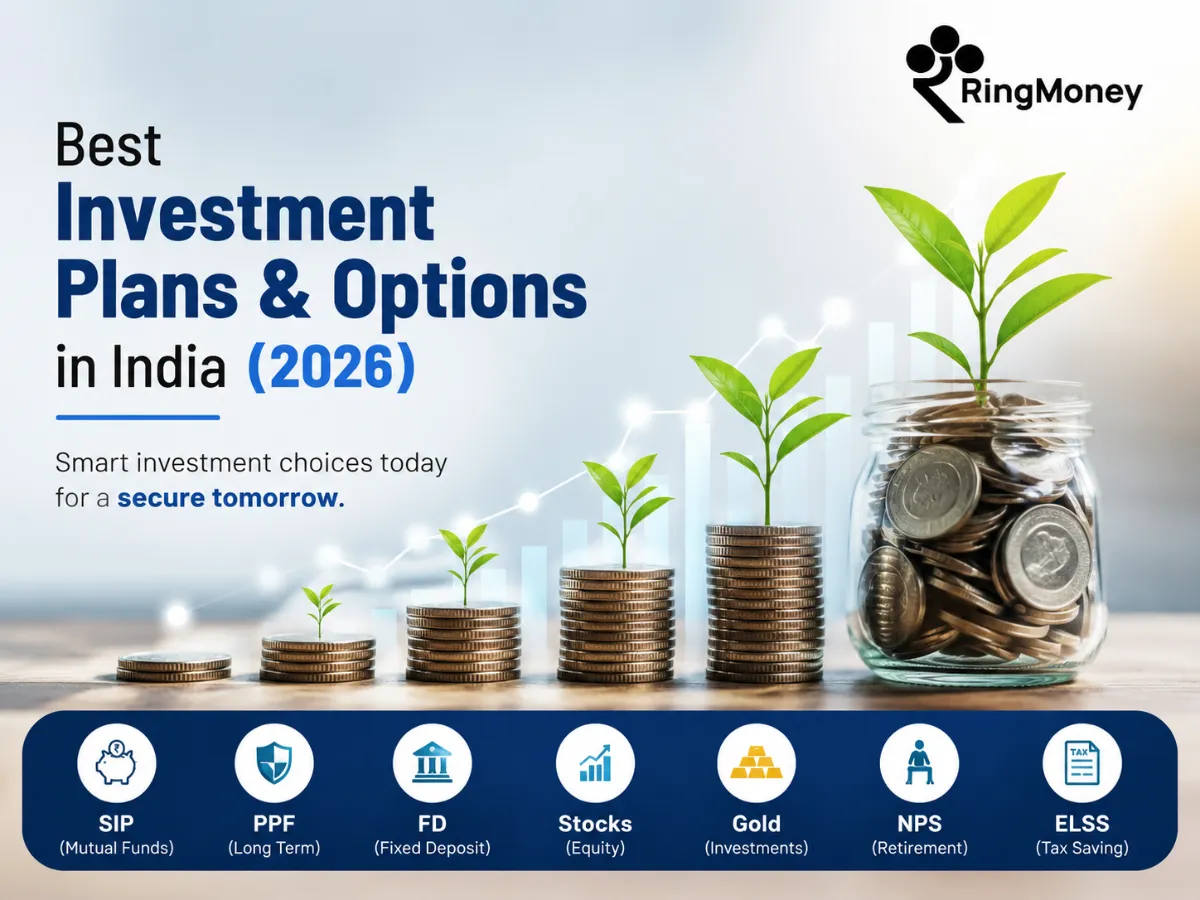
Quick Comparison: Best Investment Options at a Glance
SIP (Systematic Investment Plan)
- Returns: Depends on the mutual fund you invest in
- Risk: Varies
- Best for: Building wealth through disciplined monthly investing
Equity Mutual Funds
- Returns: Market-linked
- Risk: High
- Best for: Long-term wealth creation
Public Provident Fund (PPF)
- Returns: Government-declared
- Risk: Very Low
- Best for: Safe, long-term savings with tax benefits
Fixed Deposit (FD)
- Returns: Fixed
- Risk: Low
- Best for: Capital protection and short- to medium-term savings
National Pension System (NPS)
- Returns: Market-linked
- Risk: Medium
- Best for: Retirement planning
ELSS Mutual Funds
- Returns: Market-linked
- Risk: High
- Best for: Tax saving with long-term growth
Gold
- Returns: Market-linked
- Risk: Medium
- Best for: Portfolio diversification and inflation hedge
Stocks
- Returns: Market-linked
- Risk: Very High
- Best for: Experienced investors seeking higher growth
ULIP
- Returns: Market-linked
- Risk: Medium
- Best for: Insurance combined with long-term investing
Government & Corporate Bonds
- Returns: Fixed or variable
- Risk: Low to Medium
- Best for: Stable income and relatively lower risk
Sukanya Samriddhi Yojana (SSY)
- Returns: Government-declared
- Risk: Very Low
- Best for: Long-term savings for a girl child
REITs
- Returns: Market-linked
- Risk: Medium
- Best for: Investing in real estate without buying property
Exchange Traded Funds (ETFs)
- Returns: Market-linked
- Risk: Medium to High
- Best for: Low-cost diversified investing
Note: An SIP is not an investment option—it’s a method of investing regularly in products like mutual funds. Understanding this difference helps you make better investment decisions.
*Returns vary based on market conditions, government announcements, and the specific investment selected. Past performance should never be treated as a guarantee of future returns.
One important distinction that many investors miss is the difference between an investment option and an investment method. For example, an SIP is not an investment product—it is simply a disciplined way of investing regularly into products like mutual funds. Understanding this difference helps you compare investments more accurately instead of treating every financial term as a separate product.
Best Investment Plans Based on Your Financial Goal
Most people don’t invest because they love financial products—they invest because they want to achieve something meaningful. That’s why choosing investments based on your goal is often more effective than choosing based on advertised returns.

Best Investment for Wealth Creation
If your objective is to grow your wealth over the long term, equity-oriented investments have historically delivered better inflation-adjusted returns than traditional savings products. However, they require patience and the ability to stay invested through market fluctuations.
Suitable options include:
- Equity Mutual Funds
- Index Funds
- SIPs into diversified equity funds
- Direct Stocks (for experienced investors)
A common mistake is focusing only on short-term returns. Wealth creation is driven more by consistency and time than by trying to predict market highs and lows.
Best Investment for Retirement
Retirement planning is about creating financial independence rather than chasing maximum returns. Since retirement is usually a long-term goal, combining growth-oriented and stable investments can help build a sustainable retirement corpus.
Good options include:
- National Pension System (NPS)
- Public Provident Fund (PPF)
- Employees’ Provident Fund (EPF)
- Pension-oriented mutual funds
If you’re decades away from retirement, allowing a higher equity allocation early in your career may improve long-term compounding. As retirement approaches, gradually increasing safer investments can help reduce volatility.
Best Investment for Child's Education
Education costs have consistently risen faster than general inflation. Relying only on traditional savings accounts may not be enough to meet future expenses.
Consider combining:
- Sukanya Samriddhi Yojana (for eligible girl children)
- Equity Mutual Funds through SIP
- Hybrid Funds for medium-term goals
The earlier you start, the smaller your monthly investment may need to be because compounding has more time to work.
Best Investment for Monthly Income
If your priority is predictable cash flow instead of capital appreciation, investments focused on regular income may be more suitable.
Examples include:
- Senior Citizens’ Savings Scheme (SCSS)
- Post Office Monthly Income Scheme (POMIS)
- High-quality Bonds
- Monthly Income Mutual Fund strategies
Remember that higher monthly payouts should always be evaluated alongside the safety of the underlying investment.
Best Investment for Tax Saving
Tax-efficient investing should complement your financial goals—not replace them. Choosing a product only because it offers tax benefits can lead to unsuitable long-term decisions.
Popular tax-saving options include:
- ELSS Mutual Funds
- PPF
- NPS
- Eligible insurance-based investment plans
Keep in mind: As of 2026, the new tax regime is the default, and deductions like Section 80C generally apply only if you opt for the old tax regime. If you stay with the new regime, focus more on long-term growth and post-tax returns than tax deductions.
Always compare both the tax advantage and the investment’s long-term growth potential before making a decision.
Best Investment for Capital Safety
If protecting your principal amount matters more than maximising returns, prioritise investments backed by the government or financially strong institutions.
Examples include:
- Fixed Deposits
- PPF
- National Savings Certificate (NSC)
- Government Bonds
While these options reduce investment risk, they may not always generate returns that comfortably outperform inflation over long periods.
Important: A “safe” investment isn’t automatically the most rewarding. If inflation averages around 5% annually and your investment earns only slightly more after taxes, your purchasing power may grow much slower than expected.
Which Investment Gives the Highest Returns?
This is one of the most searched investment questions, but it doesn’t have a single answer.
Historically, equity-based investments have offered the highest long-term growth potential. These include:
- Direct Stocks
- Equity Mutual Funds
- Small-Cap Funds
- Index Funds
- REITs (over certain market cycles)
However, higher expected returns always come with greater uncertainty. Markets move in cycles, and periods of strong performance are often followed by corrections.
Keep in mind: Under current tax rules, long-term capital gains (LTCG) on equity investments are taxed at 12.5% after the applicable tax-free threshold. Always consider this tax when estimating your actual returns.
Avoid falling into recency bias, where recent market gains make you believe similar returns will continue indefinitely. Instead of chasing last year’s top-performing investment, focus on building a diversified portfolio aligned with your long-term objectives.
Best Investment Plans by Time Horizon
Matching your investment with your timeline can reduce unnecessary risk.
Investment Period | Suitable Investment Options |
Less than 3 Years | Fixed Deposits, Liquid Mutual Funds, Recurring Deposits, Treasury Bills |
3–5 Years | Hybrid Mutual Funds, ELSS, Gold ETFs |
5–10 Years | Equity Mutual Funds, REITs, Index Funds |
More than 10 Years | SIPs, Index Funds, PPF, NPS, Diversified Equity Funds |
The longer your investment horizon, the more time you have to recover from temporary market declines and benefit from long-term compounding.
Which Investment Plan Fits Your Risk Appetite?
Risk tolerance isn’t about being brave—it’s about being realistic.
Risk Profile | Suitable Investments | Typical Investor |
Low Risk | FD, PPF, NSC, Government Bonds | Conservative investors and retirees |
Medium Risk | Hybrid Funds, Gold, NPS, High-quality Bonds | Balanced investors seeking growth with stability |
High Risk | Equity Mutual Funds, Stocks, Small-Cap Funds, ETFs | Long-term investors comfortable with market volatility |
Choose investments that allow you to remain invested during difficult periods. An investment strategy you abandon midway rarely produces the desired results.
How to Choose the Best Investment Plan
Instead of choosing an investment based on recent returns or recommendations, follow this simple decision-making framework:
Step 1: Define Your Financial Goal
↓
Know exactly why you’re investing—whether it’s wealth creation, retirement, buying a home, or funding your child’s education.
Step 2: Decide Your Investment Timeline
↓
Estimate when you’ll need the money. Your time horizon determines how much risk you can realistically take.
Step 3: Assess Your Risk Appetite
↓
Choose investments that match your comfort with market fluctuations, not just their return potential.
Step 4: Consider Taxes and Inflation
↓
Focus on your post-tax, inflation-adjusted returns rather than headline returns alone.
Step 5: Diversify Your Portfolio
↓
Spread your investments across different asset classes like equity, debt, and gold instead of relying on a single product.
Step 6: Review Your Investments Regularly
Review your portfolio at least once a year and make adjustments as your financial goals, income, or life circumstances change.
Following this structured process helps you make informed investment decisions instead of reacting to market headlines or social media trends.
Common Investment Mistakes That Can Cost You Money
Even experienced investors make mistakes. Being aware of them can help you avoid unnecessary setbacks.
- Investing without a clearly defined goal.
- Chasing the highest recent returns instead of long-term consistency.
- Keeping your entire portfolio in one investment option.
- Ignoring inflation while focusing only on nominal returns.
- Stopping SIPs during market downturns.
- Buying investments solely because friends or relatives recommended them.
- Forgetting to review investments as your financial priorities change.
Many investing mistakes aren’t caused by poor products—they’re caused by poor decisions.
Start Your Mutual Fund & SIP Journey with RingMoney
If Mutual Funds and SIPs align with your financial goals, RingMoney makes getting started simple. You can explore a wide range of mutual funds, start SIPs in just a few steps, and track your investments from one easy-to-use app, helping you invest consistently and work towards your long-term financial goals.
Before You Invest: A 5-Point Investment Checklist
Before you invest your first rupee, take 30 seconds to answer these five questions:
☐ Do you know exactly what you’re investing for? (Retirement, wealth creation, home, education, etc.)
☐ Have you chosen an investment that matches your time horizon?
☐ Are you comfortable with the level of risk involved?
☐ Have you considered inflation, taxes, and your expected post-tax returns?
☐ Is your portfolio diversified instead of relying on just one investment?
If you answered “Yes” to all five, you’re ready to invest with confidence.
Remember, the biggest investing mistake isn’t choosing the wrong product—it’s delaying your decision while waiting for the “perfect” investment. A well-planned investment started today has far more time to benefit from compounding than a perfect investment started years later. Stay consistent, review your portfolio regularly, and let time do the heavy lifting.