What To Do When Your Mutual Fund Underperforms: A Practical Investor’s Guide

What To Do When Your Mutual Fund Underperforms: A Practical Investor’s Guide

If your mutual fund is underperforming, don’t rush to redeem it. The right approach is to compare its performance against its benchmark and category peers, understand the reason behind the lag, and evaluate whether the underperformance is temporary or a long-term concern.

Not every underperforming mutual fund needs to be replaced. Some funds go through short-term phases where their investment style falls out of favour, while others may face genuine structural issues. Knowing the difference can help you avoid costly mistakes and make better investment decisions.

In this guide, you’ll learn how to assess an underperforming mutual fund, identify when it makes sense to stay invested, and recognise when a switch may be necessary. We’ll also explore how we at RingMoney help investors monitor fund performance, compare options, and manage their portfolios with greater confidence and clarity.

Understanding Underperformance: Not Every Dip Is a Problem

Before reacting, you need to define what “underperformance” actually means. A fund falling in value during a market correction is normal. What matters is how it behaves relative to its benchmark and peers over time.

Mutual funds don’t operate in isolation. A large-cap fund, for example, should be compared with the Nifty 50 or its category peers, not with small-cap or debt funds. Mixing comparisons leads to confusion and poor decisions.

A simple way to think about it is this:
If the entire market is falling, your fund falling is expected. If the market is recovering but your fund is not participating, that is where the investigation begins.

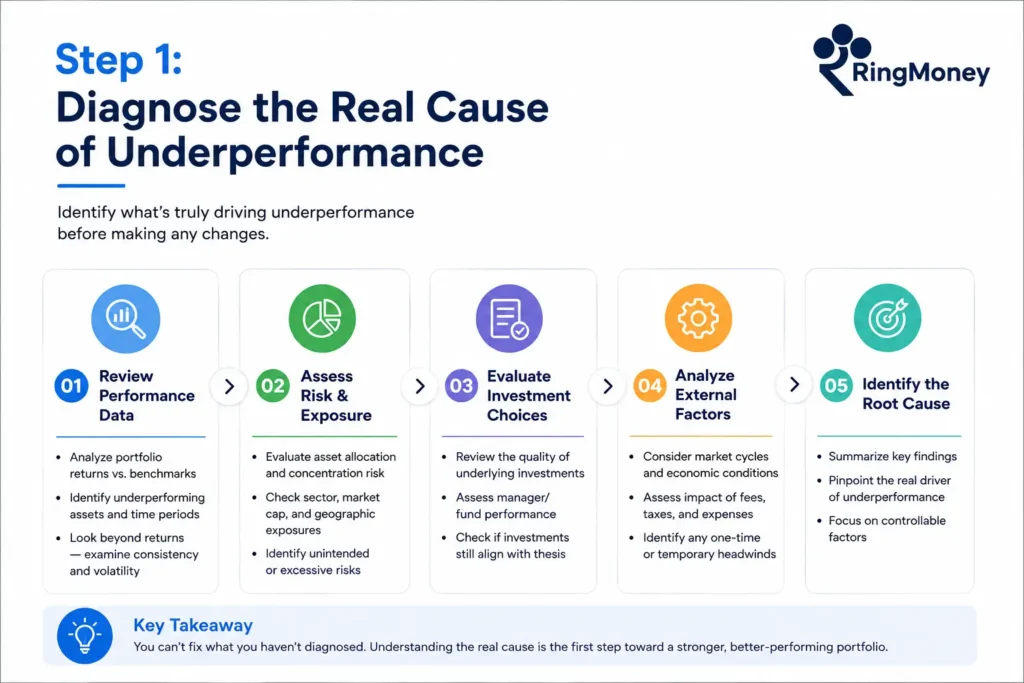
Step 1: Diagnose the Real Cause of Underperformance

Most investors skip this step and jump straight to redemption. That usually locks in losses unnecessarily.

A proper diagnosis looks at three layers.
Step 1: Diagnose the Real Cause of Underperformance

Benchmark comparison

Every mutual fund has a benchmark index. This is the first and most important reference point. If your fund consistently lags behind its benchmark across multiple market phases, it signals inefficiency in stock selection or strategy execution.

Short-term deviations don’t matter. Persistent gaps over time do.

Peer comparison within a category

Next, compare the fund with others in the same category. A mid-cap fund should be evaluated against other mid-cap funds, not across asset classes.

If most peers are performing better, the issue is likely fund-specific rather than market-driven.

Style cycles and sector behavior

Markets rotate between styles like growth, value, momentum, and quality. A fund can underperform simply because its strategy is temporarily out of favour.

For example, value-focused funds may lag during strong growth-driven rallies, but perform better over full cycles.

Sector funds add another layer of volatility. A banking or IT fund depends heavily on sector health, so underperformance may reflect industry conditions rather than fund management.

Step 2: Look at Performance Over a Full Cycle, Not a Snapshot

One of the biggest mistakes investors make is judging funds based on 3–6 month performance.

A more reliable approach is to evaluate performance over at least 2 to 3 years, ideally using rolling returns instead of point-to-point returns. Rolling returns show consistency across different market conditions rather than a single lucky or unlucky time period.

A fund is generally considered structurally weak if:

  • It underperforms its benchmark consistently over 2–3 years
  • It lags peers across multiple cycles
  • It shows no improvement during market recoveries

Anything shorter than this is usually noise, not failure.

Step 3: Understand the Hidden Costs Before You Exit

Switching funds is not just an investment decision. It is also a financial transaction with real costs.

Exit loads and taxes

Many funds charge an exit load if you redeem within a specific period, often 1 year. On top of that, capital gains tax applies depending on the holding period.

  • Short-term capital gains (STCG) can reduce net returns significantly
  • Long-term capital gains (LTCG) may still apply, depending on the profit size

A small underperformance gap may not justify paying these costs immediately.

Opportunity cost of staying vs switching

The real decision is not just “Is this fund bad?” but “Will switching improve my net outcome after costs?”

This is where many investors either switch too early or stay too long.

Step 4: Decide—Stay Invested or Exit Strategically

Once the diagnosis is complete, your action should be logical, not emotional.

When staying makes sense

You can continue investing if:

  • The fund is fundamentally strong but temporarily out of favour
  • It still performs in line with its long-term strategy
  • Market conditions are affecting the entire category

In such cases, continuing SIPs can actually help. Lower NAVs allow you to accumulate more units, improving long-term cost averaging.

When exiting becomes rational

Consider stopping fresh investments if:

  • The fund consistently underperforms the benchmark and peers for 2–3 years
  • There is a change in the fund strategy or management quality
  • The risk-return profile no longer matches your goals

Exiting should be gradual and planned, not impulsive.

Common Mistakes Investors Should Avoid

Even experienced investors fall into predictable traps when funds underperform.

  • Reacting to short-term dips as if they are permanent losses
  • Comparing funds across unrelated categories
  • Ignoring exit load and tax implications
  • Over-diversifying into similar funds
  • Reviewing portfolios too frequently can lead to emotional decisions

Good investing is less about constant action and more about disciplined evaluation at the right time.

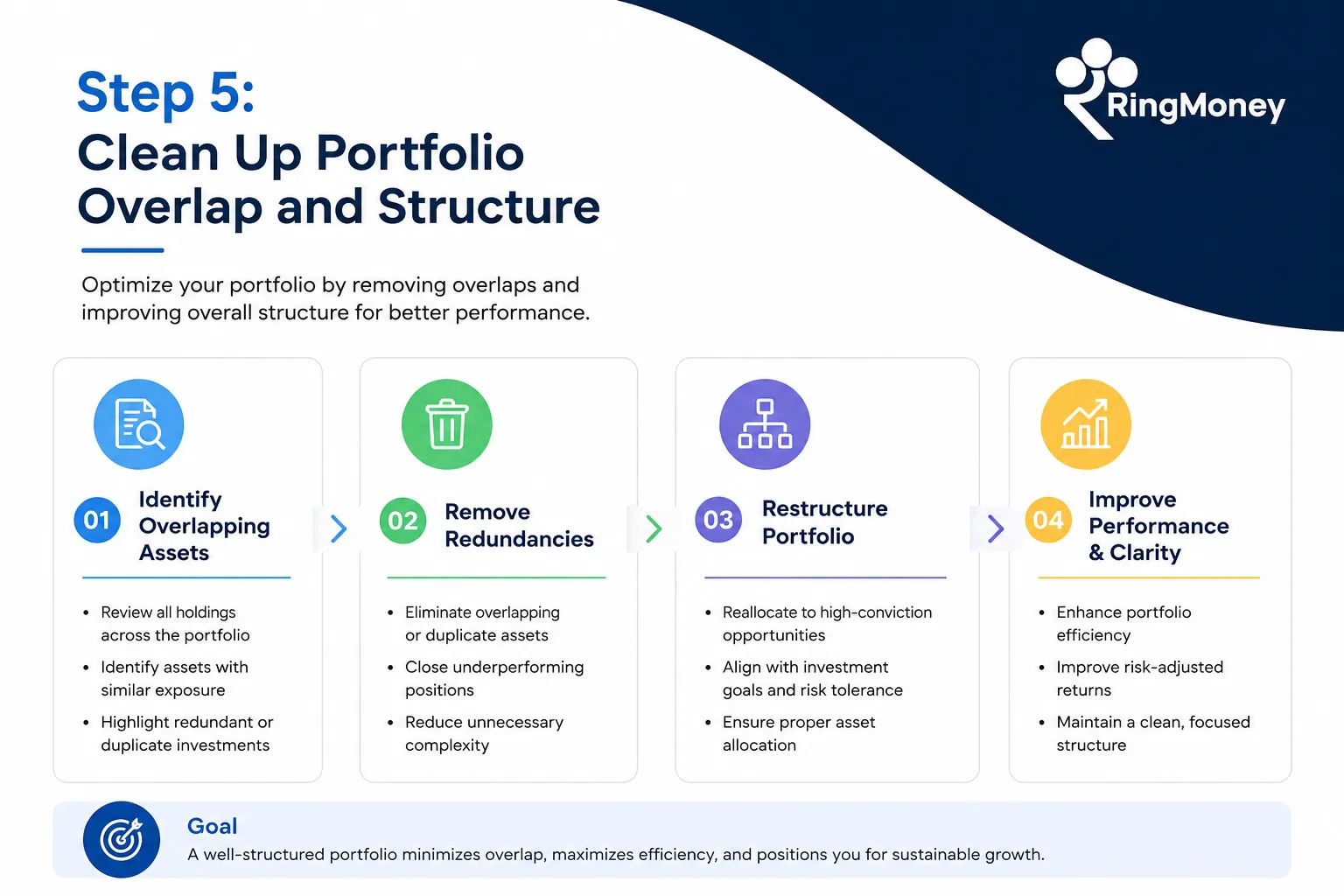
Step 5: Clean Up Portfolio Overlap and Structure

Underperformance is often not just about one fund. It can be a symptom of a poorly structured portfolio.
Step 5: Clean Up Portfolio Overlap and Structure

Many investors unknowingly hold multiple funds that invest in the same underlying stocks. This creates redundancy rather than diversification.

Use this quick structural checklist to scan your portfolio for underlying vulnerabilities: 

Checkpoint

What to Look For

Fund Overlap

More than 50–60% similarity across holdings

Category Duplication

Multiple funds serving the same role

Risk Imbalance

Too much exposure to a single market segment

A focused portfolio of well-chosen funds often performs better than a scattered one with many similar schemes.


Automating Your Portfolio Review with RingMoney

Evaluating mutual fund performance sounds straightforward in theory, but in practice, it involves data scattered across statements, platforms, and benchmarks. This is where investors often lose clarity and act emotionally.

At RingMoney, we build tools that simplify this entire process.

We help you:

Instead of manually decoding statements or switching between AMC portals, RingMoney brings everything into a single decision dashboard. It turns fund management from guesswork into structured decision-making.

In practical terms, it helps you move from confusion to clarity, and from reaction to strategy.

A More Stable Way to Think About Underperformance

A mutual fund is not meant to win every quarter. It is designed to deliver reasonable returns over long periods while managing risk.

Short-term underperformance is normal. Structural underperformance is not.

The skill lies in distinguishing between the two without emotional bias.

If you evaluate funds using benchmarks, time cycles, and cost impact rather than recent performance alone, your decisions become significantly more stable and rational.

Conclusion

When a mutual fund underperforms, the worst response is panic. The best response is a structured review.

Start with benchmarks, extend your view to full market cycles, account for switching costs, and then decide whether to stay or exit. Most importantly, ensure your portfolio is not unintentionally duplicating risk across multiple funds.

At RingMoney, we believe investors don’t need more noise—they need better clarity. With the right data and tools, underperformance stops feeling like a crisis and becomes what it truly is: a signal for adjustment, not alarm.

A disciplined process will always outperform emotional reactions in the long run.

For regular investment tips, SIP updates, and simple money guidance, follow us on Instagram and explore the link in our bio to get started instantly.

Frequently Asked Questions

Can a mutual fund recover after years of weak performance?

Yes, but recovery depends on why it underperformed. If the issue is a temporary market cycle or investment style shift, performance may improve, but persistent management or strategy issues are less likely to fix themselves.

Not always. Stopping a SIP should depend on the fund’s long-term quality, not recent returns. In many cases, continuing investments during weaker periods can improve your average purchase cost.

A fund manager change is not automatically a red flag, but it deserves attention. Review whether the new manager follows the same investment philosophy and has a strong track record managing similar funds.

Quality matters more than quantity. Most investors can achieve adequate diversification with a well-structured portfolio of 5–8 funds spread across different asset classes and market segments.

If taxes, exit loads, or market conditions are a concern, a phased switch may help reduce risk. Gradual transitions can also prevent moving a large amount of money at an unfavorable market level.

Do not forget to share this post!

Related Blogs

Many investors believe that the more mutual funds they own, the better diversified they are....

Most SIPs fail before creating real wealth because investors stop too early. They panic during...

Redeeming mutual funds often feels like a simple financial action, but the real complexity starts...

Download RingMoney App

Your personal data is safe with us

Hello India!