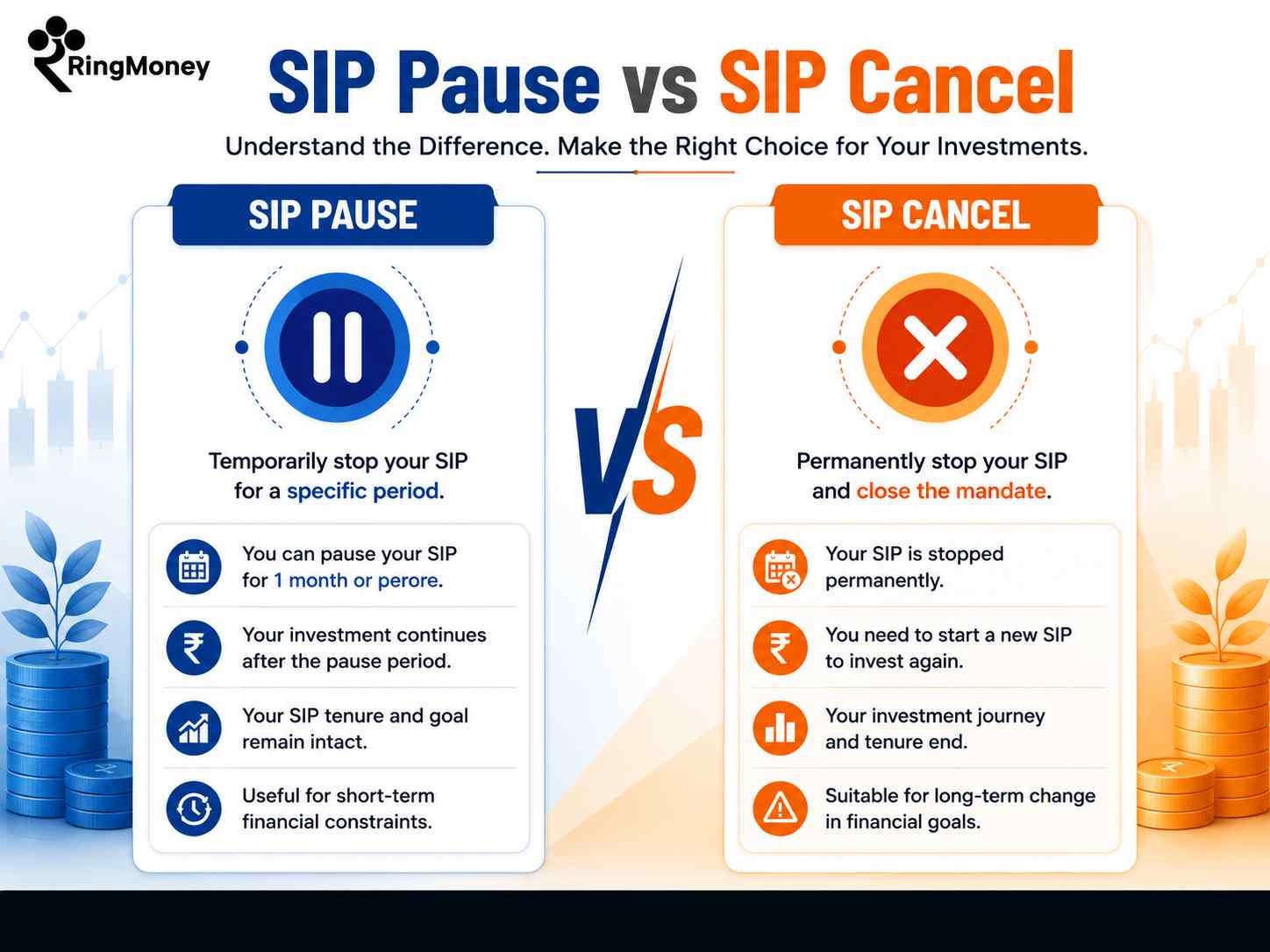
If your financial problem is temporary, pausing your SIP is usually the better choice because your monthly investments stop for a limited period and often restart automatically, depending on your fund house’s rules. If your investment goal or strategy has changed permanently, cancelling your SIP makes more sense. In both cases, your existing mutual fund units remain invested—they are not sold or withdrawn simply because you stop future instalments.
Many investors search for “SIP pause vs SIP cancel” when they receive an upcoming auto-debit reminder and realise their bank balance may not be enough. At that moment, the decision isn’t just about stopping a payment. It’s about protecting your long-term investment journey while solving today’s financial challenge.
The right choice depends on one simple question: Is your problem temporary, or has your investment plan genuinely changed?
Before You Click "Stop SIP", Ask Yourself One Question
Before you take any action, ask yourself one question:
“Will I want to continue investing in this mutual fund once my current situation improves?”
Your answer usually makes the right choice clear.
Most investors don’t actually want to stop investing. They simply want to skip the next SIP deduction because of a temporary cash-flow problem, such as:
- Delayed salary
- Job change or temporary income loss
- Medical emergency
- Unexpected home or vehicle repairs
- Wedding or education expenses
- Delayed bonus
These situations affect your finances for a short time, not your long-term investment goals.
However, cancelling your SIP may be the better choice if:
- You’ve achieved your financial goal.
- You chose the wrong mutual fund.
- You’re switching to another fund.
- Your investment strategy has changed.
- You’ve retired and no longer need regular investments.
In short, temporary cash problem = SIP pause. Permanent change in your financial plan = SIP cancellation.
SIP Pause vs SIP Cancel: The Difference in One Decision Table
Instead of comparing technical features, find the situation that matches yours.
If this sounds like you | Better Choice | Why |
Your salary is delayed this month | Pause | You only need temporary breathing room. |
You’re between jobs for a few months | Pause | Your investments can restart once your income becomes stable. |
You have unexpected medical expenses | Pause | It helps manage short-term cash flow without ending your investment habit. |
You’re travelling abroad for three months | Pause | You avoid unnecessary deductions while you’re away. |
You’ve selected the wrong mutual fund | Cancel | Future investments should move into a better-suited fund. |
Your financial goal has been achieved | Cancel | There’s no need to continue investing for that objective. |
You’re changing your overall investment strategy | Cancel | A fresh SIP can be created that matches your new plan. |
You’ve retired and no longer need regular investments | Cancel | Your monthly contribution requirement has changed permanently. |
Notice that the decision is not based on whether one option is “better” than the other. It’s based on why you’re stopping the SIP in the first place.
What Actually Happens When You Pause a SIP?
Many investors worry that pausing a SIP will affect the money they’ve already invested. It won’t.
A SIP is simply a monthly investment instruction. When you pause it, only future instalments stop for the approved period. Your existing mutual fund investment continues as usual.

What happens when you pause a SIP?
- Your existing mutual fund units stay invested.
- Your investment continues to move with the market.
- Your returns continue to grow or fluctuate based on market performance.
- Dividends (if applicable) continue as per the scheme.
- Only future SIP instalments stop temporarily.
- In many cases, the SIP restarts automatically after the pause period, subject to AMC rules.
Remember, a SIP is just the way you invest—it isn’t your investment itself.
What doesn't happen?
Pausing a SIP does not:
- Sell your mutual fund units.
- Credit your money back to your bank account.
- Freeze your investment.
- Reset your returns.
- Change the scheme’s NAV.
- Close your folio.
Your existing investment remains exactly where it is.
How long can you pause a SIP?
Most fund houses allow a SIP pause for 1 to 6 months, but the duration, eligibility, and frequency differ across AMCs. Always check your fund house’s latest policy before applying.
Apply Before the Cut-Off Date
Don’t wait until the last minute.
If you request a pause just a day or two before your SIP date, the upcoming instalment may still be deducted because the payment is often already under processing.
To avoid this, submit your request well before your next SIP date and follow your AMC’s cut-off timelines.
What Actually Happens When You Cancel a SIP?
Cancelling a SIP is different from pausing it because it permanently stops future instalments instead of putting them on hold.
Once your request is processed, no more monthly investments are made under that SIP. Unlike a pause, it doesn’t restart automatically.
The important thing to remember is this:
Cancelling a SIP does not cancel your mutual fund investment.
Your existing units remain invested until you redeem them separately.
What happens after you cancel a SIP?
- Future SIP instalments stop permanently.
- The bank auto-debit for that SIP is discontinued after processing.
- Your existing mutual fund units remain invested.
- Your portfolio continues to move with market performance.
- If you want to invest again later, you’ll usually need to create a new SIP.
Many investors mistakenly believe that cancelling a SIP also withdraws their invested money. It doesn’t.
A SIP only controls future investments. Your existing investment stays in the mutual fund and continues to earn returns or fluctuate with the market until you choose to redeem it.
SIP Pause vs SIP Cancel: Hidden Differences Most Investors Miss
On paper, the difference between a SIP pause and cancellation seems simple—one is temporary, while the other is permanent. However, the long-term impact can be much bigger than most investors expect.
You May Miss Buying at Lower Prices
One of the biggest benefits of SIP investing is rupee cost averaging. When markets fall, your fixed investment buys more units at lower NAVs. If you pause your SIP during a market correction, you may miss that opportunity. If your cash-flow problem is genuine, a pause makes sense. But pausing only because markets are falling can work against your long-term strategy.
Cancelling Can Break Your Investing Habit
A paused SIP often restarts automatically, making it easier to stay disciplined. A cancelled SIP requires you to create a new one later, and many investors keep postponing it or never restart at all. Over time, this gap can have a bigger impact than a few missed installments.
Market Recoveries Don’t Wait
Markets rarely signal when they’re about to recover. If your SIP stays paused during a rebound, you could miss investing at the start of a market recovery. Waiting for the “perfect” time to restart is often harder than simply staying consistent.
Which One Is Better? Use This Simple Decision Framework
There isn’t a single right choice. It depends on why you want to stop your SIP.
Choose SIP Pause if…
Your investment goal is still the same, but you’re facing a temporary cash-flow issue, such as:
- Delayed salary
- Temporary job loss
- Medical emergency
- Wedding or family expenses
- Maternity or paternity leave
- Short-term financial crunch
A SIP pause gives you temporary relief without disrupting your long-term investment plan.
Choose SIP Cancellation if…
Your investment strategy or financial goals have changed, for example:
- You’ve achieved your financial goal.
- You chose the wrong mutual fund.
- You’re switching to another fund.
- You’re rebalancing your portfolio.
- You’ve retired and no longer need regular investments.
In these situations, cancelling the SIP is usually the better long-term decision.
Real-Life Scenarios: What Should You Do?
Looking at real situations often makes the decision much clearer.
Rahul Lost His Job for Four Months
Rahul expects to join another company within a few months but wants to reduce monthly expenses until then.
Better choice: Pause the SIP.
His investment goal hasn’t changed. Only his income has. Pausing allows him to preserve cash today while letting the SIP restart automatically later, subject to his fund house’s rules.
Neha Wants to Switch to Another Mutual Fund
Neha has reviewed her portfolio and found that another fund now suits her long-term goals better.
Better choice: Cancel the existing SIP.
She can stop investing fresh money into the current fund and start a new SIP in the fund that better matches her investment strategy. Whether she should redeem her existing units is a separate decision that depends on taxes, exit load, and portfolio allocation.
Aman Has Heavy Wedding Expenses
Aman needs additional cash for wedding-related costs over the next two months.
Better choice: Pause the SIP.
A short pause can reduce financial pressure without forcing him to rebuild his investment habit from scratch later.
Priya Completed Her House Down Payment Goal
Priya started her SIP specifically to save for a house down payment. That goal has now been achieved.
Better choice: Cancel the SIP.
Since the original objective no longer exists, she can redirect future investments toward a new financial goal by starting a fresh SIP that aligns with her updated priorities.
Can You Restart a SIP After Pausing or Cancelling?
Yes, but the process isn’t the same.
After a SIP Pause
In most cases, your SIP resumes automatically after the approved pause period ends. You usually don’t need to submit another request.
However, always check your AMC’s rules because pause duration and restart conditions vary across fund houses.
After SIP Cancellation
A cancelled SIP does not restart automatically.
If you decide to invest again, you’ll generally need to:
- Create a new SIP request.
- Choose the investment amount.
- Select the debit date.
- Complete the required bank auto-debit setup if applicable.
This additional effort may not sound significant, but it creates friction. That’s one reason many cancelled SIPs remain inactive much longer than investors originally planned.
Will SIP Pause or Cancellation Affect Your Existing Mutual Fund Investment?
One of the biggest misconceptions is that pausing or cancelling a SIP affects your existing investment. It doesn’t.
Whether you pause or cancel your SIP, your mutual fund units remain invested unless you redeem them separately.
Your investment continues to:
- Stay invested in the scheme.
- Move with market performance.
- Earn returns based on the fund’s performance.
- Receive dividends, if applicable.
Action | Future SIP Instalments | Existing Units |
SIP Pause | Temporarily stop | Remain invested |
SIP Cancel | Permanently stop | Remain invested |
Mutual Fund Redemption | No impact | Units are sold and money is paid out |
Remember: Cancelling a SIP only stops future investments. It does not withdraw your existing mutual fund investment.
Common Mistakes Investors Make Before Stopping Their SIP
Making the wrong decision isn’t always expensive immediately, but it can affect long-term wealth creation.
Stopping Because Markets Are Falling
Falling markets let your SIP buy more units at lower NAVs Cancelling because of short-term volatility can reduce the benefits of rupee cost averaging.
Confusing SIP Cancellation with Redemption
Cancelling a SIP stops future investments only. To withdraw your existing money, you must place a separate redemption request.
Missing the Processing Deadline
If you apply too close to your SIP date, the next instalment may still be deducted. Always check your AMC’s cut-off date.
Ignoring AMC-Specific Rules
Pause duration and eligibility vary across fund houses. Check your AMC’s latest rules before applying.
Cancelling During a Temporary Cash Crunch
If your cash-flow issue is temporary, a SIP pause is often a better choice than cancelling altogether.
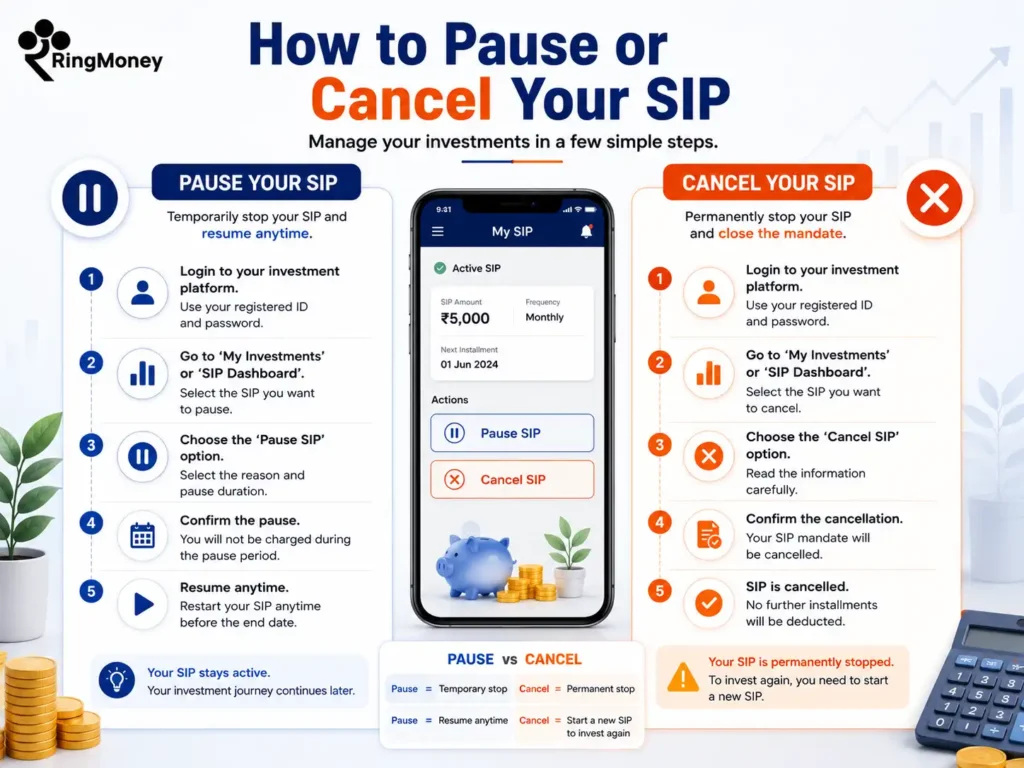
How to Pause or Cancel Your SIP
Most investors can complete the process online within a few minutes.
Depending on where you invested, you can usually submit your request through:
- Your AMC’s website or mobile app.
- CAMS portal (for supported fund houses).
- KFintech portal (for supported fund houses).
- Your investment platform or broker.
- Your financial advisor or distributor.
Offline requests are also available through physical forms at eligible service centres.
Before submitting your request, review:
- The processing timeline.
- The applicable cut-off date.
- Pause duration limits (if choosing a pause).
- Any AMC-specific conditions.
This helps prevent an unexpected debit in the upcoming SIP cycle.
Quick Decision Checklist
Use this quick checklist whenever you’re unsure whether to pause or cancel your SIP.
Ask Yourself | If Your Answer Is Yes | What It Means |
Is your financial problem temporary? | Pause your SIP | Future instalments stop for a limited period, your existing investments stay invested, and the SIP usually restarts automatically (subject to AMC rules). |
Has your investment goal or strategy changed permanently? | Cancel your SIP | Future instalments stop permanently, your existing investments remain invested, and you’ll need to create a new SIP if you want to invest again later. |
One last check: If you’re considering stopping your SIP only because markets are falling, think twice. Market volatility alone is usually not a good reason to interrupt a disciplined long-term investment plan.
Make the Decision Based on the Reason, Not the Emotion
If you’re facing a temporary cash-flow problem, a SIP pause is often the smarter choice because it gives you breathing room without forcing you to rebuild your investment habit later. If your financial goals, fund selection, or investment strategy have genuinely changed, cancelling the SIP is usually the more appropriate step.
Before submitting either request, take a moment to understand your fund house’s processing timelines and pause rules. More importantly, ask yourself whether you’re solving a short-term cash shortage or making a long-term investment decision. That simple distinction often leads to the right choice.