
You may start with a SIP amount that fits your budget today, but your income and expenses can change over time. That is why many investors wonder whether they should keep the SIP fixed or increase it gradually as their earning capacity grows.
If you start a ₹5,000 monthly SIP and increase it by ₹500 every year, your SIP reaches ₹17,000 per month by the 25th year. At an illustrative 12% annual return, it could grow to around ₹1.56 crore, compared with about ₹93.94 lakh if you kept the SIP at ₹5,000.
The ₹500 itself isn’t the main story. The impact comes from investing more over time and giving those additional investments more time to grow.
Illustration: The 12% return is assumed only for calculation. Actual mutual fund returns are market-linked and not guaranteed.
Quick Summary: What Does a ₹500 Step-Up Really Do?
Suppose you begin with a ₹5,000 monthly SIP. Instead of keeping it at ₹5,000 forever, you increase the monthly amount by ₹500 at the beginning of each year.
Your SIP would look like this:
Year | Monthly SIP | Investment During the Year |
Year 1 | ₹5,000 | ₹60,000 |
Year 2 | ₹5,500 | ₹66,000 |
Year 3 | ₹6,000 | ₹72,000 |
Year 4 | ₹6,500 | ₹78,000 |
Year 5 | ₹7,000 | ₹84,000 |
So, you are not investing an additional ₹500 once a year.
You are increasing your monthly SIP by ₹500 every year. That distinction matters because ₹500 more every month means an additional ₹6,000 gets invested during that year.
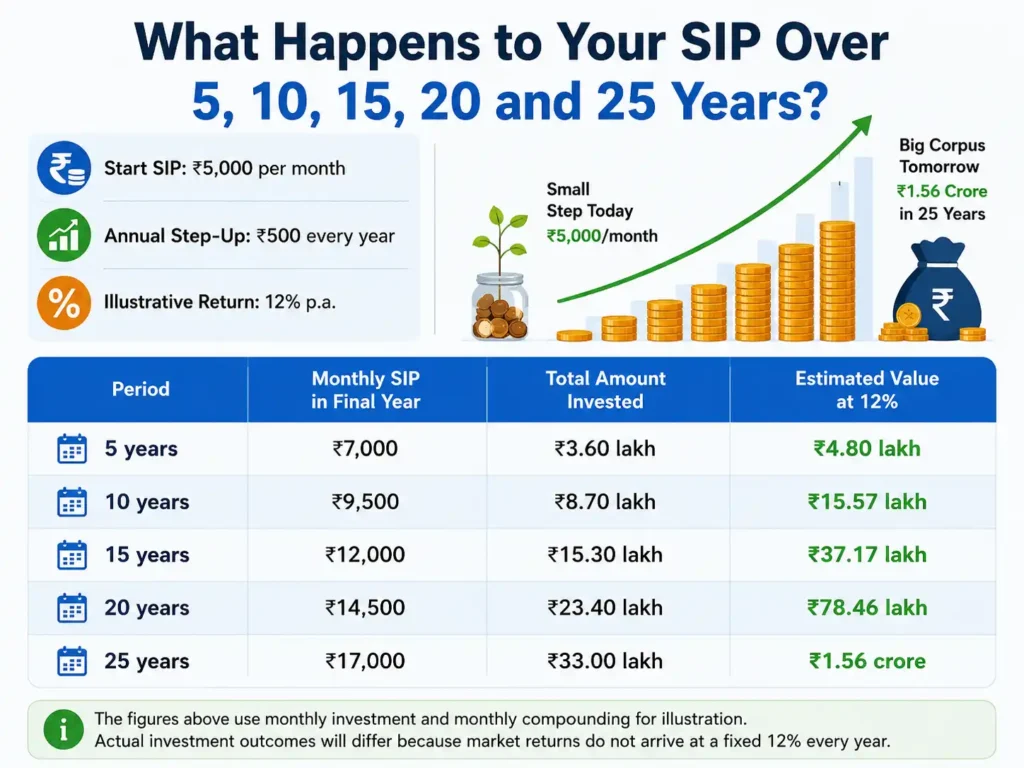
What Happens to Your SIP Over 5, 10, 15, 20 and 25 Years?
The easiest way to understand the strategy is to look at the numbers.
Assume you start with ₹5,000 per month, increase it by ₹500 every year and earn an illustrative 12% annual return.
Period | Monthly SIP in Final Year | Total Amount Invested | Estimated Value at 12% |
5 years | ₹7,000 | ₹3.60 lakh | ₹4.80 lakh |
10 years | ₹9,500 | ₹8.70 lakh | ₹15.57 lakh |
15 years | ₹12,000 | ₹15.30 lakh | ₹37.17 lakh |
20 years | ₹14,500 | ₹23.40 lakh | ₹78.46 lakh |
25 years | ₹17,000 | ₹33.00 lakh | ₹1.56 crore |
The figures above use monthly investment and monthly compounding for illustration. Actual investment outcomes will differ because market returns do not arrive at a fixed 12% every year.
There is another number worth noticing. After 25 years, you have contributed ₹33 lakh from your own pocket. The remaining roughly ₹1.23 crore in the illustration represents investment growth.
That is why looking only at the final corpus can be misleading. You should always separate what you invested from what the investment potentially earned.
₹500 Yearly Increase vs Keeping Your SIP Flat
Now consider two investors.
Investor A keeps the SIP at ₹5,000 per month for 25 years.
Investor B starts at ₹5,000 but increases the SIP by ₹500 every year.
The difference becomes substantial as the investment period gets longer.
Period | Flat ₹5,000 SIP | Difference | |
10 years | ₹11.50 lakh | ₹15.57 lakh | ₹4.07 lakh |
15 years | ₹24.98 lakh | ₹37.17 lakh | ₹12.20 lakh |
20 years | ₹49.46 lakh | ₹78.46 lakh | ₹29.00 lakh |
25 years | ₹93.94 lakh | ₹1.56 crore | ₹61.57 lakh |
The 25-year difference is particularly interesting. You invest ₹18 lakh more with the step-up strategy: ₹33 lakh versus ₹15 lakh.
But the estimated corpus is about ₹61.57 lakh higher.
Why? Because the additional money is not simply sitting in the investment. The earlier step-up contributions also get years to potentially earn returns.
This is where time becomes important.
The SIP You Start With Isn't the SIP You'll Have Forever
One practical benefit of a ₹500 step-up is that you don’t have to make a dramatic increase in your investment from day one.
Starting with ₹5,000 may feel comfortable. Moving directly to ₹10,000 could feel like a serious hit to your monthly budget.
A ₹500 increase is easier to absorb.
After 10 years, however, your monthly SIP has reached ₹9,500. After 20 years, it is ₹14,500. You have gradually increased your investment rather than forcing yourself to make a large jump.
This approach can also work well when your income rises over time. Instead of allowing every salary increase to disappear into higher spending, you can direct a small portion towards your existing investment habit.
How a Step-Up SIP Can Help With Lifestyle Inflation
Think about what happens after a salary increase.
Your income rises, and gradually your expenses rise too. Perhaps you eat out more often, upgrade a phone, increase your travel budget or simply become comfortable spending a little more each month.
None of these expenses is necessarily a problem. The issue is that your investment can remain stuck at the amount you originally chose.
A ₹500 annual step-up creates a simple counterbalance.
You don’t need to commit your entire salary increase to investing. You are simply deciding that as your earning capacity improves, your long-term investment should also move up.
The key is automation. If the increase happens automatically, you don’t have to rely on remembering to invest more every year.
Fixed ₹500 Increase vs 10% Annual Step-Up
A ₹500 annual increase isn’t the only way to step up a SIP. You could also increase it by a fixed percentage.
For example, with a 10% annual increase, a ₹5,000 SIP would become:
- Year 1: ₹5,000
- Year 2: ₹5,500
- Year 3: ₹6,050
- Year 10: about ₹11,790
- Year 15: about ₹18,987
- Year 20: about ₹30,580
Notice what happens later.
A percentage-based increase starts gently but becomes much larger as the SIP grows. That can be useful if you expect your income to rise substantially, but it can also create a bigger commitment in later years.
A fixed ₹500 increase is easier to predict.
So which should you choose? There isn’t a universal winner. The better step-up is the one you can continue without repeatedly stopping or reducing your investments.
What If Your Budget Changes?
A step-up SIP should support your finances, not compete with them.
If your expenses increase significantly one year, you don’t need to force the ₹500 increase simply because you had planned it. Your emergency fund, essential expenses and expensive debt may deserve priority depending on your circumstances.
You can also review the step-up when your income changes.
For example:
- If your income rises more than expected, you could increase the SIP by more than ₹500.
- If your cash flow becomes tight, you could keep the existing SIP unchanged.
- If your financial priorities change, you can review or stop the step-up instruction according to your investment platform’s rules.
- If you receive a substantial raise, you could consider increasing the SIP as a percentage rather than using a fixed ₹500 amount.
The important point is that consistency should not mean ignoring your real financial situation.
How to Set Up a ₹500 Annual Step-Up
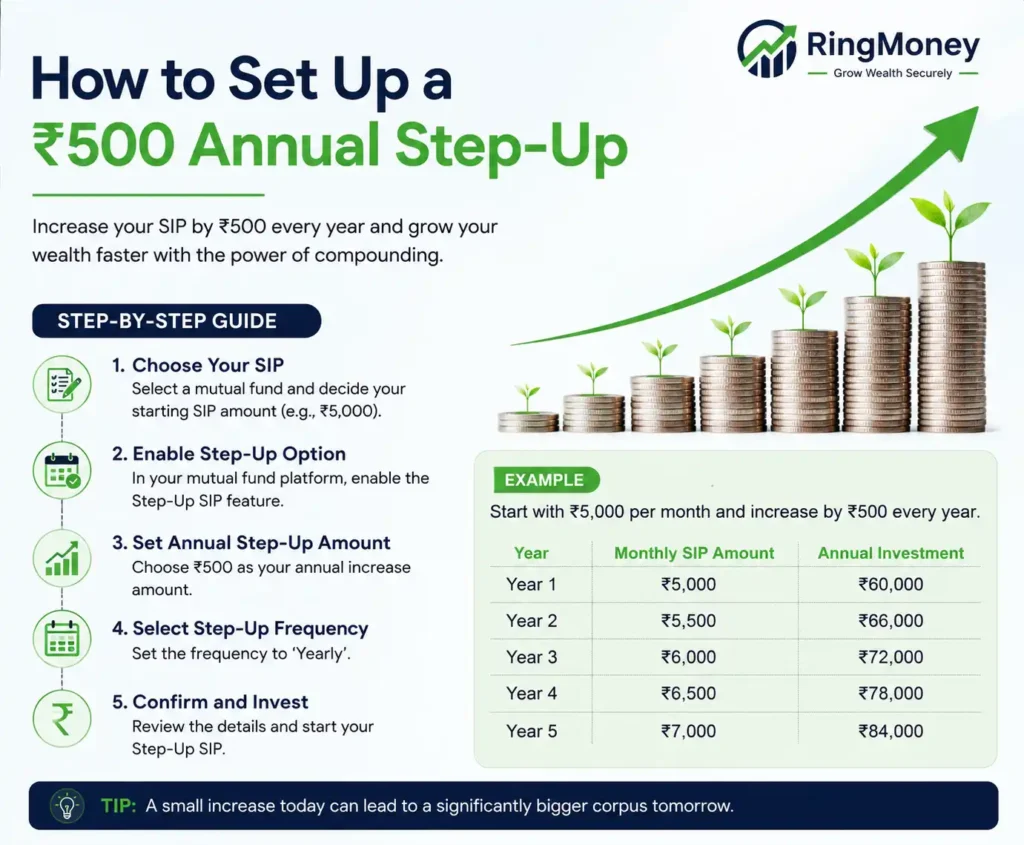
The exact process depends on your mutual fund platform, but the general approach is straightforward.
- Decide your starting monthly SIP.
- Check that the amount comfortably fits your regular cash flow.
- Look for a Step-Up SIP or Top-Up SIP option when setting up the investment.
- Select a fixed annual increase, such as ₹500.
- Choose the annual frequency and review any maximum SIP limit available on the platform.
- Revisit the arrangement periodically rather than assuming your finances will remain unchanged for 20 years.
If your platform does not support the exact step-up amount or schedule you want, check its current SIP rules rather than assuming every platform works the same way.
Is ₹500 Enough?
There is no magic number.
For someone starting with ₹3,000 a month, a ₹500 increase represents a meaningful jump. For someone already investing ₹50,000 a month, the same ₹500 may make very little difference.
The more useful question is:
Can you increase your investment gradually as your income and financial capacity improve?
If the answer is yes, even a modest annual increase can make a meaningful difference over a long period.
Final Takeaway
₹500 may not look significant when you see it as a standalone amount. But when you add ₹500 to your monthly SIP every year, the investment itself gradually becomes much larger.
Starting with ₹5,000 and stepping up by ₹500 annually means you would invest ₹33 lakh over 25 years, compared with ₹15 lakh if you kept the SIP flat. At an illustrative 12% annual return, the projected values are about ₹1.56 crore and ₹93.94 lakh, respectively.
The real lesson isn’t that ₹500 is a magic investment amount. It is that your SIP doesn’t have to remain frozen at the amount you could afford when you first started investing.
As your income grows, allowing your investment to grow with it can be a sensible long-term habit. Just make sure the increase fits your budget, and remember that projections are illustrations—not promises about what the market will deliver.