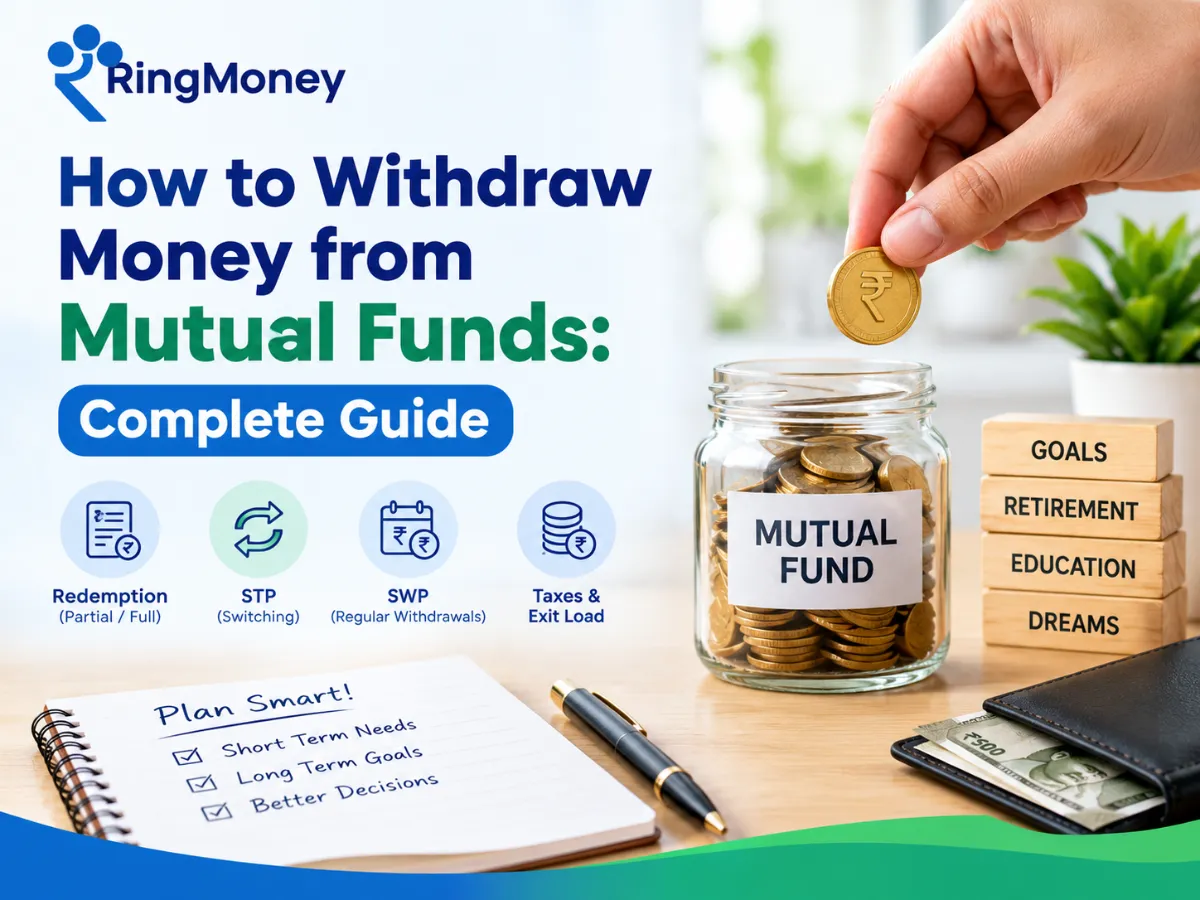
You need ₹2 lakh for an upcoming expense, but most of your savings are sitting in mutual funds. The obvious worry is: if you redeem now, will you damage the long-term goals those investments were meant to fund?
To withdraw from mutual funds without hurting long-term goals, separate your portfolio into time-based buckets. Redeem only the required amount from short-term or surplus funds, preserve your compounding equity bucket, and account for exit loads and capital gains tax before submitting the request.
You can withdraw without derailing your plans, but the key is not to treat your entire portfolio as one pool of money. Identify which investments are meant for near-term needs, redeem only what you actually need, and check the tax and exit-load implications before you place the order.
Separate Your Money by When You Need It
One of the easiest mistakes to make is opening your investment app, seeing a portfolio worth ₹10 lakh and thinking, “I have ₹10 lakh available.”
You don’t.
Some of that money may be earmarked for retirement 10 or 15 years from now. Some may be needed for a child’s education in two years. Another portion may simply be surplus. Treating all three the same can create problems.
A useful way to think about your portfolio is through time-based buckets:
Time to goal | How to think about the money |
Under 1 year | Money required soon should not depend heavily on equity-market performance |
1–3 years | Consider gradually reducing exposure to assets that can fluctuate sharply |
5+ years | Money intended for long-term growth can generally remain invested according to your planned asset allocation |
The exact investment mix depends on your circumstances, but the principle is straightforward: the shorter the deadline, the less room you have to wait for a market recovery.
That matters because a market fall six months before you need the money is very different from the same fall 12 years before retirement.
Choose the Withdrawal Method That Matches Your Need
Once you’ve identified the bucket, decide how you actually need the money.
One-Time Partial Redemption
Need ₹2 lakh for a home payment, education fee or another one-off expense? You don’t have to close the entire mutual fund investment.
A partial redemption lets you sell only the units needed and keep the rest invested. It is often the simplest option when your cash requirement is clearly defined.
Before you redeem, check:
- Which units will be sold
- Any applicable exit load
- The capital gains tax implications
Systematic Transfer Plan (STP)
An STP can help when a goal is approaching and you want to move money gradually from one mutual fund scheme to another instead of shifting the entire amount at once.
For example, if you have a sizeable equity corpus and a goal due in the next year or two, you could consider transferring predetermined amounts to a suitable lower-volatility destination scheme, if the AMC offers the facility and it fits your circumstances.
Keep in mind:
- The money that remains in equity continues to face market movements.
- STP can reduce the risk of having the entire corpus exposed at one point in time, but it does not eliminate market risk.
- Each switch-out is treated as a redemption for tax purposes, so an STP can create capital gains tax consequences on each transfer.
Systematic Withdrawal Plan (SWP)
An SWP works differently. Instead of moving money between funds, you instruct the mutual fund to redeem units periodically and pay the proceeds to you.
It can be useful when you need regular cash flows rather than one large withdrawal.
One common misconception is that an SWP withdraws “only the returns.” It doesn’t. Units are redeemed with every withdrawal, and the value of your remaining investment can continue to rise or fall with the market.
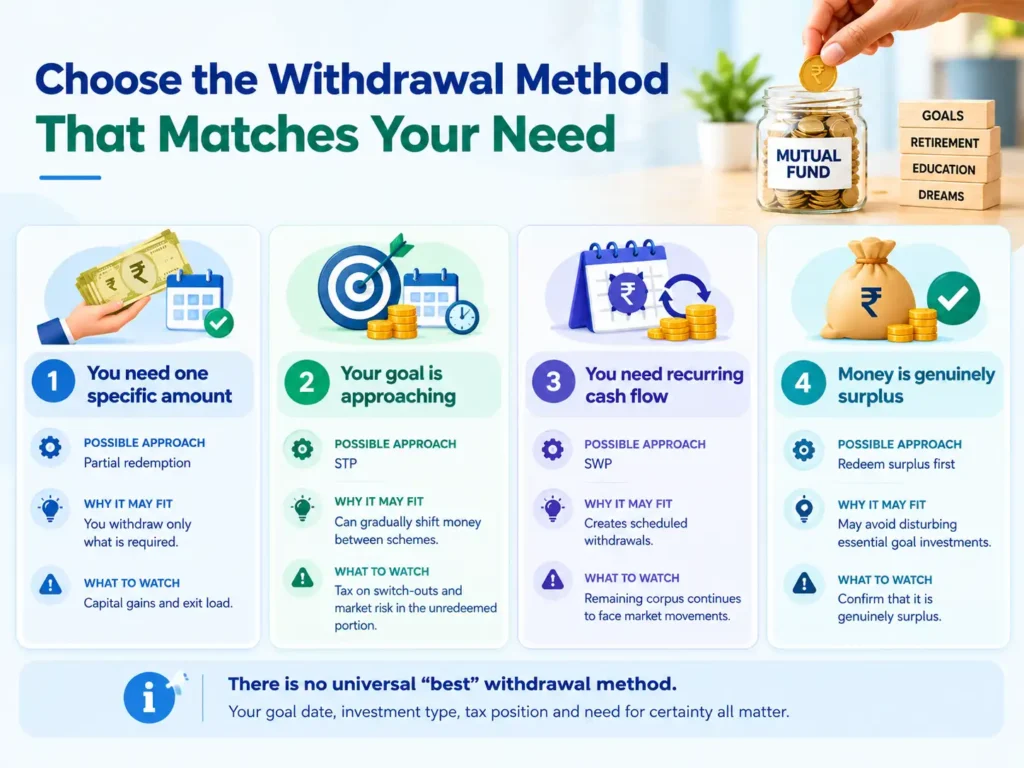
Which Withdrawal Method Fits Your Situation?
You need one specific amount
Partial redemption
You withdraw only what is required.
Capital gains and exit load.
Your goal is approaching
STP
Can gradually shift money between schemes.
Tax on switch-outs and market risk in the unredeemed portion.
You need recurring cash flow
SWP
Creates scheduled withdrawals.
Remaining corpus continues to face market movements.
Money is genuinely surplus
Redeem surplus first
May avoid disturbing essential goal investments.
Confirm that it is genuinely surplus.
Check the Costs and Taxes Before You Redeem
This is where a seemingly simple ₹2 lakh withdrawal can become more complicated.
Check the Exit Load
Some mutual fund schemes charge an exit load when you redeem within a specified period. The amount and holding period vary by scheme, so don’t assume every equity fund follows the same rule.
For example, if the NAV is ₹10 and the exit load is 2%, the redemption price would be ₹9.80 per unit.
Before redeeming: Check your scheme’s latest factsheet or scheme documents for the applicable exit load.
Check Capital Gains Tax
For equity-oriented mutual funds, the current rules generally distinguish between short-term and long-term gains:
- Short-term gains: For transfers on or after 23 July 2024, qualifying gains under Section 111A are generally taxed at 20%.
- Long-term gains: Qualifying gains under Section 112A are generally taxed at 12.5% on gains exceeding ₹1.25 lakh in the applicable financial year, subject to the relevant conditions.
The key point is that tax applies to the gain, not the entire redemption amount. If you redeem ₹2 lakh, you don’t automatically pay tax on ₹2 lakh; the taxable amount depends on the gain attributable to the units sold.
For non-equity funds, avoid the old blanket rule that “debt funds are taxed at your slab rate.” Tax treatment depends on the scheme’s classification and acquisition date. Certain specified mutual funds acquired on or after 1 April 2023 are treated as short-term capital assets under Section 50AA, while other schemes can follow different rules.
For a significant redemption, check the tax treatment of your specific scheme rather than relying on a generic calculator.
Remember FIFO for Multiple Purchases
If you’ve invested through SIPs for years, you may have units bought at different prices and on different dates. So, saying “I bought this fund three years ago” doesn’t mean every unit qualifies as long-term.
Under First-In, First-Out (FIFO), the earliest eligible units are matched first when units are sold. This can affect the holding period and, consequently, whether the resulting gain is treated as short-term or long-term.
This matters especially for long-running SIPs, where each instalment can have a different purchase date and cost.
Don't Forget the Redemption Cut-Off
The time you place a redemption request can affect the NAV you receive. For most mutual fund schemes, requests received by the 3:00 p.m. cut-off generally get that day’s closing NAV; requests after the cut-off generally get the next business day’s closing NAV.
Also remember that NAV date and bank-credit date are different:
- Equity-oriented schemes: generally T+2 for redemption settlement
- Eligible liquid/debt schemes: T+1 can apply
Actual credit times can vary based on the scheme, business days and applicable processing rules. If your expense has a fixed deadline, check the cut-off time and expected settlement date rather than assuming the money will arrive immediately.
A Practical Example: You Need ₹2 Lakh From a ₹10 Lakh Portfolio
Imagine you have ₹10 lakh invested across mutual funds. You need ₹2 lakh six months from now for a planned family expense, while the remaining ₹8 lakh is meant for a long-term goal 12 years away.
Don’t start by asking, “Which fund should I sell?” Ask: “Where should this ₹2 lakh come from?”
First, check whether the expense can be covered by your savings account, emergency reserve or another short-term investment. If not, redeem only what you actually need after considering applicable taxes and charges.
Most importantly, don’t automatically sell the fund showing the biggest profit. A ₹3 lakh gain today may be part of the investment earmarked for a much larger future goal.
The right source of cash is determined by the money’s purpose and timeline—not simply by which fund has made the most money.
Mistakes That Can Hurt Your Future Goals
Selling the fund that has made the most money. A high current gain doesn’t tell you whether that investment is surplus or earmarked for a future goal.
Stopping your SIP after one withdrawal. Redeeming existing units and continuing future SIP contributions are separate decisions. A one-time cash requirement doesn’t automatically mean your long-term investment plan needs to stop.
Assuming STP or SWP is tax-free. Switching or redeeming units can create taxable capital gains. The fact that money remains within a mutual fund platform doesn’t by itself eliminate the tax event.
Trying to withdraw “only the profit.” Mutual funds redeem units. They don’t separately identify a portion of each unit as principal and another portion as profit for you to withdraw.
Your Five-Minute Check Before You Click Redeem
Before placing the order, ask yourself:
- What goal is this money for? Is it a near-term requirement or part of a long-term corpus?
- How much do I actually need? Don’t redeem an unnecessarily large amount.
- Is there another suitable source? Check your earmarked cash or short-term bucket first.
- What is the exit load? Check the current scheme-specific terms.
- What will the tax impact be? Look at the units being redeemed, their holding period and the applicable tax regime.
- Am I disturbing a long-term goal? Make sure the redemption doesn’t quietly create a future funding gap.
- Do I need to stop my SIP? Usually, a one-time redemption and your future SIP are separate decisions.
The most useful question is also the simplest:
“If I take this money out today, which future goal becomes harder to fund?”
If the answer is “none,” you’re probably looking at surplus or appropriately earmarked money. If the answer is “my retirement” or “my child’s education,” pause before redeeming and reassess the source of the withdrawal.

Protect Today’s Need Without Sacrificing Tomorrow’s Goal
Withdrawing from a mutual fund doesn’t automatically mean you’re compromising your financial future. The real problem starts when you treat your entire portfolio as available cash, redeem more than you need, or take money away from an investment that is still tied to an important long-term goal.
Before you redeem, look at which bucket the money belongs to, how soon you need it, and how much you actually need to withdraw. Then check the applicable exit load, capital gains tax and transaction details so your short-term requirement doesn’t create an avoidable cost.
A good withdrawal decision isn’t about selling whichever fund has made the biggest profit. It’s about meeting today’s financial need while keeping the money meant for tomorrow’s goals on track.