You have ₹5,000, ₹50,000 or perhaps a larger amount ready to invest. Then you open a mutual fund app and face hundreds of options: equity, debt, hybrid, large-cap, short-duration, balanced advantage and more. The difficult part is not finding a fund; it is figuring out which type of fund fits your goal, timeline and ability to handle losses.
A useful starting point is to look at three things: when you need the money, how much volatility you can tolerate, and how important the goal is. Once those are clear, the choice between equity, debt and hybrid funds becomes much easier.
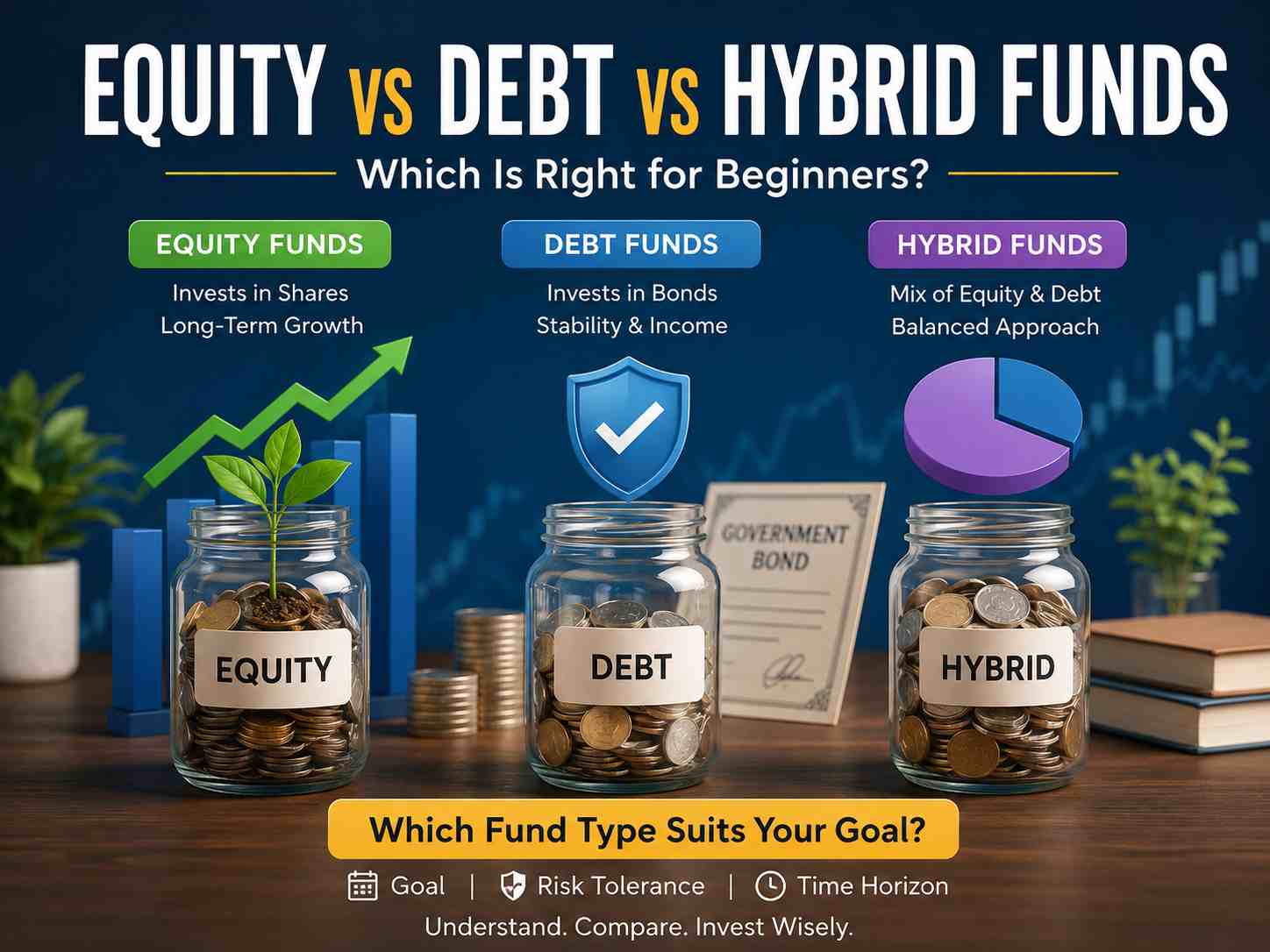
Equity vs Debt vs Hybrid Funds at a Glance
| Fund Type | Mainly Invests In | Typical Role | Volatility | Generally More Suitable For |
|---|---|---|---|---|
| Equity Funds | Shares and equity-related instruments | Long-term growth | High | Long-term goals |
| Debt Funds | Bonds, government securities and money-market instruments | Stability and income potential | Low to moderate, depending on category | Shorter or defined goals |
| Hybrid Funds | Combination of equity and debt, depending on category | Diversification across asset classes | Varies widely | Investors wanting a mix |
Which fund should you choose?
Choose equity if your goal is 7+ years away and you can handle sharp market falls.
Choose debt if you need the money sooner and your priority is lower volatility.
Choose hybrid if you want a mix of equity and debt because 100% equity feels too risky for you.
The key is to match the fund with your time horizon, goal and ability to tolerate losses—not simply with the fund category or its recent returns.
Equity Funds: When Long-Term Growth Matters
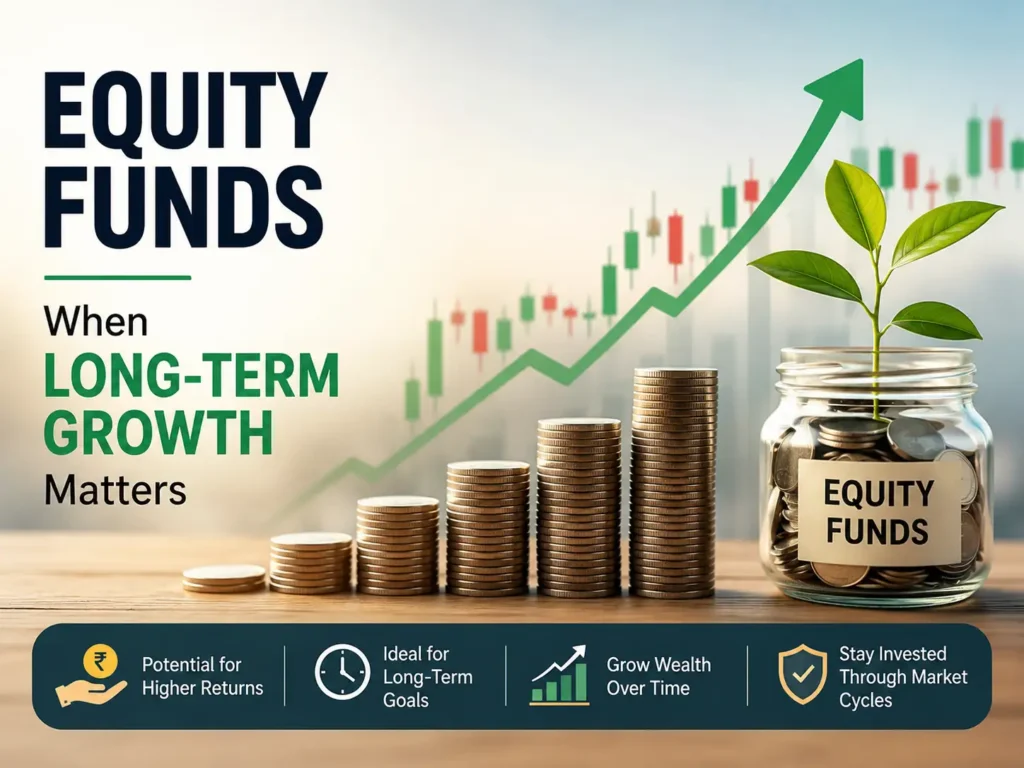
Equity funds primarily invest in shares of companies. Your returns therefore depend largely on how the underlying businesses and stock markets perform.
That makes equity useful when you have time on your side. If your goal is many years away, you have more opportunity to remain invested through market cycles instead of being forced to sell during a downturn.
When should you consider an equity fund?
Equity can make sense when:
- Your goal is long-term. You don’t expect to need the invested money soon.
- You can tolerate volatility. Your portfolio may fall substantially during market corrections.
- Growth matters more than short-term stability. You are willing to accept fluctuations for higher long-term growth potential.
- You can stay invested. You won’t abandon the investment simply because markets fall.
The important distinction is between risk capacity and risk tolerance. Your 10-year investment horizon may give you the capacity to take equity risk, but if a 20% temporary fall makes you panic and sell, your practical risk tolerance may be much lower.
Reality check: An SIP does not make equity funds risk-free. It spreads your purchases over time, which can reduce the risk of investing your entire amount at an unfortunate moment. It does not prevent your portfolio from falling when the market falls.
AMFI describes equity schemes as suitable for investors with higher risk appetite and longer investment horizons because they can be volatile over shorter periods.
Debt Funds: Lower Volatility Does Not Mean Guaranteed Returns
Debt funds mainly invest in fixed-income instruments such as government securities, corporate bonds, treasury bills and money-market instruments. Their returns can come from the interest earned on these securities as well as changes in their market value.
A common beginner mistake is assuming that debt means guaranteed returns. It doesn’t.
What Can Make a Debt Fund Fall?
Two risks are especially important to understand:
Interest-rate risk: Bond prices can move when market interest rates change. Longer-duration debt funds are generally more sensitive to these movements.
Credit risk: If a bond issuer’s credit quality deteriorates or the issuer defaults, the fund’s value can be affected.
So, don’t treat a debt mutual fund as the same as a bank fixed deposit. Both invest in fixed-income instruments, but their risks, structure and return mechanisms are different.
When Can Debt Funds Make Sense?
Debt-oriented funds may be worth considering when:
- Your goal is relatively near-term.
- You prefer lower volatility than equity.
- The fund’s duration matches your investment horizon.
- Capital stability matters more than maximum growth potential.
Also, remember that not all debt funds carry the same level of risk. A liquid or overnight fund is very different from a long-duration debt fund, so always check the specific category before investing.
Hybrid Funds: A Mix, But Not One Single Risk Level
Hybrid funds combine different asset classes, usually equity and debt, but the exact mix depends on the category. That makes the word “hybrid” less informative than it first appears.
For example, SEBI’s framework includes categories such as conservative hybrid, balanced/aggressive hybrid, dynamic asset allocation or balanced advantage, multi-asset allocation, arbitrage and equity savings funds.
That difference matters.
An aggressive hybrid fund can have substantial equity exposure and may therefore behave quite differently from a conservative hybrid fund. A balanced advantage fund can dynamically change its equity and debt allocation based on its stated strategy.
Why might you consider a hybrid fund?
A hybrid fund can be useful if you want:
- Exposure to multiple asset classes without building the allocation yourself.
- Some equity participation without choosing a pure-equity portfolio.
- A potentially smoother experience than holding only equity, depending on the category and allocation.
- A structured asset mix that matches your risk level.
But don’t assume “hybrid” automatically means safe or moderate risk. The portfolio’s actual allocation is what matters.
How to Choose Between Equity, Debt and Hybrid Funds
Instead of asking, “Which fund gives the highest return?”, ask these three questions.
1. When will you need the money?
Your investment horizon should come before return expectations.
Your time horizon | What you should focus on |
Less than 1 year | Liquidity, capital stability and appropriate short-term options |
1–3 years | Matching the fund’s risk and duration with your goal |
3–5 years | Debt or suitable hybrid categories may be considered |
5–7+ years | Equity becomes more relevant if you can tolerate volatility |
7–10+ years | Equity-oriented investing can be considered for long-term growth |
These are general decision frameworks, not guarantees. Your specific goal and the particular fund category still matter.
2. What happens if ₹1 lakh becomes ₹80,000?
Imagine your investment falls 20% during a market correction.
If your immediate reaction is, “I need to sell before it gets worse,” a 100% equity portfolio may be difficult for you to maintain.
If you can accept the decline because the money is not needed for years, you have greater practical capacity to remain invested.
The right fund is therefore not simply the one with the highest expected return. It is one you can actually hold through uncomfortable periods.
3. How rigid is your goal?
Think about the difference between retirement savings and a house down payment.
If you need ₹10 lakh for a house purchase in two years, a major market fall just before the purchase can create a serious problem. You cannot simply tell the seller that your investment needs another five years to recover.
For a flexible, distant goal, you have more room to tolerate temporary losses.
Three Beginner Examples
Rahul, 25: Long-Term Wealth Building
Rahul has no immediate financial requirement and wants to invest for a decade or longer. He understands that markets can fall and is comfortable staying invested.
Potential direction: An equity-oriented approach may be appropriate for consideration because his horizon is long and his risk tolerance is higher.
Priya, 30: House Down Payment in Two Years
Priya needs her investment for a planned down payment. Losing a significant portion shortly before the purchase would disrupt her plan.
Potential direction: Debt Funds. With only two years available, a suitable debt fund may be more appropriate than an equity fund because her priority is lower volatility and preserving access to the money.
Amit, 28: First-Time Investor
Amit wants long-term growth but knows that a large equity-market fall would make him uncomfortable.
Potential direction: A suitable hybrid category may be worth evaluating if its actual asset allocation fits his objective and risk tolerance.
These examples are illustrations, not personalised investment recommendations.
What Should You Check Before Investing?
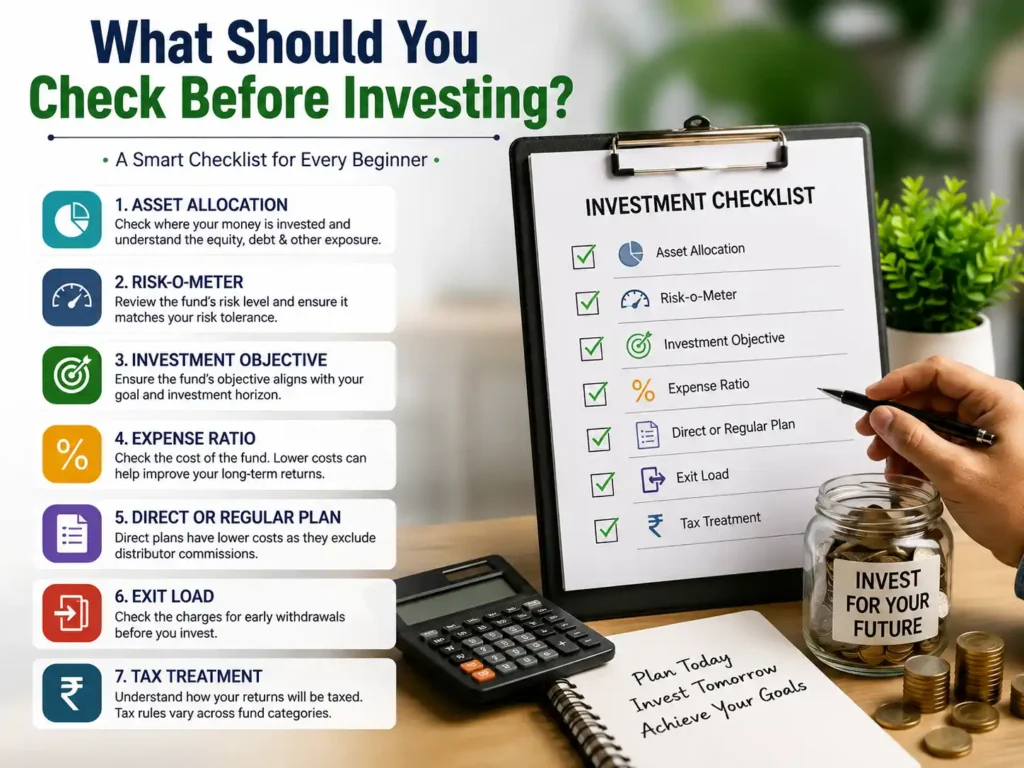
Once you have identified the category, don’t immediately choose the fund with the best one-year return.
Check these seven things:
- Asset Allocation
Check where your money is actually invested. Look at the percentage allocated to equity, debt and other permitted assets. This helps you understand the fund’s actual risk rather than relying only on its name.
- Risk-o-Meter
Check the fund’s stated risk level. SEBI’s Risk-o-Meter helps you understand how risky the scheme is compared with other mutual fund investments.
- Investment Objective
Make sure the fund matches your goal. A fund designed for long-term growth may not be suitable for money you need within a few years.
- Expense Ratio
Check how much the fund costs you. The expense ratio is the ongoing cost charged by the scheme, and higher costs can reduce your returns over time.
- Direct or Regular Plan
Know which plan you are buying. Both invest in the same scheme, but Regular Plans include distributor commissions and generally have higher expense ratios than Direct Plans.
- Exit Load
Check the cost of withdrawing early. Some funds charge an exit load if you redeem your investment within a specified period.
- Tax Treatment
Check how your returns will be taxed. Equity, debt and hybrid funds do not necessarily have the same tax treatment, and applicable rules can change. Verify the current tax rules before investing.
Common Beginner Mistakes to Avoid
Chasing recent returns: A fund that performed exceptionally well last year may not be the right fund for your goal today.
Calling debt “safe”: Lower volatility is not the same as guaranteed capital.
Treating every hybrid fund alike: Check the actual asset allocation and strategy.
Investing emergency money for growth: Money you may need immediately should not depend on a risky market recovery.
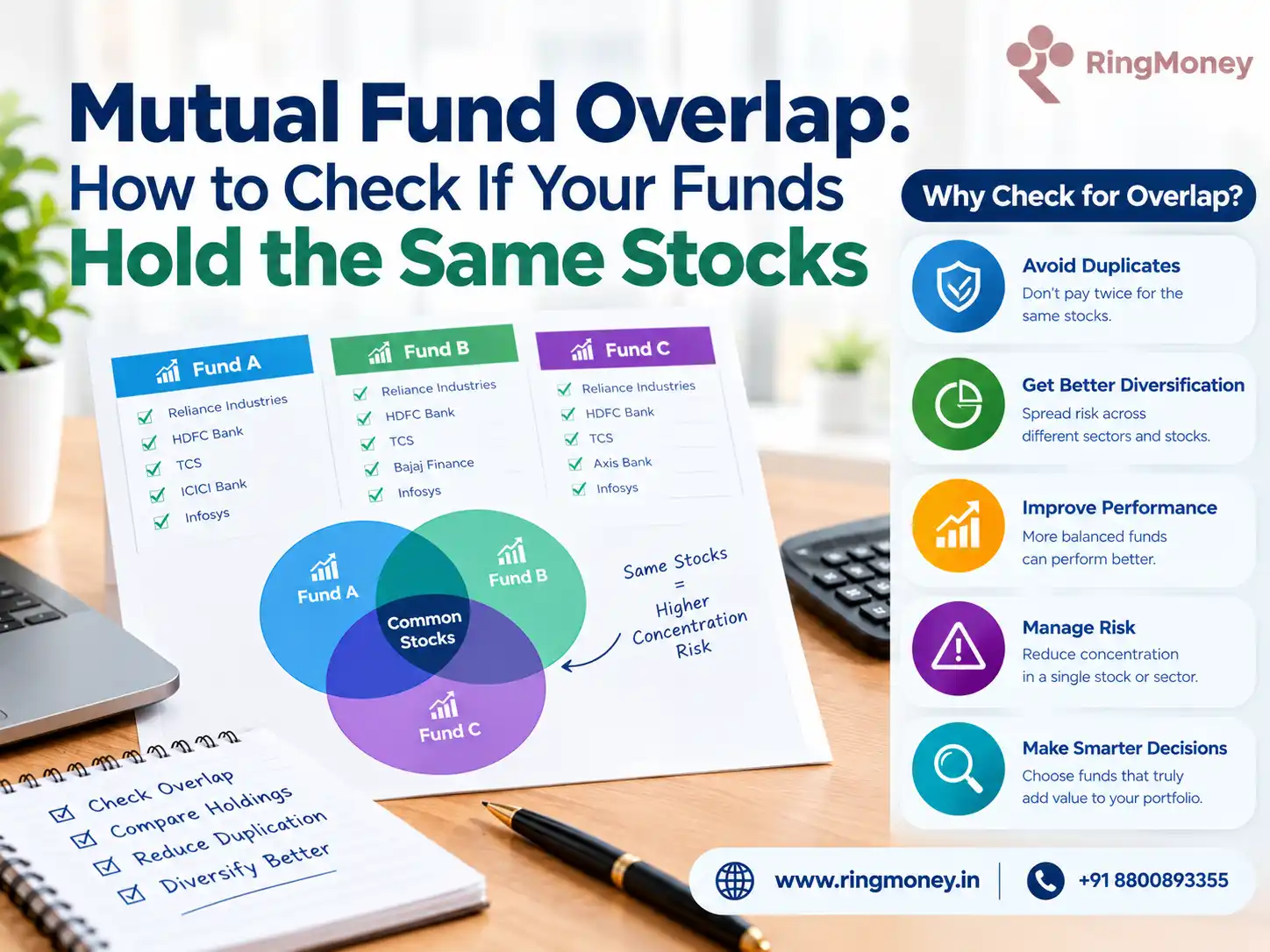
Buying too many funds: Holding equity, debt and several hybrid funds simply because they sound diversified can create unnecessary overlap and make your portfolio harder to understand.
So, Which Is Right for You?
There is no universally best choice between equity, debt and hybrid funds.
Choose equity-oriented funds when you have a long horizon, want long-term growth and can tolerate significant temporary declines.
Consider debt-oriented funds when your goal is closer, lower volatility matters more, and the chosen debt category matches your horizon and risk level.
Consider hybrid funds when you want exposure to more than one asset class and prefer an allocation that is less dependent on pure equity.
The better question is not “Which fund has performed best?” It is “What job does this money need to do, and which category gives it a reasonable chance of doing that without forcing me to sell at the wrong time?”
For a beginner, that shift in thinking can be more valuable than memorising every mutual-fund category.
Frequently Asked Questions
Can you switch from one mutual fund category to another later?
Yes, but switching usually means redeeming one investment and investing in another. Check the tax impact and any applicable exit load before making the switch.
Should you invest in all three fund categories for diversification?
Not necessarily. Holding equity, debt and hybrid funds can create overlapping exposure and make your portfolio harder to manage without adding meaningful diversification.
Is it better to invest a lump sum or through an SIP as a beginner?
It depends on your cash flow, market conditions and comfort with investing a larger amount at once. An SIP can make investing more disciplined, but it does not guarantee better returns.
What should you do if your chosen fund starts underperforming?
Don’t switch immediately based on a short period of poor performance. First check whether the fund’s strategy, portfolio and risk profile have changed and whether they still fit your original goal.
Can you stop investing in a fund without withdrawing your existing money?
Yes. You can stop future SIP instalments while keeping your existing investment in the scheme. However, review whether the remaining investment still suits your goal and time horizon.