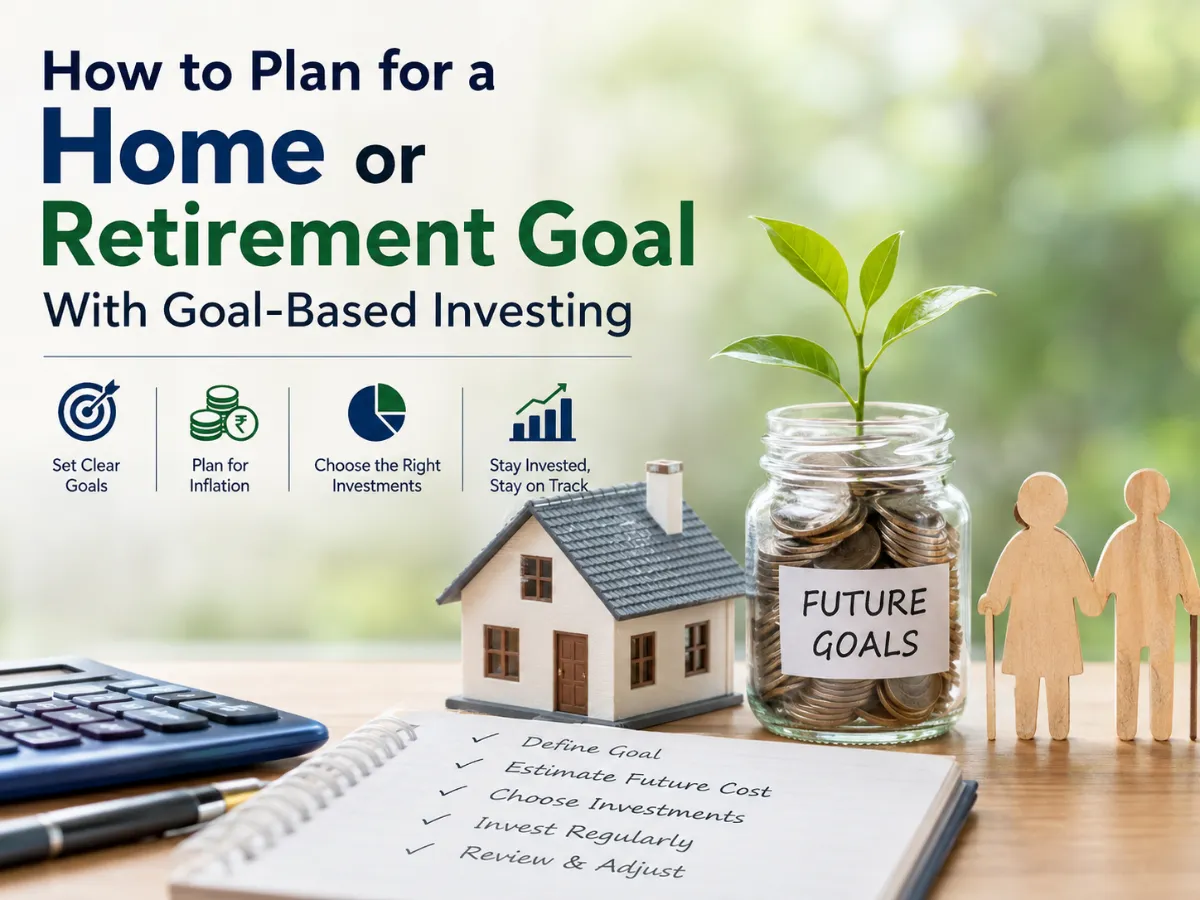
Goal-based investing helps you decide how much to invest, where to invest, and how much risk to take based on a specific financial goal and its timeline. Instead of chasing the highest possible return, you work backwards from what you need and when you will need it.
This matters because a home purchase and retirement need different strategies. If you need your home corpus in five years, a sharp market fall just before the purchase can disrupt your plans. If retirement is 20 or 30 years away, you have more time to handle market ups and downs and focus on home purchase.
The starting point is simple: define the amount you need, set a realistic timeline, account for inflation, and then choose investments that fit the goal.
What Makes Goal-Based Investing Different?
Goal-based investing connects your money to a specific financial objective. You decide the target, estimate the time available, choose how to split your savings, and then review whether you are still on track.
General investing | Goal-based investing |
Focuses mainly on investment returns | Focuses on achieving a financial goal |
May have no fixed deadline | Has a defined target and timeline |
Money may sit in one broad portfolio | |
A market fall can trigger emotional decisions | Risk is managed according to the goal’s deadline |
Success is often measured by returns | Success is measured by goal readiness |
The important shift is that returns become a means to an end, rather than the end itself.
Step 1: Define the Real Cost of Your Goal
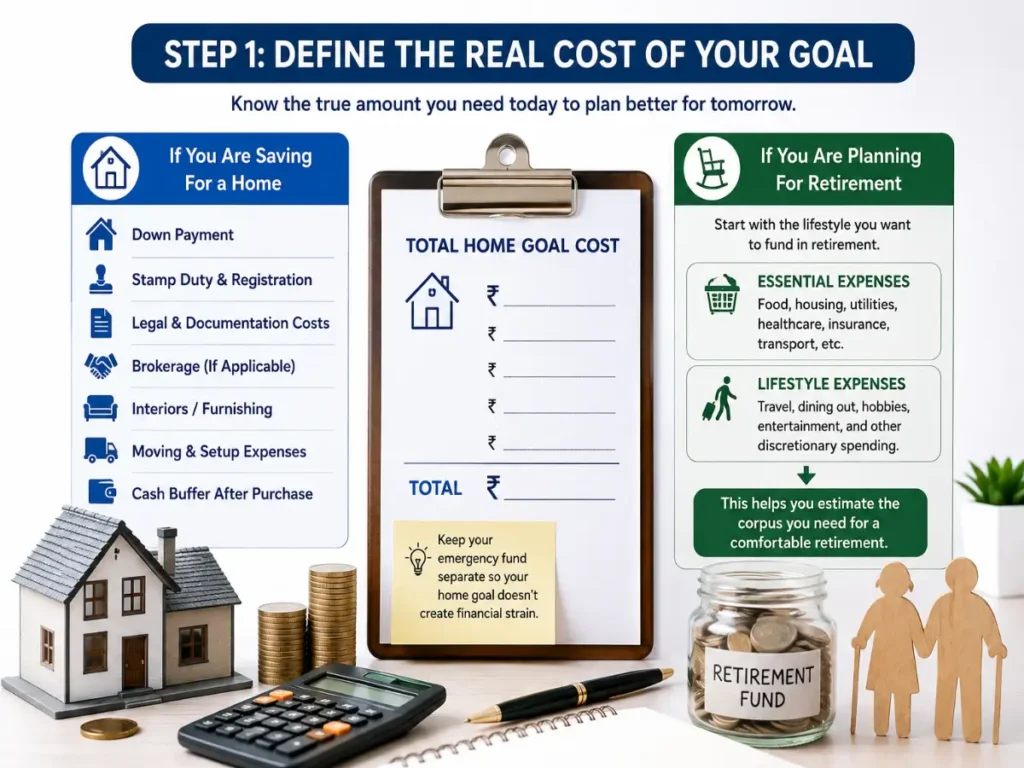
Before deciding how much to invest each month, first calculate what your goal will actually cost.
If you are saving for a home
A ₹50 lakh property doesn’t necessarily mean you only need ₹10 lakh for the down payment. Your upfront requirement may also include:
- Stamp duty and registration
- Legal and documentation costs
- Brokerage, where applicable
- Basic interiors or furnishing
- Moving and setup expenses
- A cash buffer after the purchase
If you estimate that you need ₹15 lakh for the down payment and related costs, that ₹15 lakh becomes your immediate investment target. Keep your emergency fund separate so the home purchase doesn’t leave you financially stretched.
If you are planning for retirement
Instead of picking an arbitrary corpus, start with the lifestyle you want to fund. Separate your current expenses into:
Essential: Food, housing, utilities, healthcare, insurance and transport.
Lifestyle: Travel, dining out, hobbies, entertainment and other discretionary spending.
This gives you a more realistic starting point for estimating how much income your retirement savings may eventually need to provide.
Step 2: Adjust Your Target for Inflation
The amount you need in the future will usually be higher than today’s cost. Inflation means the same ₹1 lakh is unlikely to buy the same basket of goods and services several years from now.
A simple planning formula is:
Future cost = Today’s cost × (1 + assumed inflation rate) ^ number of years
Suppose a goal costs ₹10 lakh today and you expect to need the money 10 years from now. You cannot simply continue planning around ₹10 lakh; you need to account for the effect of rising prices.
The inflation assumption is a planning assumption, not a prediction. Different expenses can also rise at different rates. Healthcare, for instance, may behave differently from everyday household spending.
That matters particularly in retirement because you could be paying for healthcare and living expenses for several decades.
Step 3: Match Your Investment Strategy to the Time You Have
Your time horizon should influence how much volatility your portfolio can reasonably take.
If you need the money soon, preserving it becomes increasingly important. If you have many years before the goal, you generally have more time to tolerate short-term market declines.
For a short-term goal: around 0–3 years
The priority is generally stability and access to the money.
Depending on your circumstances, products such as bank fixed deposits or suitable short-duration/liquid investment options may form part of the strategy. Putting money needed for a house in two years into highly volatile assets can create a serious timing problem if markets fall just before you need it.
For a medium-term goal: around 3–5 years
You may have somewhat more room to balance growth and stability, but the appropriate mix depends on your risk capacity and how fixed the deadline is.
The closer the goal becomes, the less sensible it is to depend on a strong market performance arriving exactly when you need the money.
For a long-term goal: more than 5 years
A monthly contribution can give you greater capacity to consider growth-oriented assets, including diversified equity funds, provided they are appropriate for your risk profile.
However, a long horizon does not make equity risk-free. A diversified equity fund and a portfolio of individual stocks are also not the same thing; direct stocks carry company-specific and concentration risks.
Step 4: Calculate How Much You Need to Invest
Once you know your future target, calculate what your existing savings and future contributions need to accomplish.
You will typically need these inputs:
- Future target amount
- Current amount already invested for the goal
- Time remaining
- Monthly contribution
- Assumed rate of return
- Potential annual increase in your contribution
Don’t build your entire plan around an optimistic return assumption. Markets do not deliver the same return every year, and separate goal buckets.
A better approach is to test your plan under different assumptions. If the plan only works when everything goes perfectly, it is probably too fragile.
Step 5: Create Separate Buckets for Separate Goals
increase your contribution as your income growsKeeping your home corpus, retirement savings and emergency money in one undifferentiated pool can make decisions unnecessarily difficult.
Separate goal buckets give every rupee a job.
For example:
- Home bucket: Money required for your planned purchase
- Retirement bucket: Long-term money that you ideally won’t touch for other expenses
- Emergency bucket: Cash or suitable liquid savings for unexpected events
This separation also helps during market volatility. If your retirement portfolio falls temporarily but your home corpus is already protected in safer investments, you don’t have to make a rushed decision across your entire financial plan.
Step 6: Automate Your Investments and Increase Them Over Time
A sustainable monthly investment is usually more useful than an ambitious amount you cannot maintain.
Set up automatic contributions around your income cycle so investing becomes part of your routine rather than a decision you have to make every month.
Then increase your contribution as your income grows.
You might, for example, increase your monthly investment by 5–10% a year if your income and expenses allow it. The percentage is not a universal rule; the point is to prevent your investment amount from remaining permanently stuck at the level you could afford several years ago.
Step 7: Move Money to Safer Options as the Deadline Approaches
One of the most overlooked parts of goal-based investing is what you do after building the corpus.
Suppose you are investing for a house that you plan to buy five years from now. A portfolio that is suitable when the purchase is distant may become inappropriate when only a few months remain.
As the deadline approaches, gradually review your exposure to volatile assets and move the portion needed for the near-term goal toward more stable and liquid options, where appropriate.
This is often called a glide path, but the idea is simple: the closer you get to needing the money, the less dependent you should be on a favourable market outcome arriving on time.
A Simple Home-Goal Example
Suppose you estimate that you will need ₹15 lakh in five years for your down payment and related upfront costs, and you already have ₹2 lakh earmarked for the goal.
Assuming a 7% annualised return for illustration, your existing ₹2 lakh could grow to around ₹2.8 lakh over five years. To build the remaining amount, you would need to invest approximately ₹17,500 per month for the next five years.
The calculation gives you a starting point, but the plan shouldn’t end there. You should also consider:
- Whether ₹15 lakh will still be enough after inflation and changes in property prices
- Whether your existing ₹2 lakh needs to remain partly accessible
- What happens if your actual returns are lower than assumed
- When to gradually move the corpus into safer, more stable options
A review after two to three years can help you spot a shortfall early. If your target has increased or your investments are behind schedule, you still have time to increase your monthly contribution, step up investments with your income, or adjust the purchase timeline rather than taking excessive risk close to the goal.
The return and SIP figures above are illustrative, not guaranteed.
Retirement Needs Two Phases, Not One
Retirement planning is often presented as a single question: “How much corpus do you need?” In reality, you need to think about both building the money and eventually using it.
Phase 1: Accumulation
While retirement is still many years away, your focus is on building the portfolio and making regular contributions. A longer horizon may allow you to hold more growth-oriented investments, depending on your circumstances.
Phase 2: Decumulation
As retirement approaches, the question changes from “How fast can my money grow?” to “How can I use this money sustainably?”
You need to consider:
Regular living expenses
Healthcare costs
Inflation
How long the money may need to last
Other income sources
The possibility of major unexpected expenses
This is why reaching a particular corpus does not automatically mean your retirement plan is complete.
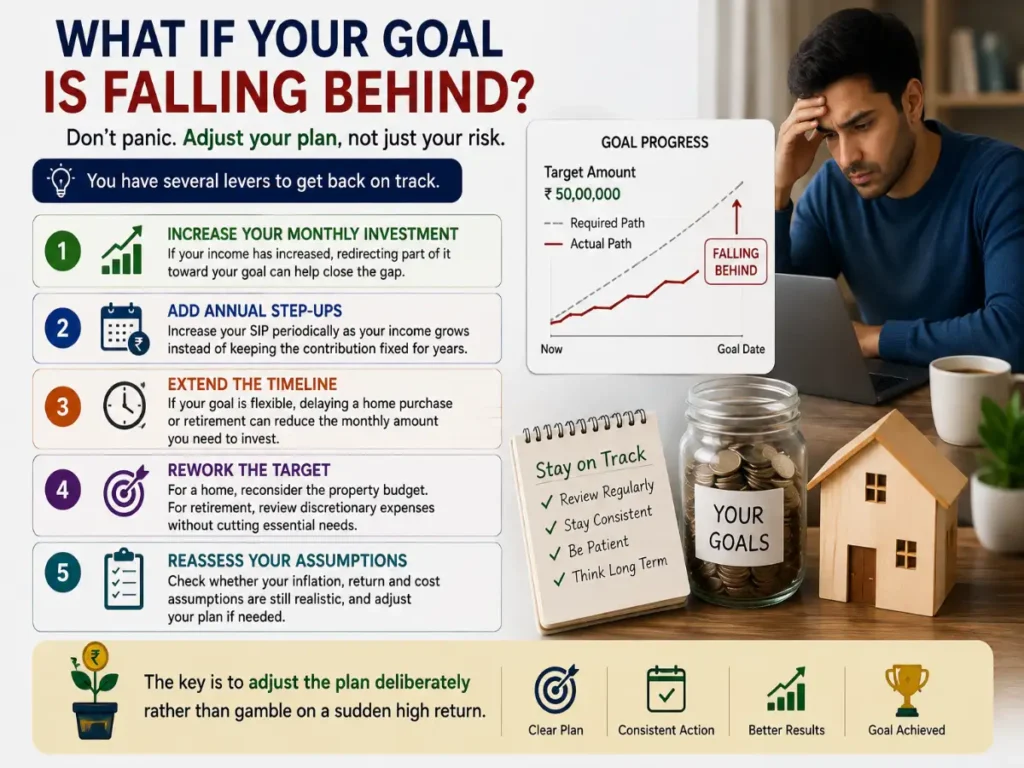
What if Your Goal Is Falling Behind?
Don’t immediately try to close the gap by taking more investment risk. You have several other levers available.
- Increase Your Monthly Investment
If your income has increased, redirecting part market fall of it toward your goal can help close the gap.
- Add Annual Step-Ups
Increase your SIP periodically as your income grows instead of keeping the contribution fixed for years.
- Extend the Timeline
If your goal is flexible, delaying a home purchase or retirement can reduce the monthly investment required.
- Rework the Target
For a home, reconsider the property budget. For retirement, review discretionary expenses without cutting essential needs.
- Reassess Your Assumptions
Check whether your inflation, return and cost assumptions are still realistic, and adjust your plan if needed.
The key is to adjust the plan deliberately rather than gamble on a sudden high return.
Home Goal vs Retirement Goal: Why the Strategy Differs
Factor | Home purchase | Retirement |
Deadline | Usually specific | Often flexible, but important |
Main requirement | Large amount available around purchase | Sustainable income over many years |
Early-stage risk | Depends on timeline | Can potentially be higher during accumulation |
Near the goal | Protect required purchase money | Gradually prepare for withdrawals |
Inflation concern | Property and associated costs | Living expenses and healthcare |
Key risk | Market fall just before purchase | Outliving assets or losing purchasing power |
The biggest difference is the nature of the deadline. If you have to pay for a house in six months, a market recovery cannot be assumed to happen before your payment is due. Retirement usually gives you more flexibility to plan across multiple decades.
Review Your Plan at Least Annually
A goal-based portfolio should evolve when your life changes. You don’t need to react to every market movement, but you should review the plan when something important changes.
Ask yourself:
- Has the goal amount changed?
- Has the deadline moved?
- Are your monthly contributions still sufficient?
- Has your income changed?
- Has your portfolio drifted from its intended allocation?
- Is it time to move more money toward safer assets?
- Have your retirement expenses or expected retirement age changed?
A review is about keeping the plan relevant, not constantly replacing investments.
The Simplest Way to Think About Goal-Based Investing
You don’t need a complicated investment system to get started. You need a clear sequence:
Define the goal → estimate the future cost → set the timeline → calculate the required contribution → choose an appropriate investment mix → automate contributions → review progress → move money toward safety as the deadline approaches.
The best investment for a goal is not necessarily the one with the highest historical return. It is the strategy that gives you a reasonable chance of having the right amount of money available when you actually need it.