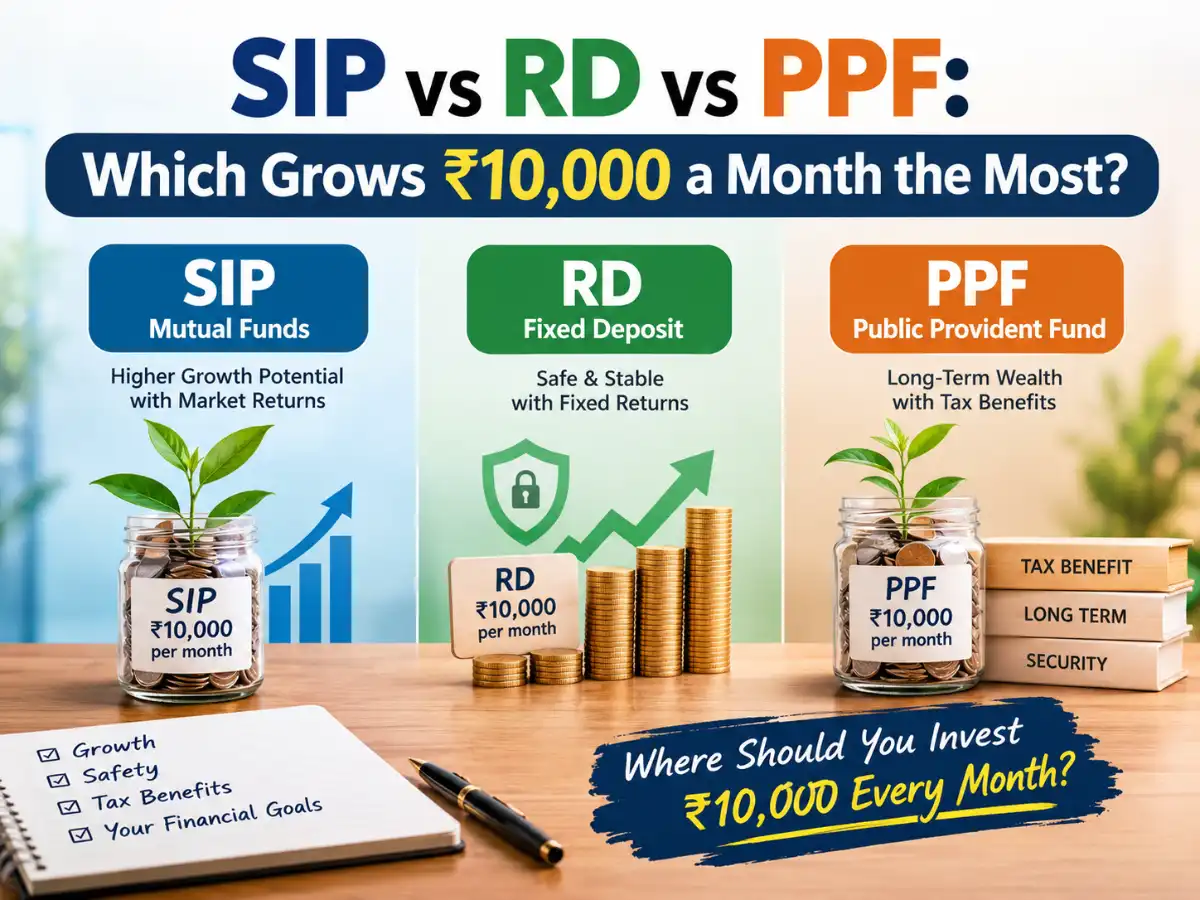
If you are wondering where to invest your money in India, don’t start by choosing between an FD, mutual fund or PPF. Start with when you need the money, what you need it for, and how much loss you can afford along the way.
For money you may need soon, capital safety and easy access usually matter most. For goals 7–10 years away, you can generally consider more market-linked investments if you can tolerate temporary falls. For retirement and other long-term goals, a mix of growth and stability often makes more sense than putting everything into one product.
Where Should You Invest? A Quick Decision
If you want the short answer, start with when you need the money:
If you need the money | Consider first | Why |
Within 1–3 years | FD, savings/short-term options | Protect your money and keep it accessible |
In 3–7 years | A mix of debt and suitable growth investments | Balance stability with some growth |
After 7–10+ years | Diversified equity funds, index funds | More time to handle market ups and downs |
For retirement | Designed around a long-term retirement goal | |
For a child’s long-term goal | PPF, SSY if eligible, and suitable growth investments | Match safety and growth to the goal |
For emergency money | Savings account, FD or other highly accessible options | You may need the money without warning |
One rule matters most: don’t put SEBImoney into a high-risk investment simply because it offers higher potential returns. The right choice depends on your goal, time horizon, risk capacity, liquidity needs and taxes.
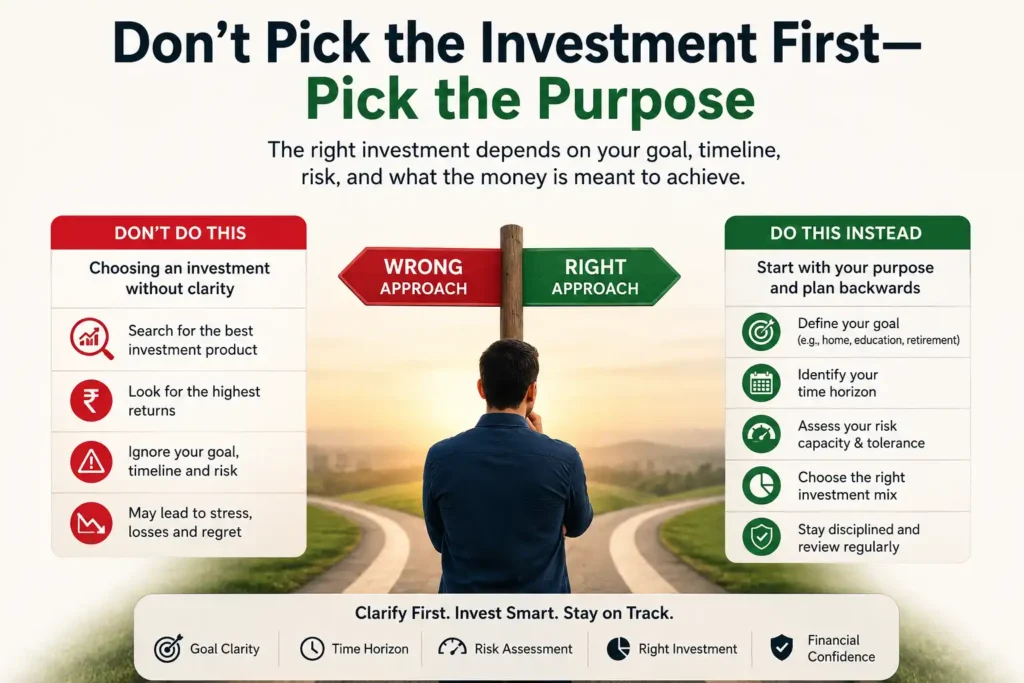
Don't Pick the Investment First—Pick the Purpose
Suppose you have ₹5 lakh sitting in your savings account. The right place for it depends entirely on what that ₹5 lakh is meant to do.
If it is your emergency fund, you need quick access and low risk. If it is a house down payment five years from now, you have more time but still need to think carefully about a potential market fall just before you need the money.
If it is retirement money that you won’t touch for 20 years, your priorities change again.
Before investing, identify:
- Your goal: emergency fund, education, house, retirement or wealth creation
- Your time horizon: when you will actually need the money
- Your risk capacity: how much loss your finances can withstand
- Your risk tolerance: how comfortable you are seeing the value fall
- Your liquidity needs: how quickly you may need to withdraw
- Tax impact: how much of the return you actually keep
That simple filter will eliminate many unsuitable investments before you even compare returns.
Three Honest Questions to Ask Before You Put Money Anywhere
When Do You Need This Money Back?
The time horizon should guide your investment choice. Money you need soon should prioritise safety and access, while long-term money can take more market risk.
- Less than 3 years: Prioritise stability and easy access.
- 3–7 years: Balance safety and growth based on your goal.
- 7–10+ years: Consider more growth-oriented investments.
These are broad guidelines, not fixed rules.
Can You Afford to See the Investment Fall?
Your age doesn’t decide your risk level. Your income, savings, debt and financial responsibilities matter too.
A 20% market fall may be manageable for a goal 15 years away, but painful if you need the money next year. Consider both risk capacity—what you can afford to lose—and risk tolerance—what you can comfortably handle.
How Quickly Can You Get Your Money Out?
Don’t look only at returns. Check how easily you can access your money and whether there are lock-ins, withdrawal restrictions or exit penalties.
This is especially important with investments such as PPF and NPS, where access to your money is more restricted.
Safe Options Where Capital Stability Matters
Bank Fixed Deposits
A bank FD offers predictable returns without daily market fluctuations. You choose a tenure and earn interest according to the FD terms.
However, FD returns can be affected by tax, inflation and premature-withdrawal penalties. Eligible bank deposits are insured by DICGC up to ₹5 lakh per depositor per bank, including principal and interest.
Best for: Short-term goals and capital stability.
Avoid if: You need long-term growth that can stay ahead of inflation.
Public Provident Fund (PPF)
PPF is a long-term savings option with a 15-year account structure and restricted withdrawals. Its tax treatment and government-backed nature make it useful for conservative investors.
The trade-off is limited access to your money, so it may not suit shorter-term goals.
Best for: Long-term, low-risk savings.
Avoid if: You may need the money within a few years.
Sukanya Samriddhi Yojana
SSY is a government-backed savings scheme for an eligible girl child. It is designed for long-term goals and comes with specific contribution and withdrawal rules.
If you’re eligible, compare its tenure and tax treatment with your child’s actual financial goal.
Best for: Long-term savings for an eligible girl child.
Avoid if: You need a flexible investment with easy withdrawals.
Options That Balance Stability and Growth
National Pension System
NPS is a retirement-focused investment where your money can be allocated across equity and debt. It offers long-term growth potential but comes with withdrawal restrictions.
At retirement, the normal exit rules generally allow up to 60% as a lump sum, with at least 40% used to purchase an annuity, subject to applicable rules and conditions.
Best for: Long-term retirement planning.
Avoid if: You may need the money for a near-term goal.
Debt Mutual Funds
Debt funds invest in bonds and other debt securities, so they are not the same as FDs. Their value can rise or fall with interest rates, credit quality and the securities held by the fund.
Check the fund’s portfolio and risk before investing rather than assuming your money is guaranteed.
Best for: Investors seeking market-linked debt exposure.
Avoid if: You expect guaranteed returns or capital protection.
Options for Long-Term Wealth
Index Funds and Equity Mutual Funds
Equity mutual funds invest in shares of companies and can offer higher growth potential over the long term, but their value can fall sharply during market downturns.
Index funds track a market index, while actively managed funds follow a specific investment strategy.
One common misconception: SIP is not an investment product. It is simply a way to invest a fixed amount regularly into a mutual fund.
Best for: Long-term goals where you can handle market falls.
Avoid if: You need the money soon.
Direct Stocks
Buying individual stocks gives you direct exposure to specific companies, but your risk is more concentrated than with a diversified fund.
You should understand the company’s business, financials, debt and valuation before investing. Social-media tips or “sure-shot” calls are no substitute for research.
Best for: Experienced investors who can research companies and handle higher risk.
Avoid if: You are investing mainly on tips or short-term price movements.
What About Gold and Real Estate?
Gold can have a place in a diversified portfolio, but buying jewellery is not the same as investing in gold. Making charges, resale considerations and storage can reduce the practical value of physical jewellery as an investment.
Gold ETFs and other regulated market-based routes can offer different cost and convenience characteristics. Evaluate the product structure before investing.
Real estate can provide rental income and potential appreciation, but it also requires significant capital and involves registration, maintenance, taxes and legal due diligence. It is not as easy to sell quickly as a listed security.
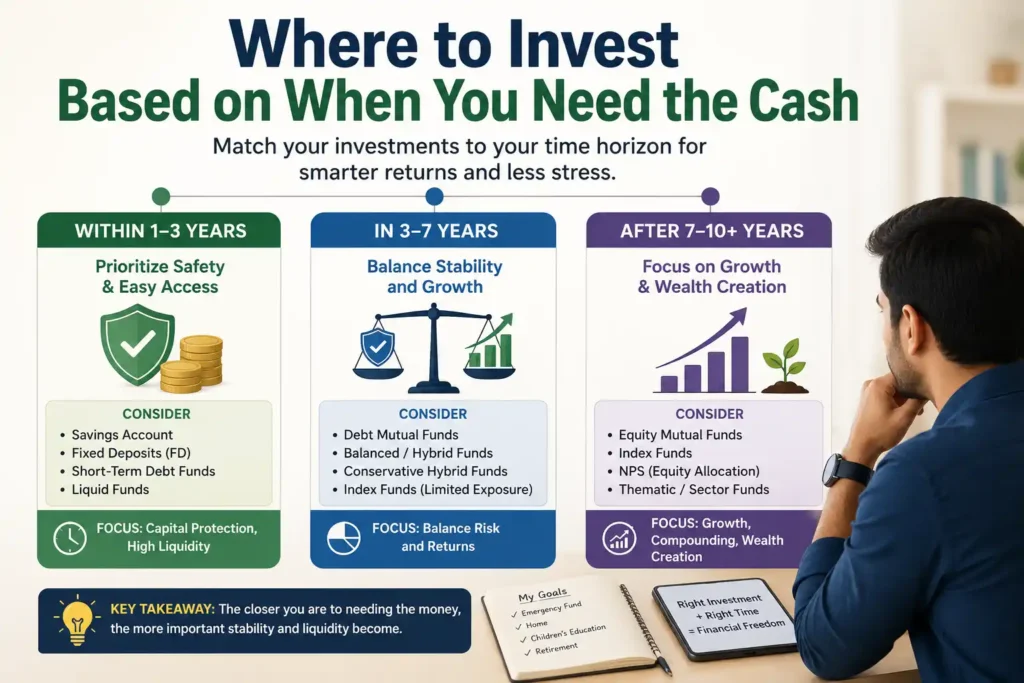
Where to Invest Based on When You Need the Cash
If you need the money within 1–3 years: prioritise stability and access. Bank deposits and other suitable low-volatility options may deserve more attention than equity.
If you need it in 3–7 years: don’t automatically choose a 50:50 equity-debt split. Match the mix to how important the goal is and how much loss you could tolerate near the goal date.
If you need it after 7–10+ years: diversified equity investments can have a larger role for suitable investors, alongside investments chosen for stability and specific tax or retirement objectives.
The closer you get to an important goal, the more carefully you should review the amount exposed to market fluctuations.
The Hidden Trap: Taxes and Inflation
The return you see isn’t always the return you keep. For example, a 7% FD for someone in the 30% tax bracket works out to about 4.9% after tax, before cess and other factors. If inflation is 5.5%, your money may still be losing purchasing power.
Tax also varies by investment. Listed equity and equity mutual funds currently attract 20% STCG and 12.5% LTCG, with the ₹1.25 lakh annual exemption for eligible long-term gains. Debt mutual funds bought after April 1, 2023, are generally taxed at your applicable slab rate.
Don’t invest just to save tax. First check whether the investment actually fits your goal, timeline and risk level.
Seven Common Investing Mistakes
- Investing before building an adequate emergency fund
- Putting short-term goal money into volatile assets
- Treating an FD’s interest rate as its real return
- Confusing SIP with a mutual fund
- Chasing whichever fund or stock recently performed best
- Buying investments you don’t understand
- Trusting promises of guaranteed, unusually high returns
You should also deal with basic financial protection first. Appropriate health insurance and pure term insurance, where relevant to your circumstances, should not be ignored simply because you are eager to start investing.
How to Check If an Investment Scheme Is Real
Before transferring your money, verify who regulates the product and who is actually receiving your money.
For securities and mutual funds, check the relevant registration and regulatory information with SEBI. SEBI maintains a current list of registered mutual funds and intermediaries.
For banks and applicable deposit-related matters, check the relevant RBI information. For NPS, use PFRDA and the official NPS information rather than relying on a social-media post.
Be particularly cautious if someone asks you to transfer money to a personal UPI account while promising fixed, unusually high returns. A professional-looking app or website does not by itself prove that an investment is legitimate.
Frequently Asked Questions
Which is the safest investment in India?
There isn’t one answer for every purpose. Government-backed savings schemes can provide high capital stability, while eligible bank deposits have DICGC protection within the applicable ₹5 lakh limit.
Can you start investing with ₹500 a month?
Yes. The amount matters less than choosing a suitable product and staying consistent. You can use small regular contributions for appropriate mutual funds or other investments that accept your chosen contribution amount.
Is an FD better than a mutual fund?
Neither is universally better. An FD offers greater return predictability, while a suitable equity mutual fund may offer greater long-term growth potential but with market risk.
Can you lose money in a debt mutual fund?
Yes. Debt funds can fall in value because of factors such as interest-rate movements and credit risk. They should not be treated as guaranteed-return alternatives to bank FDs.
Is PPF still useful under the New Tax Regime?
It can be, but don’t assume its tax-saving benefit applies in the same way under the New Tax Regime. Evaluate PPF for its long-term structure, safety and tax treatment under the rules applicable to you, rather than investing solely to claim a deduction.
Your Next Step: Start With the Goal
Don’t look for the “best investment.” Choose what fits your goal, timeline, risk and access needs.
Compare options based on risk, liquidity, lock-in, tax and inflation—not just advertised returns.
Investment rules, tax rates and scheme conditions can change. Check the latest details with the relevant official regulator before investing.