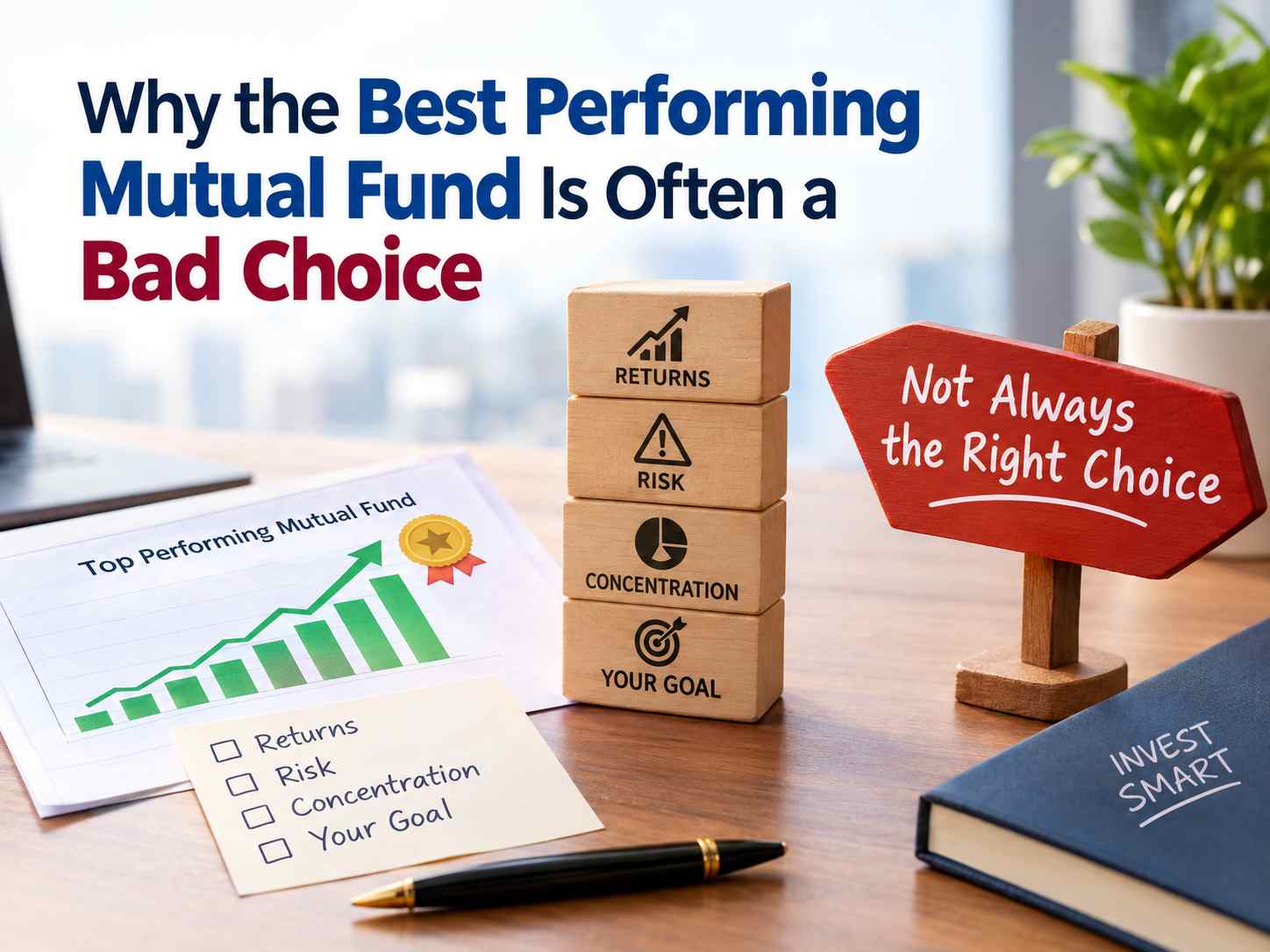
The best-performing mutual fund is not always the best one for you. A high return may reflect a favourable market cycle, concentrated bets, or higher risk—not necessarily a better investment process.
When you sort funds by “highest return,” you see what worked in the past, not whether it fits your goal today. Before choosing a top-performing fund, look at what drove its returns, the risk it took, and whether that approach suits your investment horizon.
What a Performance Table Actually Shows — and What It Hides
A mutual fund ranking is useful. It gives you a starting point for research. The problem begins when you treat the ranking as the conclusion.
Suppose a fund shows a 30% annualised return over the past three years. That number looks impressive. But the three-year figure is calculated from two points in time: where the investment started and where it ended.
You cannot see the journey from that number alone.
The fund might have:
- Performed reasonably well every year.
- Been average for two years and surged during the third.
- Benefited heavily from one booming sector.
- Held more mid- and small-cap stocks than its peers.
- Taken concentrated bets that happened to work.
Those are very different situations.
This is why a trailing return is evidence of what happened, not proof of what will happen next.
A better analysis looks at several periods and, where available, rolling returns. Rolling returns show how a fund performed across many overlapping periods instead of relying on one convenient start and end date.
That helps you see whether the fund was consistently competitive or simply benefited from one unusually favourable window.
Why Yesterday’s Winner Can Slow Down
Markets do not reward the same sectors and investment styles forever. At different times, large companies, smaller companies, technology, financials, infrastructure, or energy may lead.
A fund with heavy exposure to the sector currently performing well can quickly rise to the top of the rankings. But that does not necessarily mean its manager has suddenly become better than everyone else.
For example, a diversified fund may deliver steady returns, while another fund with a large allocation to infrastructure stocks surges during an infrastructure rally. The second fund could become the category leader.
But when the market cycle changes, that same concentration can hurt returns. The fund has not necessarily become worse; the conditions that favoured its portfolio may have changed.
That is why strong recent performance deserves closer scrutiny before you invest.
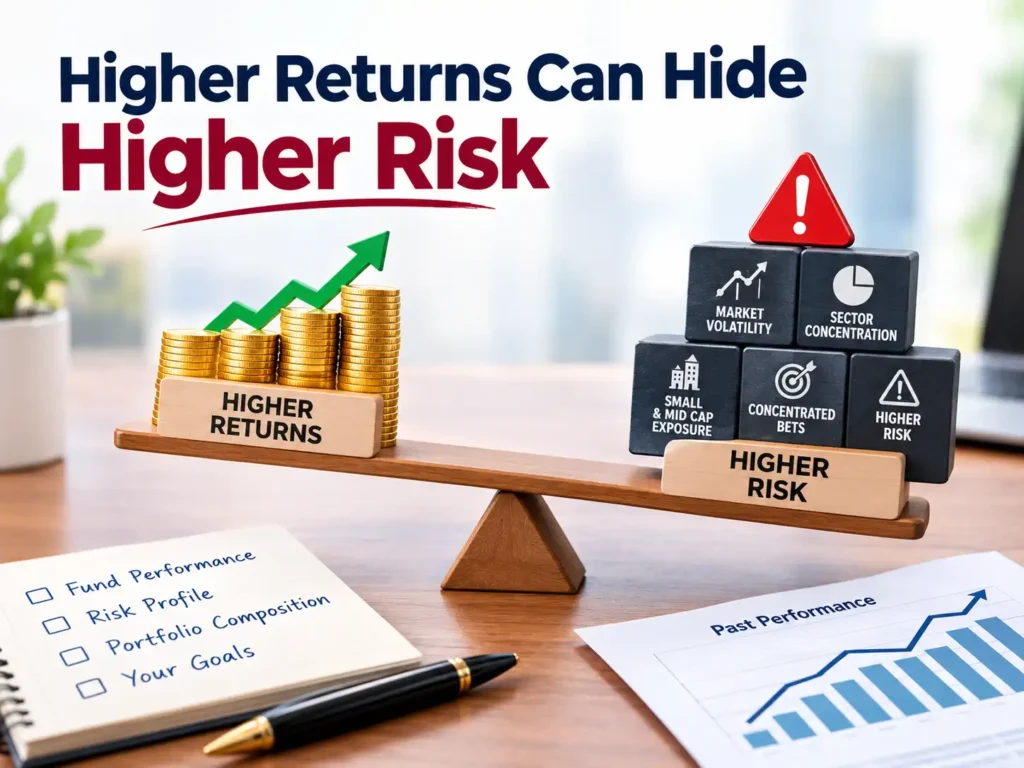
Higher Returns Can Hide Higher Risk
Returns never happen in isolation.
If one fund beats comparable funds by a wide margin, you should ask what it did differently.
Did it own smaller companies? Did it hold fewer stocks? Was it heavily invested in one sector? Did it make large bets on a particular investment style?
None of these automatically makes a fund bad. But each can change the level of risk you are taking.
Consider this simple illustration:
What you see | Fund A: Steadier approach | Fund B: Recent category winner |
3-year annualised return | 18% | 22% |
Fall during a difficult period | 8% | 24% |
Sector exposure | Spread across several sectors | Heavy exposure to two sectors |
Year-to-year performance | Relatively consistent | Weak for two years, sharp surge in year three |
Investor experience | Easier to stay invested | Greater chance of panic during a fall |
Fund B looks better if you only compare returns.
But ask yourself a different question: Could you actually remain invested when that fund falls 24%?
That matters because a theoretically higher return is of little use if you abandon the investment during a sharp decline.
Look At Where the Return Came From
This is the most useful question you can ask after finding a high-performing fund.
Break the return down before you decide whether it deserves your money.
Start by asking whether the broader market was responsible for much of the gain. If most comparable funds also performed strongly, the fund’s headline return may tell you less about its individual investment decisions.
Next, examine sector and company exposure.
If a fund made unusually high returns while holding a very large portion of its portfolio in one booming area, some of that performance came from that exposure. You need to decide whether you are comfortable carrying the same risk today.
Finally, look at stock selection.
A fund that has added value across different sectors and market conditions presents a different case from one whose results depend heavily on a handful of successful positions.
You are not trying to prove that one fund manager is “better.” You are trying to understand whether the source of past performance appears repeatable.
The Habit That Can Quietly Hurt Your Returns
There is a familiar pattern among retail investors. A fund performs exceptionally well, moves to the top of comparison screens, and starts getting attention on financial websites and social media.
You invest because you do not want to miss the opportunity. Then market leadership changes, the fund’s returns slow down, or it falls more than expected. You get uncomfortable and sell.
Soon, another fund becomes the new top performer, and the cycle starts again. You end up buying yesterday’s winner after a strong run and selling when the performance becomes difficult to tolerate.
Switching can also involve exit loads and tax consequences, depending on the scheme and your circumstances. More importantly, frequent changes can take your portfolio away from the asset allocation you originally chose.
The problem is not replacing a mutual fund when there is a good reason. The problem is replacing it simply because another fund has recently moved ahead in the rankings.
What to Check Before Investing in a Top-Performing Fund
You do not need a complicated spreadsheet to perform a sensible first review. Start with these checks.
Compare it with the right benchmark
Do not compare a fund only with other funds. Check whether it has beaten its stated benchmark—for example, the Nifty 50 TRI for a large-cap fund or an appropriate benchmark such as the Nifty Smallcap 250 for a small-cap fund. Also compare it with funds in the same category.
Look at difficult market periods
Check how the fund performed when markets fell, not just during strong rallies. Look at how much it declined and how it recovered.
The goal is to understand how much downside you are accepting for its potential returns.
Check concentration
Review the latest factsheet for:
- Top 10 holdings
- Sector allocation
- Market-cap exposure
A fund heavily concentrated in a few companies or sectors carries a different level of risk.
Check whether it fits your goal
A high-growth equity fund may suit a long-term goal but be unsuitable for money you need soon.
Your goal should determine the fund you choose, not its position on a leaderboard.
When a Top-Performing Fund Can Still Be a Good Choice
There is nothing inherently wrong with choosing a fund that has recently performed well.
In fact, strong historical performance can be one useful piece of evidence.
The difference is how you use it.
A top-performing fund deserves closer consideration when its results remain competitive across several periods, its portfolio is consistent with its stated strategy, its risk is appropriate, and its performance is not dependent on one unusually concentrated bet.
You should also consider whether the current portfolio resembles the portfolio that produced the historical returns you are impressed by.
Past performance belongs to a past portfolio. Today’s investment belongs to today’s portfolio.
That is an easy detail to overlook.
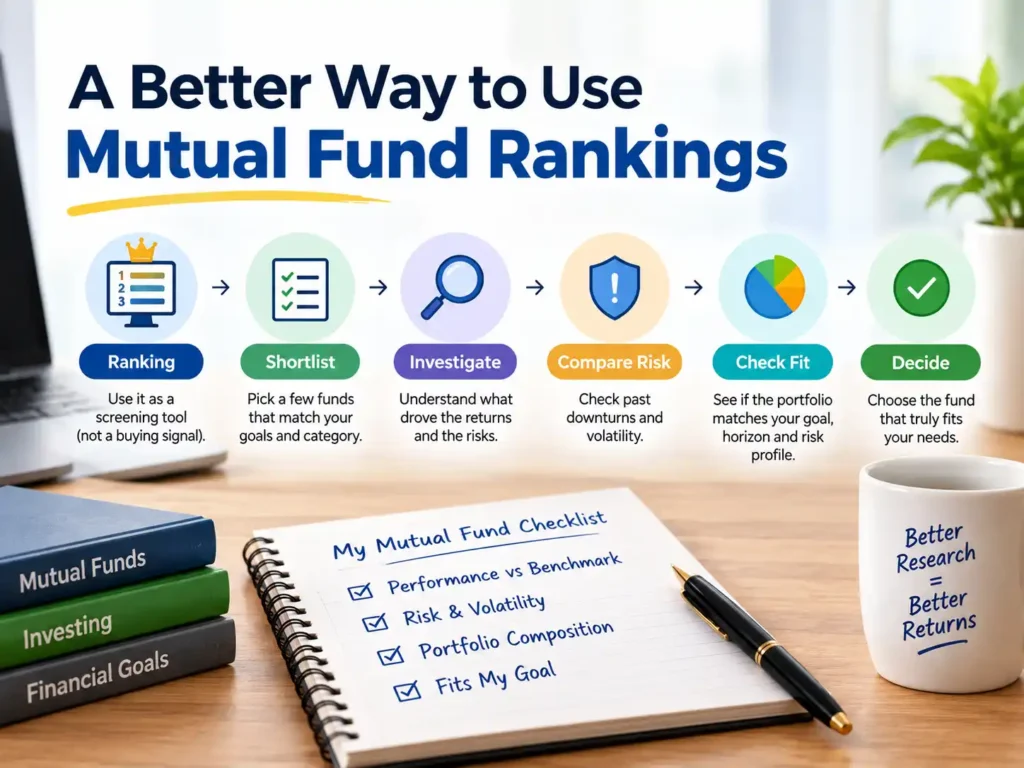
A Better Way to Use Mutual Fund Rankings
Think of a ranking as a screening tool, not a buying signal.
A sensible process looks more like this:
Ranking → shortlist → investigate → compare risk → check portfolio fit → decide
Not:
Ranking → invest
Before choosing the current category leader, ask yourself:
- What actually drove its recent performance?
- Did it outperform across different market conditions?
- How badly did it fall during weak markets?
- Is its portfolio highly concentrated?
- How does it compare with its benchmark?
- Has the investment strategy remained consistent?
- Does it overlap with funds you already own?
- Does it suit your time horizon and risk tolerance?
- What would make you replace the fund later?
Those questions take a little longer than sorting an app by returns. They can also lead to a much better investment decision.
The Bottom Line
The best-performing mutual fund is not automatically a bad investment.
The mistake is assuming that the highest historical return makes it the best choice for you.
A fund can reach the top because of strong stock selection, favourable market conditions, sector exposure, higher risk, or a combination of these factors. Your job is to understand which explanation fits before putting your money behind the result.
So the next time a mutual fund sits at the top of your comparison screen, pause before you invest.
Do not ask only, “How much did it return?”
Ask, “Why did it return so much, what risks produced that result, and would I still want this portfolio if the market environment changed?”
That is a much more useful way to choose a mutual fund.
Disclaimer: This article is for educational purposes only and does not constitute financial advice. Mutual fund investments are subject to market risks. Read all scheme-related documents carefully before investing.
Frequently Asked Questions
Is it better to invest in a fund after it has fallen from the top?
Not necessarily. A fall can make a fund cheaper, but it does not automatically make it better value. Check whether the decline reflects normal volatility or a genuine change in the fund’s portfolio or strategy.
Should you stop investing in a fund if its ranking drops?
Not simply because its rank has fallen. Rankings can change frequently, so focus on whether the fund still meets the criteria that made you choose it in the first place.
Does a fund with a higher expense ratio need to be avoided?
No. A higher cost can be reasonable if the fund consistently delivers enough value to justify it. Compare costs alongside performance, risk and the fund’s investment approach.
Is a mutual fund with more stocks automatically safer?
Not always. Holding more companies can spread company-specific risk, but the fund can still be exposed to the same sectors, market segments or investment style.
How often should you review a mutual fund after investing?
You do not need to check its ranking every month. Review it periodically and focus on meaningful changes such as a shift in strategy, persistent underperformance, major portfolio changes or a change in your own financial goals.