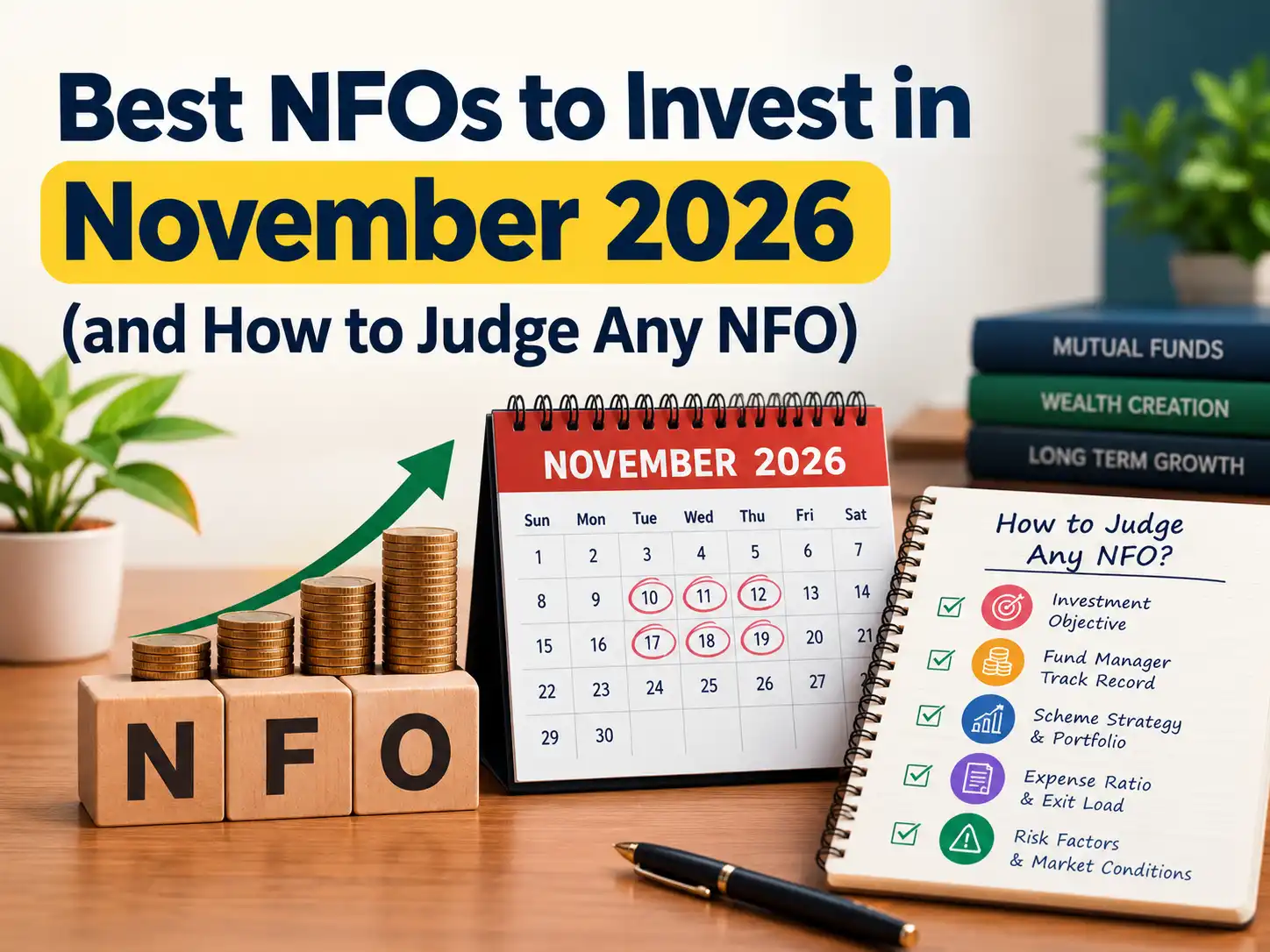
Quick answer: Here are the mutual fund NFOs open or announced for November 2026, with dates, category and minimum investment. Before you invest in any of them, ask one question: does this fund give you something your existing funds don’t? Most NFOs, especially index funds and thematic funds that copy existing strategies, don’t. An NFO priced at ₹10 isn’t “cheaper” than an existing fund at ₹150.
Last updated: [date]. See the live list on our NFO page.
NFOs open in November 2026
On smaller screens, each scheme appears as a separate card.
| Scheme | AMC | Category | Opens | Closes | Min. investment | Exit load | Worth a look if… |
|---|---|---|---|---|---|---|---|
| [Add verified scheme name] | [AMC name] | [Fund category] | [Opening date] | [Closing date] | [Verify amount] | [Check SID] | [Relevant investor goal] |
| [Add verified scheme name] | [AMC name] | [Fund category] | [Opening date] | [Closing date] | [Verify amount] | [Check SID] | [Relevant investor goal] |
| [Add verified scheme name] | [AMC name] | [Fund category] | [Opening date] | [Closing date] | [Verify amount] | [Check SID] | [Relevant investor goal] |
Disclaimer: Inclusion in this list is not an investment recommendation. NFO dates, minimum investments and exit loads should be verified against the latest official AMC documents and Scheme Information Document (SID) before investing. Mutual fund investments are subject to market risks.
The 5-point NFO checklist
Use this on any NFO, this month or any other.
1. Is it genuinely new?
If the AMC (or another AMC) already runs a fund with the same strategy and a 5-year record, the existing fund is usually the better choice. You can see how it behaved in a crash. An NFO only has a brochure.
2. What will it cost?
Check the expected expense ratio in the SID. Under SEBI’s 2026 rules, costs now show as a Base Expense Ratio plus brokerage and levies (what changed). A new index fund should be among the cheapest in its category, or there’s no reason to pick it.
3. Who’s managing it, and what’s their record?
For an active NFO, look at the fund manager’s other funds over 5+ years, not the AMC’s marketing.
4. Does it overlap with what you own?
A new “flexi cap” or “large & mid cap” fund may hold the same 30 stocks as your existing funds. Check before you add it (how to check mutual fund overlap).
5. Is it a theme you’d hold for 7+ years?
Thematic NFOs (defence, manufacturing, consumption, AI) often launch after a theme has already run up. If you couldn’t sit through the theme falling 30%, skip it.
“NFO at ₹10 is cheap”: the myth
An NFO’s NAV starts at ₹10. An existing fund might be at ₹150. Neither number says anything about value. If both funds hold the same stocks and those stocks rise 10%, both NAVs rise 10%. Your ₹10,000 grows to ₹11,000 either way.
When an NFO can make sense
- A strategy that didn’t exist before: a new index, a new asset mix, or a category opened up by SEBI’s 2026 framework, such as a Life Cycle Fund near your target year.
- A fund house you trust adding a category you’re missing.
- A passive fund that’s cheaper than existing options on the same index.
Even then, you can usually wait 6–12 months and invest after the fund has a short record. You don’t need to rush in during the NFO window.
What happens to NFOs after a few years?
We looked at this in What Happens to NFOs After 5 Years. The short version: many NFOs end up as average funds in their category, and launch timing often clusters around market peaks.
Frequently asked questions
Which NFOs are open this month?
See the table above (updated [date]) and our live NFO page.
Should I invest in an NFO?
Only if it offers a strategy or cost advantage your existing funds don’t. Otherwise, an established fund with a track record is usually the better choice.
Is an NFO cheaper because its NAV is ₹10?
No. NAV level doesn’t make a fund cheap or expensive. Returns depend on how the underlying holdings perform.
Can I start a SIP in an NFO?
Yes. Most NFOs let you register a SIP during the offer period, starting after the scheme reopens.
When can I redeem NFO units?
Open-ended NFOs reopen for redemption usually within a few days to weeks after allotment. Check the exit load in the SID.