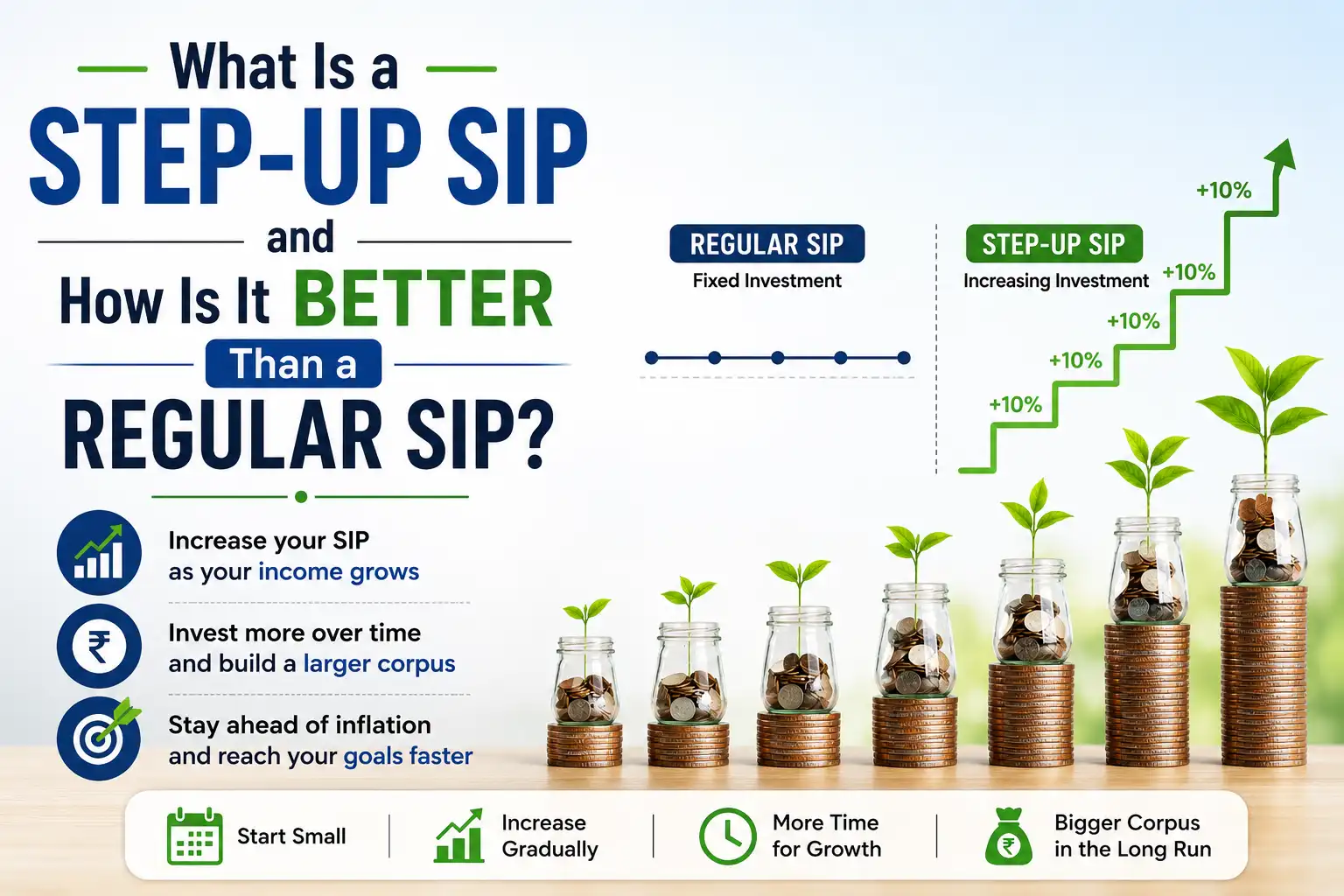
As your salary grows, your ability to save usually increases too. But if your SIP amount stays fixed, your investments may not grow in line with your increasing income. This can limit how much you accumulate over the long term.
A Step-up SIP allows you to increase your SIP investment at predetermined intervals, such as every year. It does not increase your mutual fund’s rate of return; instead, you invest more money over time, giving the additional amount more opportunity to grow.
Compared with a regular SIP, a Step-up SIP helps you invest more as your income increases. This can make it easier to build a larger investment corpus over the long term without making a large increase in your monthly investment all at once.
What Is a Step-up SIP?
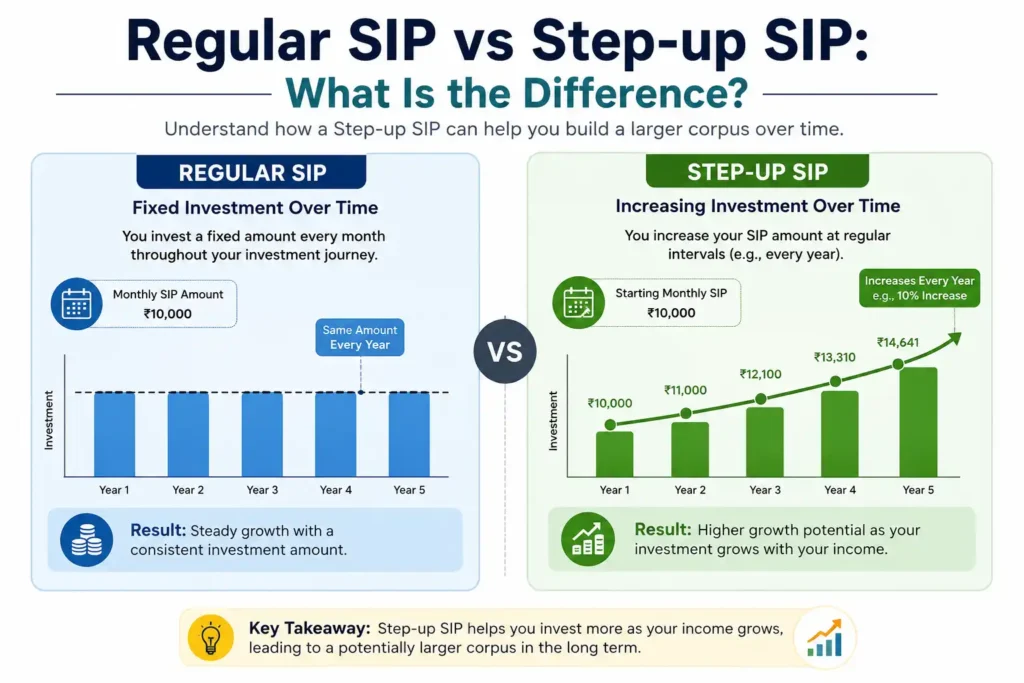
A Step-up SIP, also called a top-up SIP, is a systematic investment plan where your contribution increases periodically by a fixed amount or percentage. For example, if you start with a ₹10,000 monthly SIP and choose a 10% annual step-up, your monthly investment becomes ₹11,000 in the second year, ₹12,100 in the third year, and so on.
A regular SIP generally keeps your contribution unchanged. A Step-up SIP changes the contribution according to a schedule you decide in advance.
Here is how a 10% annual step-up would look:
Year | Monthly SIP |
1 | ₹10,000 |
2 | ₹11,000 |
3 | ₹12,100 |
4 | ₹13,310 |
5 | ₹14,641 |
The increase can also be a fixed rupee amount. For instance, you could start at ₹10,000 and increase the SIP by ₹1,000 every year.
The choice matters because a percentage increase becomes progressively larger, while a fixed increase remains predictable.
Regular SIP vs Step-up SIP: What Is the Difference?
The basic difference is simple: a regular SIP keeps the contribution constant, while a Step-up SIP increases it over time.
Factor | Regular SIP | Step-up SIP |
Starting investment | Fixed | Fixed |
Contribution over time | Usually unchanged | Increases periodically |
Can follow salary growth | Not automatically | Yes |
Future cash-flow commitment | Easier to predict | Gradually increases |
Potential long-term corpus | Lower, if all else is equal | Higher, because more is invested |
Best suited to | Stable investment budgets | Growing income and savings capacity |
There is one point worth keeping clear: Step-up SIP does not make the underlying mutual fund earn a higher CAGR. If the same fund earns the same return, the Step-up SIP can still produce a larger corpus because you are putting more money to work.
More capital invested, not a higher rate of return.
How the Numbers Work: A 15-Year Example
Consider two investors who both start with a ₹10,000 monthly SIP and invest for 15 years. To isolate the effect of increasing contributions, assume both investments earn a 12% annualised return for illustration.
Investor A keeps the SIP fixed at ₹10,000 every month.
Investor B increases the SIP by 10% every year.
Here is the broad comparison:
Regular SIP | 10% Step-up SIP | |
Starting monthly SIP | ₹10,000 | ₹10,000 |
Investment period | 15 years | 15 years |
Annual step-up | None | 10% |
Total amount invested | ₹18.00 lakh | ₹38.13 lakh |
Illustrative value after 15 years | ₹50.46 lakh | ₹85.98 lakh |
Difference in final value | — | ₹35.52 lakh |
Calculation assumes monthly investing and a steady 12% annualised return for illustration. Actual mutual fund returns are market-linked and can be substantially different.
The table reveals something easy to miss when you look only at the final corpus. The Step-up SIP does not create ₹35.52 lakh of additional wealth simply because it is a “better” SIP.
A significant part of the difference comes from the investor putting ₹20.13 lakh more of their own money into the investment over the 15 years. The additional contributions also get time in the market and can potentially earn returns.
That is the real mechanism behind the larger corpus.
Why Can Step-up SIP Be Better for a Growing Income?
A fixed SIP can become less effective as your income grows. For example, if you start with a ₹50,000 salary and invest ₹10,000, keeping the SIP unchanged even after your income rises means your investment no longer matches your ability to save. A Step-up SIP helps bridge this gap.
1. Aligns with salary growth
You can increase your SIP gradually as your income rises, directing a part of each increment towards your long-term goals.
2. Helps control lifestyle inflation
A pre-decided SIP increase ensures that part of your salary increment goes towards investing instead of being fully absorbed by higher spending.
3. Gives additional investments more time to grow
Increasing your SIP earlier means the additional contributions get more time to potentially compound. A contribution made in Year 2 has more time to grow than one made in Year 12.
Percentage Step-up vs Fixed Amount: Which Should You Choose?
Both methods can work. The better choice depends on how predictable your income and future cash flow are.
Method | Example | Advantage | Watch-out |
Percentage step-up | 10% every year | Naturally grows with income | Monthly commitment rises faster |
Fixed amount | ₹1,000 more every year | Easy to budget | May become small relative to future income |
A percentage-based step-up may suit someone expecting regular salary increments. A fixed increase may feel more comfortable if you prefer knowing exactly how much your monthly commitment will rise.
There is no universal “correct” step-up percentage. A 10% increase is not automatically suitable for everyone.
Who Should Consider a Step-up SIP?
A Step-up SIP can make sense if:
- Your income is likely to increase over time.
- You have a long investment horizon.
- Your current SIP is comfortably affordable.
- You want to increase your savings without making a large jump immediately.
- You are investing towards a long-term goal such as retirement or children’s education.
For a young professional, for example, starting with a manageable SIP and increasing it with annual increments may be more practical than trying to commit to a very large SIP on day one.
But there is an important other side.
Who May Be Better Off With a Regular SIP?
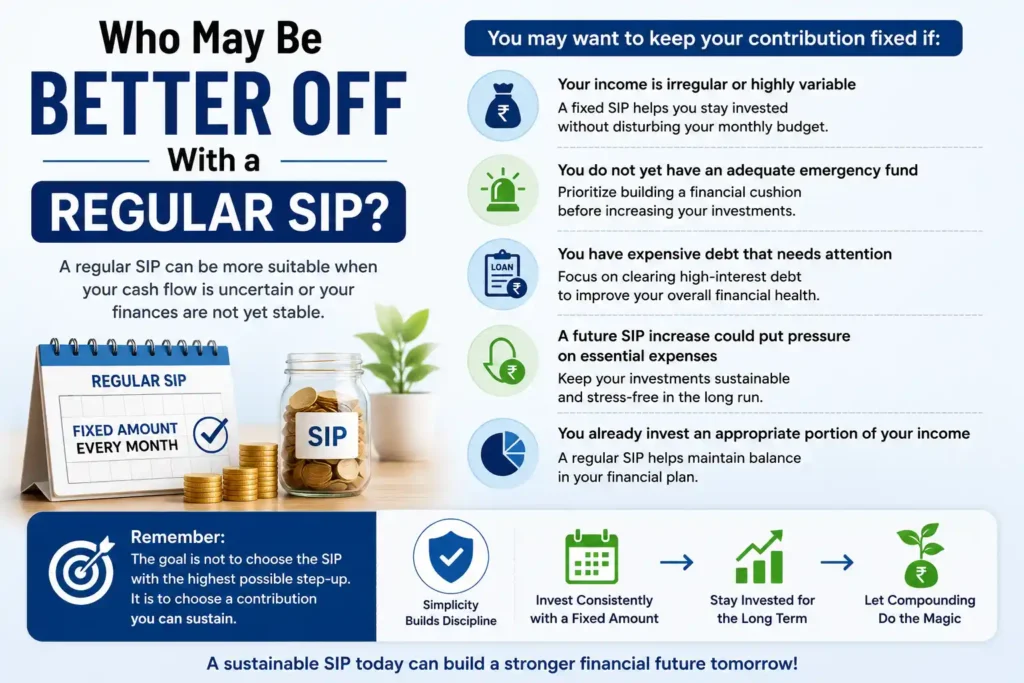
A regular SIP may be more appropriate when your cash flow is uncertain, or your current finances are not yet stable.
You may want to keep the contribution fixed if:
- Your income is irregular or highly variable.
- You do not yet have an adequate emergency fund.
- You have expensive debt that needs attention.
- A future SIP increase could put pressure on essential expenses.
- You already invest an appropriate portion of your income.
For a freelancer whose monthly income changes significantly, for example, an automatic 10% annual increase may not always fit the reality of their cash flow.
The goal is not to choose the SIP with the highest possible step-up. It is to choose a contribution you can sustain.
The 5-Year Affordability Check
Before selecting a step-up, don’t ask only, “Can I afford ₹10,000 today?”
Ask a more useful question: “Can I comfortably afford the SIP I will have several years from now?”
A 10% annual increase turns a ₹10,000 monthly SIP into approximately ₹14,641 by Year 5 and nearly ₹23,579 by Year 10.
That future commitment should fit your expected income and expenses.
You can also create a step-up ceiling. Once your monthly investment reaches the amount you intend to save for your goals, there is no requirement to keep increasing it indefinitely. Your financial plan should be reviewed as your circumstances change.
A Few Mistakes to Avoid
A Step-up SIP works best when it supports your broader financial plan rather than replacing it.
Avoid these common mistakes:
- Choosing an aggressive step-up: A 20% or 30% annual increase may become difficult to maintain.
- Ignoring your emergency fund: Long-term investments should not come at the cost of having no accessible cash reserve.
- Assuming returns are guaranteed: Market-linked investments can rise and fall.
- Increasing investments while carrying costly debt: Your overall financial position matters more than simply increasing the SIP.
- Looking only at the final corpus: Always consider how much money you will actually have to contribute along the way.
So, Is Step-up SIP Better Than a Regular SIP?
It can be, but not for everyone.
A Step-up SIP is particularly useful when your income and savings capacity are expected to grow. It gives you a structured way to increase investments instead of relying on yourself to remember to do it after every appraisal.
A regular SIP, meanwhile, can be the better choice when your budget is fixed, or your future cash flow is uncertain. A sustainable ₹10,000 SIP is preferable to a Step-up SIP that looks impressive on paper but becomes unaffordable later.
Before choosing one, check four things:
- Can you comfortably afford the starting SIP?
- Can you afford the contribution five years from now?
- Do you have an emergency fund and manageable debt?
- Does the investment strategy match your financial goal and time horizon?
A useful way to remember the difference is this:
A regular SIP answers, “How much can you invest today?” A Step-up SIP asks, “How should your investment grow as your ability to save grows?”
The right answer depends on your income, expenses, goals and ability to stay invested through market ups and downs.
Frequently Asked Questions
Can you pause or stop a Step-up SIP?
The exact process depends on the mutual fund platform or SIP arrangement you use. If your financial circumstances change, review the SIP rather than continuing an increase that you can no longer comfortably afford.
Is a 10% annual Step-up SIP too high?
Not necessarily. It may be reasonable for someone whose income is growing steadily, but it should not be treated as a standard recommendation for everyone. Check what the contribution becomes in future years before committing.
Does Step-up SIP give higher returns?
No. The step-up feature itself does not increase the mutual fund’s rate of return. A larger corpus can result because you invest more money over time, and those additional contributions can potentially earn returns.
What if you don't get a salary increment?
Your investment plan should reflect your actual cash flow. If your income does not increase, reassess whether the scheduled step-up remains affordable rather than treating it as something that must continue regardless of circumstances.
Can beginners use Step-up SIP?
Yes, provided the starting amount is affordable, and the future increases are realistic. For a beginner, a modest SIP that can be sustained is generally more useful than an aggressive contribution that becomes difficult to maintain.
Note: The numerical illustration in this article assumes a steady 12% annualised return only to demonstrate how contribution patterns can affect outcomes. Mutual fund returns are not fixed or guaranteed, and actual results will vary with market performance.