You have been investing ₹5,000 every month through SIP for the last 18 months. Now an unexpected expense comes up, and you need ₹30,000.
The first question that comes to mind is simple: Can you take your SIP money out whenever you want?
Yes, in most open-ended mutual funds, you can redeem your accumulated units when you need the money. But “anytime” does not mean there are no conditions. Lock-in periods, exit loads, taxes, applicable NAV and the difference between stopping a SIP and redeeming your investment can all affect what happens.
Before you tap Redeem, check these five things:
- Is your fund subject to a lock-in?
- Does it have an exit load?
- What tax could apply to the gains?
- Which units are being redeemed?
- Do you actually need to withdraw the entire investment?
What You Actually Own When You Invest Through SIP
One common misunderstanding is to think of a SIP as a separate account where your money keeps accumulating.
That is not quite how it works.
SIP is simply a method of investing regularly. Every instalment you pay is used to buy units of the mutual fund you selected. The number of units you receive depends on the fund’s applicable NAV, or Net Asset Value, for that transaction.
Think of it this way:
₹5,000 SIP instalment → buys mutual fund units → units accumulate in your investment account
So when you later withdraw your SIP money, you are not really “breaking” the SIP. You are redeeming some or all of the mutual fund units you already own.
This distinction matters because your SIP and your existing investment are two separate things.
You can stop the monthly SIP while keeping your old units invested. Or you can redeem some units while continuing your monthly SIP.
Can You Withdraw Only Part of Your SIP Money?
Yes. You don’t necessarily have to withdraw your entire investment.
Suppose your mutual fund investment is currently worth ₹1,00,000, but you need only ₹20,000 for an urgent expense. If the scheme permits the redemption, you can request a partial redemption instead of selling everything.
After the redemption, roughly ₹80,000 worth of your investment may remain, subject to the actual NAV, units redeemed, exit load and other applicable factors.
This can be useful when you need temporary access to money but don’t want to completely exit an investment that was meant for a longer-term goal.
You may be able to redeem:
- A specific rupee amount
- A specific number of units
- All eligible units
The minimum redemption amount and other conditions can vary by scheme, so check the fund’s terms before submitting the request.
Stopping Your SIP vs. Withdrawing Your Money
This is where many first-time investors get confused.
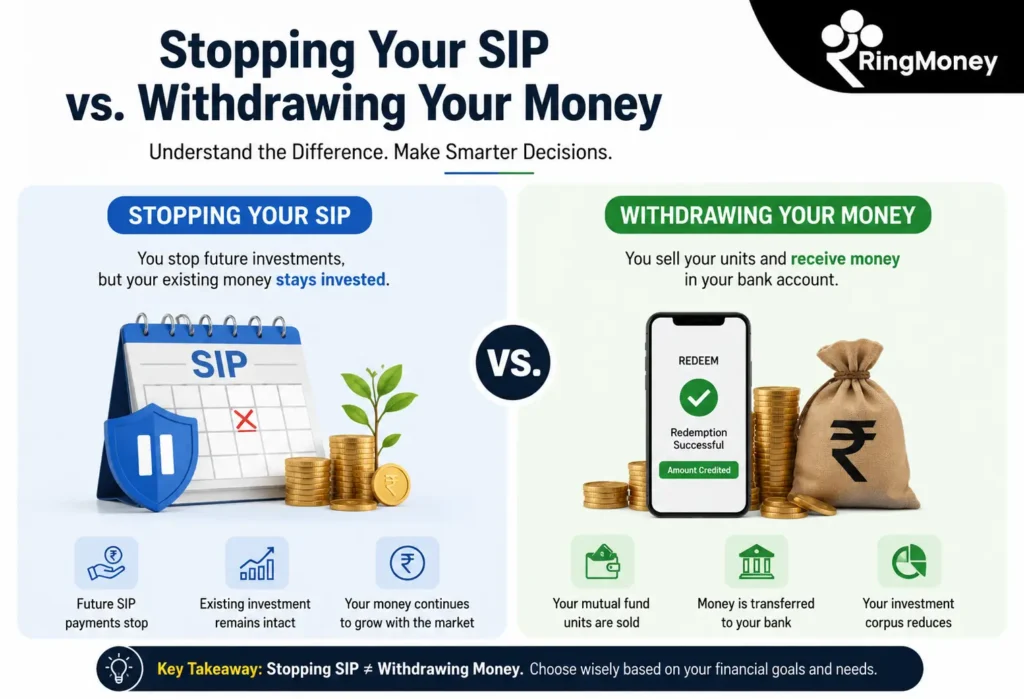
If you press “Stop SIP”, you are generally stopping future instalments. You are not automatically withdrawing the money you have already invested.
For example, imagine you invested ₹5,000 every month and have accumulated ₹1.20 lakh.
If you stop the SIP, the future ₹5,000 deductions stop, but your ₹1.20 lakh remains invested in the mutual fund unless you separately redeem it.
Action | Future SIP payments | Existing investment |
Stop SIP | Stop | Remains invested |
Redeem | Usually continues unless separately stopped | Selected units are sold |
Stop + Redeem | Stop | Selected or all eligible units are sold |
So if you need money today, simply cancelling your SIP won’t put the accumulated money into your bank account.
You need to submit a redemption request.
When Can You Not Withdraw Your SIP Money Immediately?
The answer is “yes” for most open-ended funds, but there are exceptions.
ELSS Has a 3-Year Lock-In
Equity Linked Savings Schemes, or ELSS, have a statutory three-year lock-in. AMFI also confirms that ELSS investments are subject to a three-year lock-in.
The important part for SIP investors is that each instalment has its own lock-in period.
For example:
SIP instalment | Lock-in generally ends |
January 2024 | January 2027 |
February 2024 | February 2027 |
March 2024 | March 2027 |
So if you have been running an ELSS SIP for three years, don’t assume every instalment automatically becomes available on the same date.
Your older units may have completed their lock-in while newer units are still locked.
Some Other Schemes May Have Different Restrictions
Not every mutual fund follows the same redemption structure.
Close-ended schemes and certain schemes with specific maturity or liquidity conditions may not offer the same anytime-redemption facility as a normal open-ended fund.
That’s why checking the scheme information document and redemption conditions is more reliable than assuming every mutual fund works exactly like your current fund.
What Is Exit Load?
Being able to redeem your units does not always mean you can do it without a charge.
Some mutual funds apply an exit load when you redeem units within a specified period. However, not every fund charges one, and the amount varies by scheme.
For example, if you redeem ₹50,000 and the applicable exit load is 1%, the charge would be ₹500, leaving ₹49,500 before any other applicable deductions.
Always check your fund’s exit-load rules before redeeming.
Will You Pay Tax When You Withdraw Your SIP?
Possibly, but there is an important difference:
You are generally taxed on the capital gain, not the entire amount you withdraw.
With SIPs, each instalment is a separate purchase, so the holding period of the redeemed units matters. Mutual funds generally follow the FIFO (First-In, First-Out) rule, meaning your oldest units are considered redeemed first.
Equity-Oriented Mutual Funds
For applicable equity-oriented mutual funds:
- Short-term capital gains: 20% where Section 111A applies
- Long-term capital gains: 12.5% on gains above ₹1.25 lakh under Section 112A
Equity fund units are generally considered long-term after more than 12 months.
The ₹1.25 lakh exemption applies to your aggregate eligible LTCG in a financial year, not separately to each mutual fund.
What About Debt Mutual Funds?
Debt mutual funds can have different tax treatment depending on the fund and when you invested.
Some specified mutual funds acquired on or after 1 April 2023 may have gains taxed as short-term capital gains regardless of the holding period.
So, check the tax rules applicable to your specific fund before redeeming.
What Happens When You Redeem SIP Units?
The process is fairly straightforward, but the amount you receive is not necessarily the exact portfolio value you see on your screen at the moment you press the button.
For a normal mutual fund redemption:
- You submit a redemption request.
- The applicable NAV is determined.
- The required number of units is redeemed.
- Any applicable exit load and tax implications are considered.
- The redemption proceeds are transferred to your registered bank account.
The 3 PM NAV Cut-Off Matters
For most mutual fund schemes other than liquid funds, AMFI states that a valid redemption request received up to 3:00 PM on a business day generally gets that day’s closing NAV. A request received after 3:00 PM generally gets the next business day’s closing NAV.
That does not mean the NAV displayed at 2:59 PM is guaranteed to be your redemption price.
Mutual fund NAVs are calculated at the end of the day. The cut-off determines which day’s NAV is applicable; it does not give you an intraday selling price like a stock exchange transaction.
How Long Does It Take to Get Your Money?
Don’t expect the money to necessarily appear in your bank account immediately after you click “Redeem.”
AMFI states that redemption or repurchase proceeds are generally required to be transferred within three working days from the date of redemption, with certain exceptions and additional timelines for specific situations or schemes.
So if you need money for an expense tomorrow, don’t wait until the last minute to redeem a mutual fund.
Also make sure your registered bank details are correct. A bank-account change or additional verification close to a redemption request can affect the payout timeline.
What If the Market Is Down When You Need to Withdraw?
This is less about the withdrawal process and more about the decision behind it.
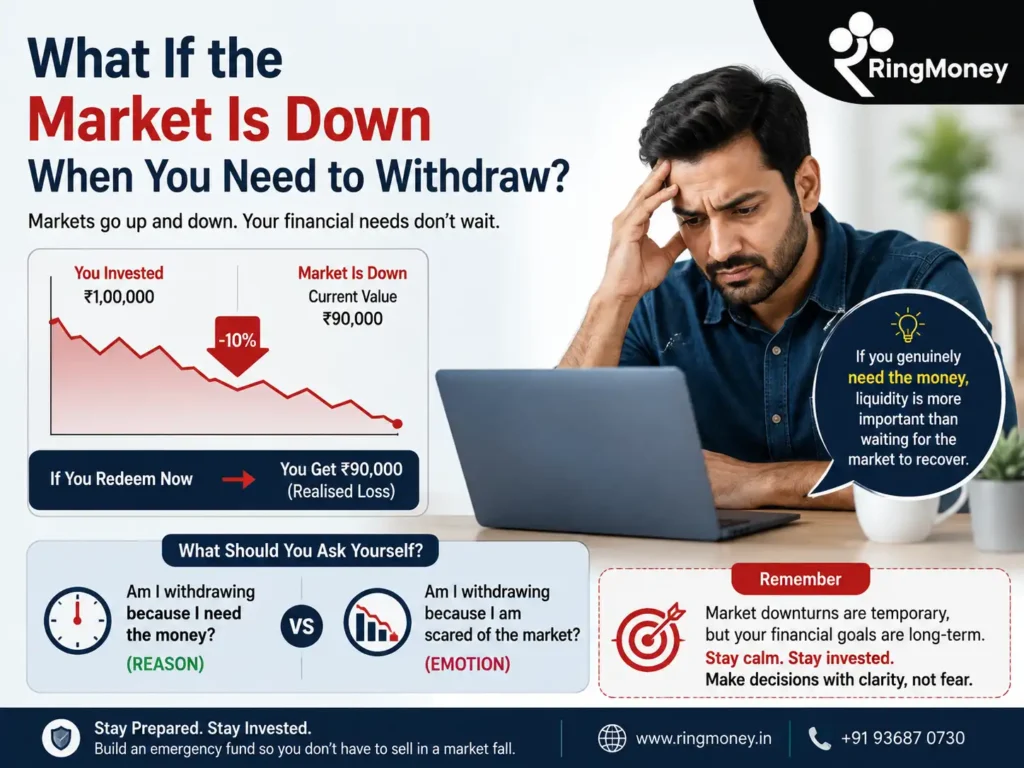
Suppose you invested ₹1 lakh and the current value has fallen to ₹90,000. If you redeem at that point, you are selling those units at the prevailing value and converting that decline into a realised loss.
That doesn’t mean you should never withdraw during a market fall. If you genuinely need the money for an emergency, liquidity can be more important than waiting for the market to recover.
The useful question is:
“Am I withdrawing because I need the money, or because I am scared of the market?”
Those are very different decisions.
A Simple Example: You Need ₹30,000
Let’s say Rahul invests ₹5,000 every month through an equity mutual fund.
After 18 months:
- Total amount invested: ₹90,000
- Current value: ₹1,05,000
- Amount Rahul needs: ₹30,000
Rahul has three choices.
Option 1: Stop the SIP
His future ₹5,000 monthly investments stop, but the ₹1,05,000 remains invested.
Option 2: Partially redeem
He can request a redemption of approximately ₹30,000, subject to the applicable NAV, exit load and tax implications. The remaining units stay invested.
Option 3: Redeem everything
He can exit the investment entirely if the units are eligible for redemption.
The important point is that Rahul does not have to stop investing just because he needs some money now. He can separately decide whether to pause his SIP.
Also, don’t assume that the ₹30,000 withdrawal is simply “₹30,000 of my profit” or “₹30,000 of my original investment.” Redemption happens through units, and the tax treatment depends on the cost and holding period of the units actually redeemed.
4 Things to Check Before You Press “Redeem”
Before taking the money out, spend a minute checking these four things.
- Check for a lock-in
If you’re invested in ELSS, make sure the specific units you want to redeem have completed their three-year lock-in.
- Check the exit load
Look at the scheme’s current exit-load structure. A redemption shortly after purchase may cost you more than you expected.
- Check the tax impact
Look at the capital gain on the units being redeemed and their holding period. Don’t calculate tax simply by applying a percentage to your total withdrawal amount.
- Ask how much you actually need
If you need ₹20,000, don’t automatically redeem ₹2 lakh.
A partial redemption may give you the cash you need while allowing the remaining investment to stay invested.
Can You Withdraw SIP Money Whenever You Want?
For most open-ended mutual funds, yes, you can redeem your units when you need money. Just check for any lock-in, exit load, applicable NAV, and tax implications first.
Remember, stopping your SIP and withdrawing your investment are different. Stopping only ends future instalments, while redeeming sells the units you already own.
Before you press “Redeem,” ask yourself: How much do I actually need, and what will it cost me to withdraw it now?