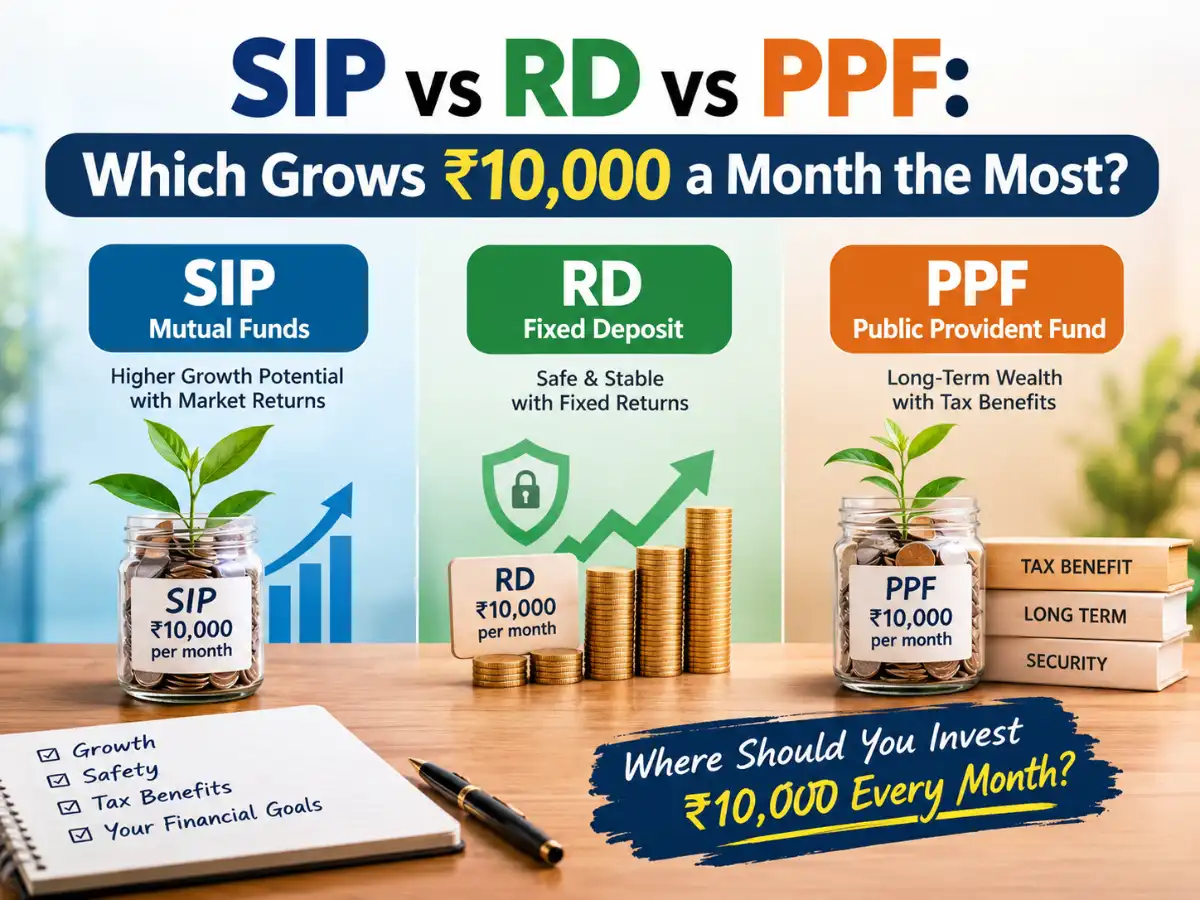
Quick answer: Over 15 years, ₹10,000 a month could grow to about ₹29 lakh in a bank RD (about ₹26 lakh after tax in the 30% slab), ₹31.6 lakh in PPF (fully tax-free) or ₹42–50 lakh in an equity SIP at an assumed 10–12% (about ₹39–46 lakh after tax). The SIP has the highest potential and the most risk. PPF is the best guaranteed option for long horizons. An RD suits goals under 3 years.
These three products are the most common answers to “I can save ₹10,000 a month, where should it go?” They aren’t really competitors. Each one does a different job well.
₹10,000 a month: the numbers
| Duration | Invested | RD at 6.05% | PPF at 7.1% | SIP at 10% | SIP at 12% |
|---|---|---|---|---|---|
| 10 years | ₹12 lakh | ₹16.5 lakh (~₹15.1 lakh after tax*) | ₹17.3 lakh (tax-free, but locked till year 15) | ₹20.7 lakh | ₹23.2 lakh |
| 15 years | ₹18 lakh | ₹29.3 lakh (~₹25.8 lakh after tax*) | ₹31.6 lakh (tax-free) | ₹41.8 lakh (~₹38.9 lakh after tax**) | ₹50.5 lakh (~₹46.4 lakh after tax**) |
Assumes the 30% slab. RD interest is actually taxed every year, which lowers compounding further. ** Assumes the whole SIP is redeemed at once: 12.5% LTCG on gains above ₹1.25 lakh, plus cess. Redeeming over several years lowers the tax. RDs run for up to 10 years, so the 15-year RD figure assumes renewal at the same rate. SIP returns are assumptions, not guarantees. PPF rate is reset quarterly (7.1% for Oct–Dec 2026).
How they compare beyond returns
| Feature | RD | PPF | Equity SIP |
|---|---|---|---|
| Returns | Fixed at booking | Fixed by government each quarter | Market-linked |
| Risk | Very low (deposit insurance up to ₹5 lakh per bank) | Sovereign-backed | High in the short term, lower over 10+ years |
| Lock-in | Tenure you choose (6 months–10 years); penalty to break | 15 years; partial withdrawals from year 7 | None (except ELSS: 3 years) |
| Tax on returns | Interest taxed at slab every year, with TDS | Fully tax-free | 12.5% LTCG above ₹1.25 lakh a year |
| Max per year | No limit | ₹1.5 lakh | No limit |
| Flexibility to skip months | Penalties on missed instalments | Need ₹500 a year minimum | Can pause or stop anytime |
SIP vs RD: which is better?
Lorem ipsum dolor sit amet, consectetur adipiscing elit. Ut elit tellus, luctus nec ullamcorper mattis, pulvinar dapibus leo.
For goals under 3 years, the RD. You know exactly what you’ll have, and a market fall can’t hurt you a month before you need the money.
For goals over 5–7 years, the SIP. RD returns barely keep up with inflation after tax for anyone in the 20–30% slab. Equity SIPs have historically been the main way to beat inflation over long periods. The trade-off is that some years your SIP will show a loss, and you have to keep going anyway (I Started SIP and the Market Crashed).
For 3–5 years, neither is ideal. A hybrid or short-duration debt fund SIP often fits better (equity vs debt vs hybrid).
SIP vs PPF: which is better?
PPF is a strong product. A tax-free 7.1% is worth about 10.3% pre-tax to someone in the 30% slab, with no risk. Its limits are the ₹1.5 lakh yearly cap and the 15-year lock-in.
An equity SIP has no cap and no lock-in, and a higher potential return, but no guarantee.
Our view: they aren’t either-or. PPF makes an excellent debt part of a long-term portfolio. The SIP is the growth part. A common split for a 30-year-old saving ₹10,000 a month: – ₹7,000 in an equity SIP (flexi cap or index fund) – ₹3,000 in PPF
For the tax angle, see ELSS vs PPF vs NPS.
Which should you choose? A simple guide
Your goal | Best fit |
|---|---|
Vacation, gadget or wedding in 1–2 years | RD or liquid fund SIP |
Car or home down payment in 3–5 years | Hybrid or debt fund SIP, or RD |
Child’s education in 10–15 years | Equity SIP + PPF |
Retirement 20+ years away | Equity SIP (step it up yearly) + PPF/EPF |
You can’t stomach any fall at all | RD + PPF |
Frequently Asked Questions
Which is better, SIP or RD?
For goals 5+ years away, an equity SIP has historically produced far higher returns. For goals under 3 years, an RD is safer and more predictable.
Is SIP better than PPF?
SIPs have higher return potential and no lock-in, but no guarantee. PPF is guaranteed and tax-free but capped at ₹1.5 lakh a year and locked for 15 years. Many investors use both.
Is RD interest taxable?
Yes. RD interest is added to your income and taxed at your slab rate every year, and banks deduct TDS above the threshold.
Can I lose money in a SIP?
Yes, especially over short periods. Equity SIPs held for 7–10+ years have historically recovered from falls, but nothing is guaranteed.
What is the minimum for SIP, RD and PPF?
SIPs can start from ₹100–₹500 a month, RDs from ₹100 at many banks, and PPF needs at least ₹500 a year.
Mutual fund investments are subject to market risks. Read all scheme-related documents carefully. RingMoney is an AMFI-registered mutual fund distributor (ARN-320453). RD and PPF rates as of October 2026; SIP figures are illustrative.
Try it: SIP Calculator · Related reading: SIP vs Lumpsum · Best Investment Plans in India · Mutual Fund vs FD