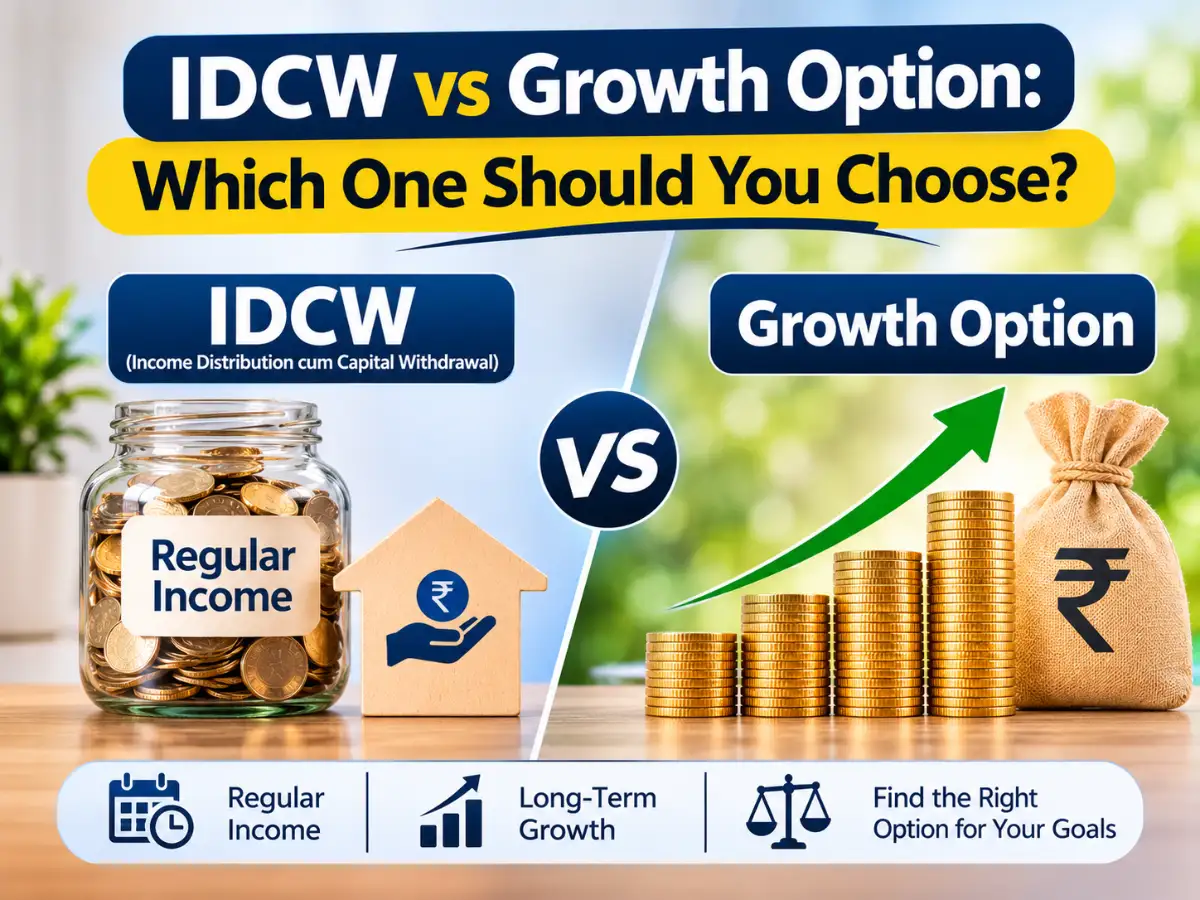
Quick answer: IDCW (Income Distribution cum Capital Withdrawal) is the new name for the old “dividend” option. The fund pays out part of its NAV to you, as cash (payout) or as extra units (reinvestment). In the growth option, nothing is paid out and all gains stay invested. IDCW payouts are taxed at your income tax slab rate every year, with 10% TDS once a fund house pays you more than ₹10,000 in a year. Growth is taxed only when you redeem, at lower capital gains rates. For most people, growth is the better choice, unless you genuinely need a regular payout and you’re in a low tax bracket.
Last updated: 18 November 2026
IDCW full form and meaning
IDCW = Income Distribution cum Capital Withdrawal. SEBI introduced the name in April 2021 to replace “dividend”. The old name made people think they were earning extra income on top of their investment. They weren’t.
The new name says what really happens: part of what’s paid out can be your own capital coming back to you. The NAV falls by exactly the amount paid out.
How IDCW works: a simple example
You hold 1,000 units of a fund in the IDCW option. NAV is ₹50, so your holding is worth ₹50,000.
The fund declares an IDCW of ₹2 per unit.
| Before IDCW | After IDCW | |
|---|---|---|
| NAV | ₹50 | ₹48 |
| Value of your units | ₹50,000 | ₹48,000 |
| Cash paid to you | ₹2,000 | |
| Total | ₹50,000 | ₹50,000 |
You haven’t gained anything. ₹2,000 has simply moved from your investment to your bank account, and now it’s taxable. If you’re in the 30% bracket, about ₹600 (plus cess) goes in tax.
The three options compared
| Growth | IDCW payout | IDCW reinvestment | |
|---|---|---|---|
| What happens to gains | Stay invested and compound | Part paid to your bank account | Part used to buy more units |
| NAV over time | Keeps rising with the fund | Falls by each payout | Falls by each payout, but you hold more units |
| Tax | Only when you redeem (capital gains) | Slab rate on every payout | Slab rate on every reinvested amount, even though you got no cash |
| TDS | None for residents | 10% if over ₹10,000 a year from that fund house | Same as payout |
| Payout amount and timing | N/A | Decided by the fund, not guaranteed | Decided by the fund |
| Suits | Almost all long-term investors | Low-tax-bracket investors wanting occasional cash | Rarely the best choice now |
Why growth usually wins: the tax gap
Here’s ₹10 lakh invested for 10 years in a fund returning 12% a year. In the IDCW reinvestment option, the fund distributes 5% a year, taxed at 30%.
| Growth | IDCW reinvestment | |
|---|---|---|
| Value after 10 years (before redemption tax) | ₹31.1 lakh | ₹27.1 lakh |
| Tax paid along the way | ₹0 | Every year, on each distribution |
| Tax if you redeem everything in year 10 | About ₹2.5 lakh (12.5% LTCG on gains above ₹1.25 lakh) | Some capital gains tax still due |
| Roughly what you keep | About ₹28.6 lakh | Less than ₹27.1 lakh |
Illustrative. Assumes a constant 12% return, 5% annual distribution and 30% slab, excluding cess. Actual distributions vary and aren’t guaranteed.
Growth comes out ahead because:
- The tax is deferred. Money that would have gone in tax stays invested and compounds.
- The tax rate is lower. Long-term equity gains are taxed at 12.5% above ₹1.25 lakh a year, compared with up to 30% (plus surcharge and cess) on IDCW.
- You choose the timing. You decide when to redeem, so you can spread gains across years.
TDS on IDCW (Section 194K)
- From 1 April 2025, a fund house deducts 10% TDS only if your IDCW from it exceeds ₹10,000 in a financial year. Before that, the limit was ₹5,000.
- Without a valid PAN, TDS is 20%.
- TDS isn’t your final tax. The IDCW is added to your income and taxed at your slab. Claim the TDS when you file your return.
- If your total income is below the taxable limit, you can submit Form 15G (or 15H for senior citizens) to the fund house to avoid TDS.
When IDCW payout can make sense
- You’re in the 0–5% tax bracket, for example a retiree with little other income, and you want occasional cash without placing redemption requests.
- You’re investing in a fund whose purpose is regular distributions, and the predictability matters to you more than tax efficiency.
Even then, a Systematic Withdrawal Plan (SWP) from the growth option is usually better. You choose the amount and the date, and you’re taxed only on the gain portion of each withdrawal, at capital gains rates. See What Is a Systematic Withdrawal Plan? and Best SWP Mutual Funds.
Should you switch from IDCW to growth?
Probably, if you’re in a higher tax bracket. But a switch from IDCW to growth counts as a redemption:
- Capital gains tax applies on the units you switch.
- Exit load may apply if the units are recent.
A practical approach:
- Stop new money going into IDCW. Point future SIPs at the growth option of the same fund.
- Switch older units in stages, keeping long-term gains within the ₹1.25 lakh exemption each financial year where possible.
- Leave very recent units until they’re past the exit load period and 12 months old.
How to check which option you hold
Look at the scheme name on your CAS or app. It will say “Growth” or “IDCW” (sometimes “IDCW Payout”, “IDCW Reinvestment” or “Payout of Income Distribution cum Capital Withdrawal”). See How to Check All Your Mutual Funds by PAN.
FAQs
What does IDCW mean in mutual funds?
Income Distribution cum Capital Withdrawal, the option formerly called “dividend”. The fund pays out part of its NAV, which can include your own capital.
Is IDCW better than growth?
For most investors, no. Growth defers tax and is usually taxed at lower rates. IDCW payout can suit low-tax-bracket investors who want occasional cash.
Is IDCW income guaranteed?
No. The fund decides whether and how much to distribute, depending on the surplus available. It can skip distributions entirely.
How is IDCW taxed?
It’s added to your income and taxed at your slab rate. A fund house deducts 10% TDS if it pays you more than ₹10,000 in a financial year.
What is IDCW reinvestment?
The distribution is used to buy more units of the same fund instead of being paid to you. It’s still taxed as income in the year it’s distributed.
Does the NAV fall after IDCW?
Yes, by the amount distributed per unit. That’s why IDCW doesn’t make you richer. It just moves money out of the fund.
Mutual fund investments are subject to market risks. Read all scheme-related documents carefully. RingMoney is an AMFI-registered mutual fund distributor (ARN-320453). Tax rules are as per current law and may change. Examples are illustrative. This isn’t tax advice.
Related reading: Dividend Reinvestment vs Growth Option · Mutual Fund Taxation in India · LTCG on Mutual Funds · Mutual Fund Terms (Glossary)