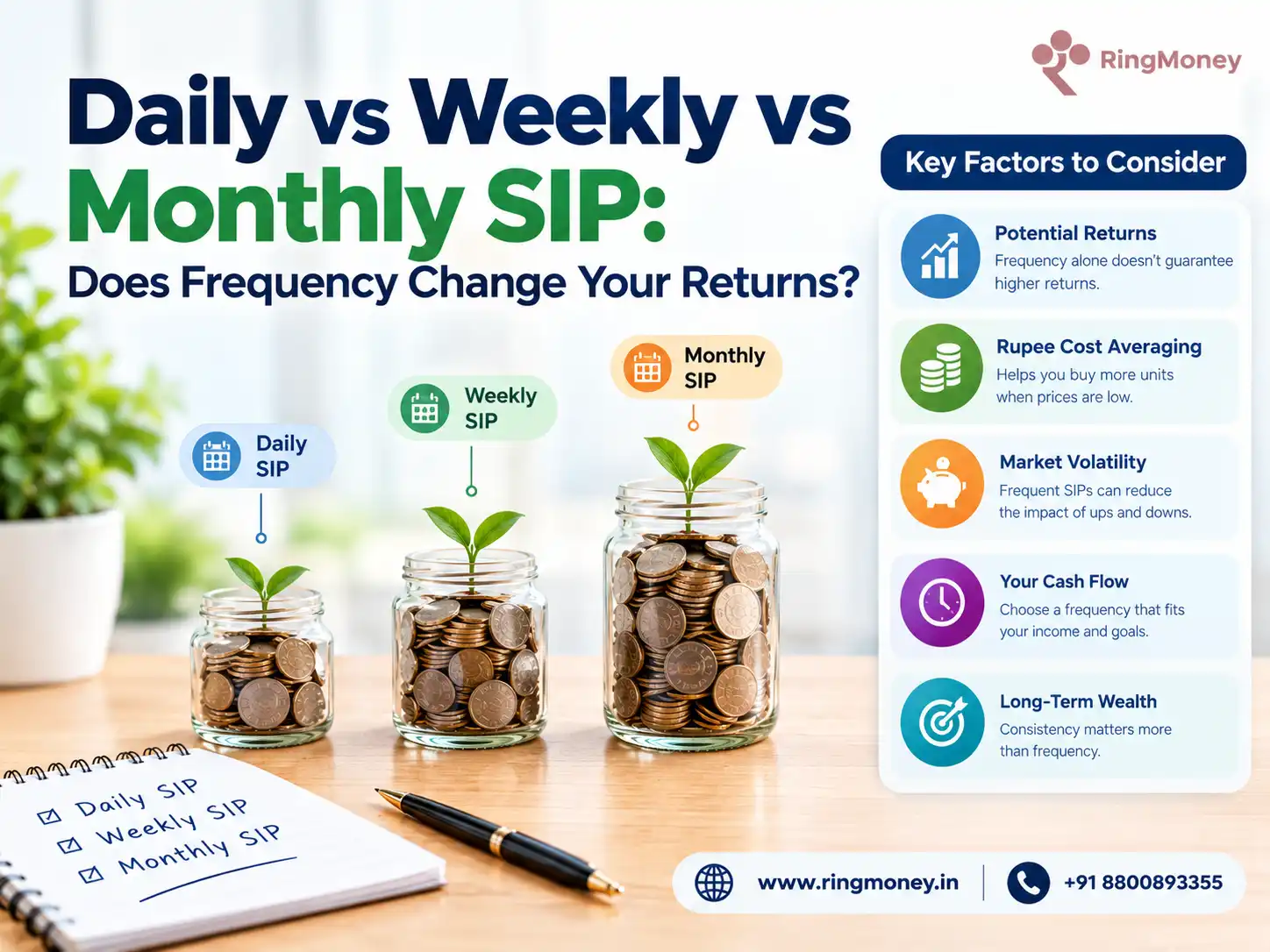
Quick answer: Barely. A 15-year back-test on the Nifty 50 Total Return Index found daily SIPs returned about 12.18% XIRR, weekly 12.14% and monthly 12.09%, a gap of under 0.1 percentage point a year. Monthly SIPs aligned to your salary date are simpler, cause fewer bank debits and failed mandates, and are easier to stick with. Sticking with it is what drives returns.
Every few months, a “daily SIP gives better returns” post goes viral. The maths behind it isn’t wrong. It just describes such a small effect that one missed SIP undoes years of it.
What the numbers say
A 2026 analysis by MyAT Finance back-tested the three frequencies on the Nifty 50 TRI over 15 years:
SIP frequency | XIRR (15-year back-test) |
|---|---|
Daily | 12.18% |
Weekly | 12.14% |
Monthly | 12.09% |
On ₹15,000 a month for 20 years, that worked out to a difference of roughly ₹57,000 on a corpus of about ₹1.5 crore, under 0.4%.
Why so small? Rupee-cost averaging works because you buy across many different prices. A monthly SIP already buys at 240 different prices over 20 years. Going to 5,000 daily purchases adds very little new information.
Lorem ipsum dolor sit amet, consectetur adipiscing elit. Ut elit tellus, luctus nec ullamcorper mattis, pulvinar dapibus leo.
The hidden costs of daily SIPs
- More bank debits. About 20 a month. Each is a chance for a bounce if your balance dips, and failed mandates can attract bank charges.
- Messier tax records. Every instalment is a separate purchase lot with its own holding period. Your capital gains statement gets very long.
- Harder to track. It’s tough to see at a glance what you’ve invested this month.
- Not every fund or platform supports it, and some have higher minimums for daily SIPs.
Does the SIP date matter?
Not much either. Over 10–20 years, the date in the month washes out: some months the 5th is cheaper, some months the 25th is. Any single date gets a mix of good and bad prices, so the difference over a long SIP is too small to plan around.
What does matter:
Choose a date 2–5 days after your salary lands. The money is there, so the SIP doesn’t bounce, and it goes before you spend it.
That’s the whole strategy.
What actually changes your SIP returns
If you want to improve your outcome, these matter hundreds of times more than frequency:
Lever | Typical impact |
|---|---|
Not stopping in a crash | Units bought when markets are down 20–30% often do the heaviest lifting later (I Started SIP and the Market Crashed) |
A 10% annual step-up | A ₹5,000 SIP grows to roughly ₹99 lakh vs ₹50 lakh in 20 years at 12% (₹5,000 SIP table) |
Starting 5 years earlier | Often the single biggest factor in final corpus size |
Lower costs | 0.5–1% a year compounds to lakhs over 20 years |
Right fund for the goal | Equity for 7+ years, hybrid or debt for shorter goals |
SIP frequency | About 0.1% a year |
When a weekly or daily SIP can make sense
- Irregular earners (freelancers, shop owners, gig workers) who get paid weekly or daily. Matching the SIP to cash flow helps them stay consistent. See Investing on a Salary That Comes Irregularly.
- Deploying a lump sum gradually. Moving ₹5 lakh from a liquid fund into equity over 6 months via a weekly STP spreads the entry.
For a regular salaried investor, monthly wins on simplicity.
Lorem ipsum dolor sit amet, consectetur adipiscing elit. Ut elit tellus, luctus nec ullamcorper mattis, pulvinar dapibus leo.
Frequently Asked Questions
Is daily SIP better than monthly SIP?
Back-tests show daily SIPs return only marginally more (about 0.1% a year). Monthly SIPs are simpler and less likely to fail, so most investors are better off with monthly.
Which date is best for SIP?
A few days after your salary is credited. Long-term studies show the calendar date makes almost no difference to returns.
Can I change my SIP frequency later?
Usually you cancel the existing SIP and register a new one with the new frequency. Your existing units stay invested.
Does weekly SIP reduce risk?
Slightly smoother averaging, but the risk reduction is negligible over long periods. Fund choice and time horizon matter far more.
What if my SIP fails one month?
Most funds simply skip that instalment. Repeated failures (often 3 in a row) can cancel the SIP. See What Happens If You Miss Your SIP for 3 Months.