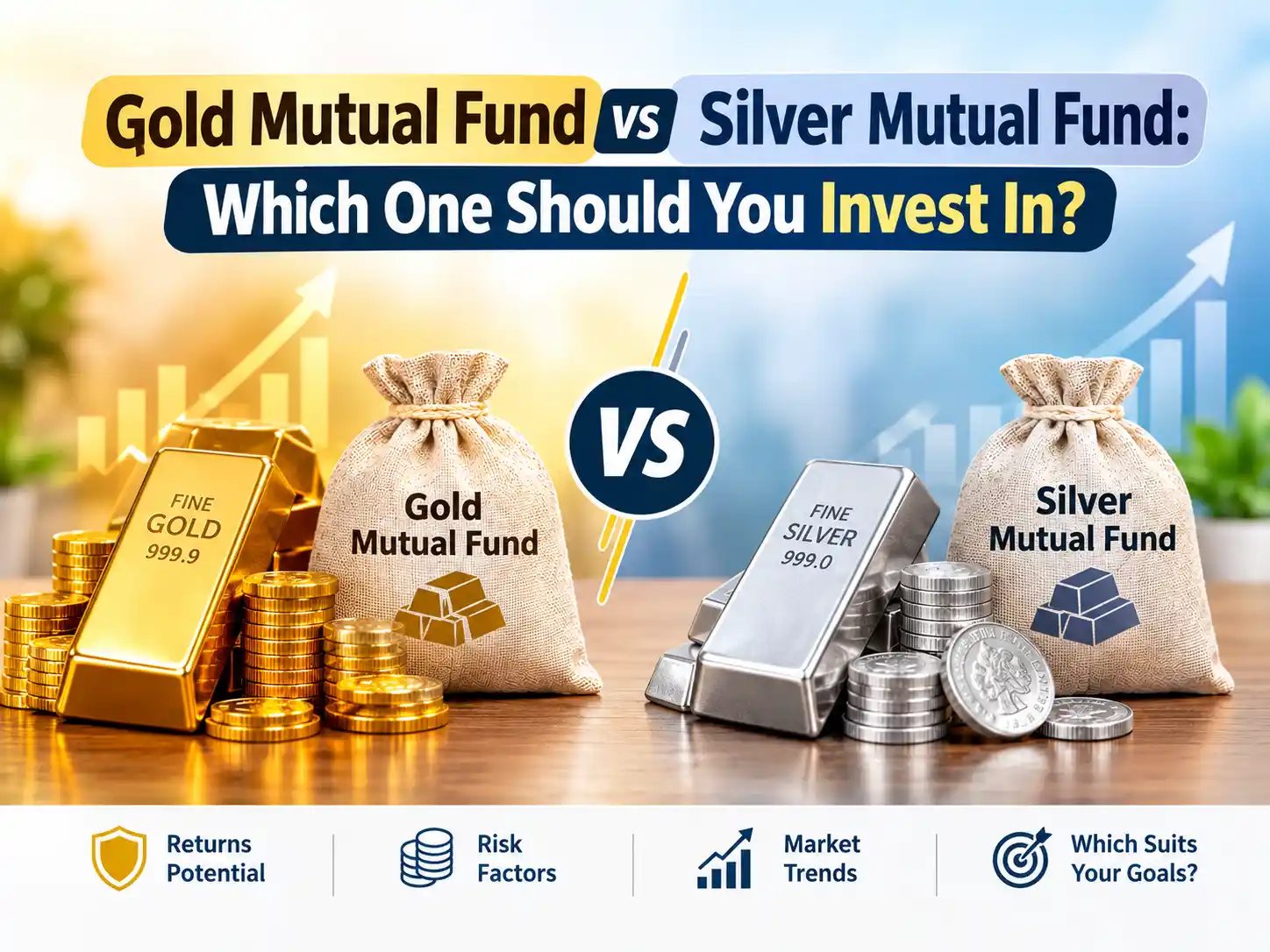
If you are choosing between a gold mutual fund and a silver mutual fund, gold is generally the better choice if you want relatively stable precious-metal exposure, while silver may suit you if you can handle higher volatility and want exposure to industrial demand.
Gold and silver may look similar because both are precious metals, but their price drivers are quite different. Gold has a stronger monetary, investment and safe-haven role, while silver has a much larger connection with industrial activity. That difference can affect how much volatility you experience, how each metal behaves during economic stress, and which one makes more sense for you.
Gold Mutual Fund vs Silver Mutual Fund: Quick Comparison
Factor | Gold Mutual Fund | Silver Mutual Fund |
Primary role | Diversification and defensive exposure | Diversification with greater cyclical exposure |
Major demand drivers | Investment, jewellery, central banks and technology | Industrial applications, investment, jewellery and silverware |
Volatility | Generally lower than silver | Generally higher |
Economic sensitivity | Relatively lower | Higher because of industrial demand |
During market stress | Can benefit from safe-haven demand | Can also rise, but may be hurt by weaker industrial expectations |
Suitable for | Investors seeking relatively steadier precious-metal exposure | Investors comfortable with larger price swings |
Key consideration | Gold-price movement and fund tracking | Silver-price movement, industrial cycle and higher volatility |
What Are Gold and Silver Mutual Funds?
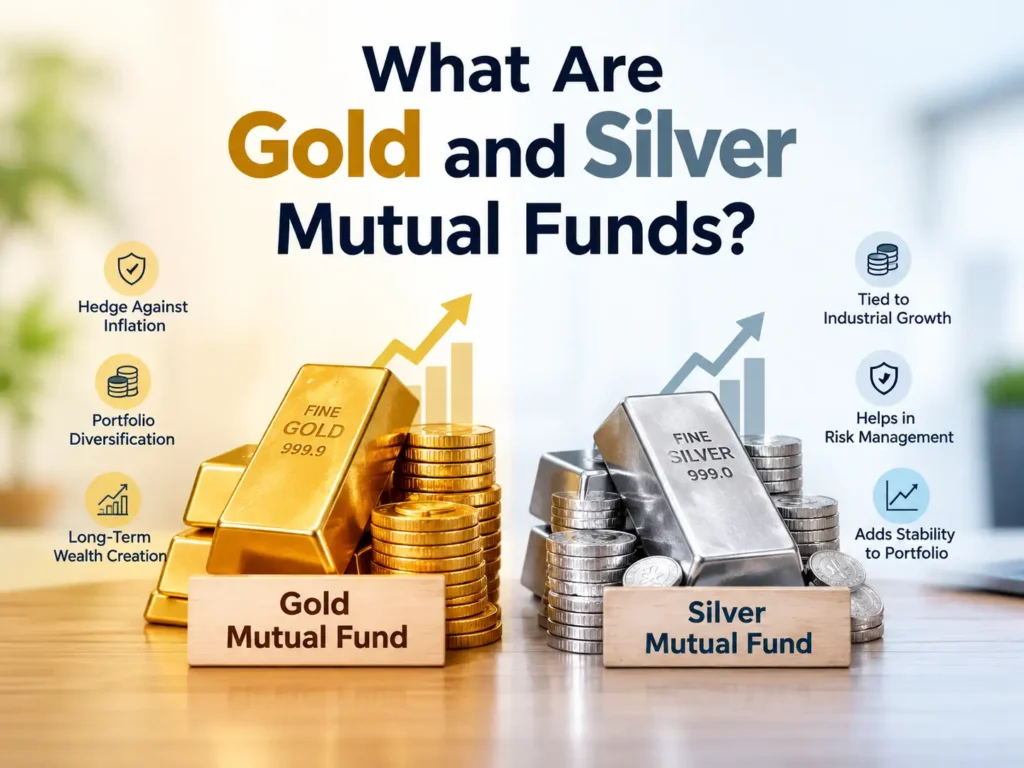
A gold or silver mutual fund in India is typically a Fund of Funds (FoF) that invests in an underlying Gold ETF or Silver ETF. This gives you exposure to the metal without buying or storing physical bars and coins.
In simple terms:
- Gold Mutual Fund: Invests in a Gold ETF that generally holds physical gold.
- Silver Mutual Fund: Invests in a Silver ETF that generally holds physical silver.
- You invest through: A regular mutual fund route, without handling the metal.
For example, a Silver ETF FoF can invest in a Silver ETF holding physical silver. SEBI scheme documents specify 99.9% purity for the underlying silver.
How Does a Gold Mutual Fund Work?
A Gold ETF generally holds physical gold, with SEBI investor material specifying 99.5% purity for gold bullion.
The FoF route is convenient if you want to invest through a regular mutual fund platform instead of trading ETFs. You also avoid storage and locker-related hassles.
What About the Costs?
Your fund’s return may not exactly match the movement in the metal’s market price.
Look beyond the expense ratio and check:
- Tracking difference: How closely the fund follows the metal or ETF.
- Fund expenses: Costs deducted from the scheme.
- Underlying ETF costs: Expenses within the ETF held by the FoF.
- Liquidity and spreads: Mainly relevant when investing directly in an ETF.
So, don’t choose a fund only because it has a lower expense ratio. Tracking differences and other costs can also affect your actual returns.
Why Do Gold and Silver Prices Move Differently?
The simplest way to understand the difference is to look at what people and businesses actually demand each metal for.
Gold Has a Stronger Monetary Role
Gold demand comes from investment, jewellery, central banks and technology. Investment demand often strengthens when investors are concerned about inflation, currencies, geopolitical risks or financial-market uncertainty.
The World Gold Council reported that central banks added 863 tonnes of gold in 2025, while global investment demand reached 2,175 tonnes. This doesn’t mean gold always rises when markets fall, but its diverse demand base gives it a stronger defensive role.
Silver Has a Stronger Industrial Connection
Silver is widely used in electronics, solar technology, automotive applications and power infrastructure. This makes its price more closely linked to industrial activity than gold.
According to the Silver Institute, industrial silver demand reached 657.4 million ounces in 2025. So, silver can benefit from strong manufacturing and technology demand, but a weaker economic cycle can also put pressure on its price.
That is why silver isn’t simply “cheaper gold” — the two metals respond to different economic forces.
How Do Gold and Silver Behave in Different Market Conditions?
You should not expect the two metals to move in opposite directions every time. They can rise together, fall together or diverge sharply depending on what is driving the market.
During geopolitical stress: Gold may attract stronger safe-haven and reserve-diversification demand. Silver can also benefit from precious-metal investment demand, but its industrial component can complicate the picture.
During a manufacturing expansion: Silver can have more upside sensitivity because stronger industrial activity can increase demand for the metal.
During an industrial slowdown: Silver can come under pressure if investors start expecting weaker manufacturing, electronics or construction activity.
During inflation or currency weakness: Both metals can attract investor interest, but their actual returns depend on interest rates, currency movements, valuations and supply-demand conditions.
The Indian angle matters too. Your return is affected not only by the international metal price but also by the rupee. The World Gold Council noted that rupee depreciation amplified India’s domestic gold-price gains during recent periods.
Is Silver Mutual Fund Riskier Than Gold Mutual Fund?
Generally, yes. Silver is more volatile than gold, and you should be prepared for larger ups and downs.
The reason isn’t simply that silver is a smaller market. Its price is influenced by both investment sentiment and industrial demand. That means a change in economic expectations can affect it from two directions.
Gold can also fall substantially, so you should never treat a gold fund as a capital-protection product. But if you are uncomfortable watching a commodity allocation experience sharp corrections, silver may test your patience much more quickly.
The important distinction is therefore not safe versus risky. It is relatively defensive exposure versus higher-cyclical exposure.
Gold Mutual Fund vs Silver Mutual Fund: What About SIP?
A monthly SIP can make investing more disciplined, but it does not make either metal safe.
When you invest a fixed amount every month, you buy more units when prices are lower and fewer units when prices are higher. This can reduce the risk of putting your entire investment in at one unfortunate price point.
But there is a catch.
If silver enters a prolonged weak cycle, your SIP does not prevent your portfolio from losing value. Rupee-cost averaging manages entry timing; it does not remove investment risk.
For that reason, don’t start a silver SIP simply because its recent returns look impressive. First decide whether you can stay invested through a sharp correction.
Tax on Gold and Silver Mutual Funds in India
Tax treatment differs between Gold/Silver Mutual Funds (FoFs) and listed Gold/Silver ETFs, so you should check the product structure before investing.
For Gold and Silver Mutual Fund FoFs, units generally become long-term after more than 24 months. Long-term capital gains are generally taxed at 12.5% without indexation, while gains on units held for 24 months or less are generally taxed at your applicable income-tax slab rate.
Listed Gold and Silver ETFs follow a different holding-period rule: they generally qualify as long-term investments after more than 12 months.
Investment | Long-term holding period | LTCG tax* |
Gold/Silver Mutual Fund (FoF) | >24 months | 12.5% |
Listed Gold/Silver ETF | >12 months | 12.5% |
*Tax rules and product classification can change. Check the latest Income Tax Department provisions and scheme documents before investing or redeeming.
Which Fund Should You Choose?
There is no universal winner. overall portfolio want the investment to perform.
A Gold Mutual Fund may suit you if:
- You want relatively steadier precious-metal exposure. Gold generally has lower volatility than silver.
- You already have a large equity allocation. Gold can add an asset whose demand drivers are different from corporate earnings.
- You want monetary and safe-haven exposure. Gold has a stronger role in central-bank reserves and investment portfolios.
- Large price swings make you uncomfortable. You still face losses, but silver is generally the more volatile choice.
A Silver Mutual Fund may suit you if:
- You can tolerate higher volatility. You need to be comfortable with sharper rallies as well as corrections.
- You want industrial exposure. Silver gives you exposure to themes such as electronics, automotive applications, power infrastructure and other technology-related uses.
- You have a longer investment horizon. A longer horizon can make it easier to stay invested through commodity cycles.
- You already have defensive assets elsewhere. Silver can add a more cyclical element to your precious-metal allocation.
Can You Invest in Both Gold and Silver?
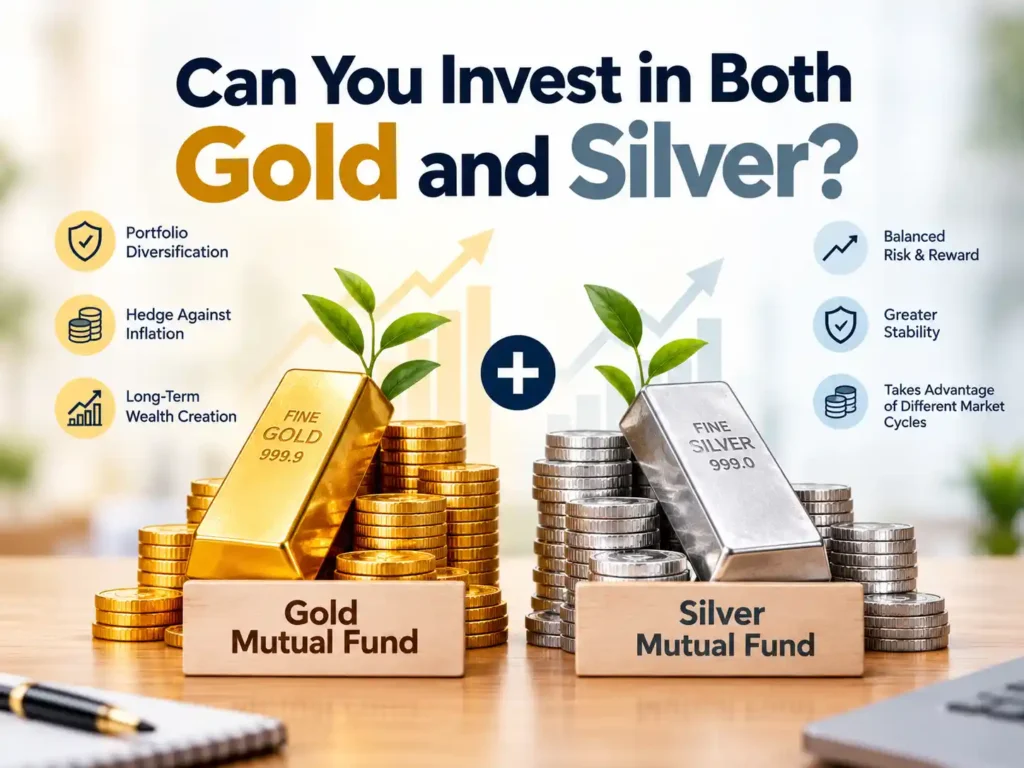
Yes, but don’t treat them as two completely separate asset classes when deciding how much exposure you want.
If you already hold gold and then add silver, you are increasing your overall exposure to precious metals and commodities. That may be reasonable, but it should be considered alongside your equity, debt, cash and other investments.
A simple way to think about it is:
Gold = the relatively defensive part of your precious-metal allocation.
Silver = the more cyclical, industrially sensitive part.
Rather than blindly following a fixed 70:30 or 80:20 formula, first decide how much of your overall portfolio you actually want in precious metals. The right allocation depends on your goals, risk tolerance and existing investments.
Mistakes to Avoid Before Investing
Don’t buy silver because it looks cheaper than gold. A lower price per gram doesn’t make one metal cheaper in investment terms. Silver has its own supply-demand cycle.
Don’t chase whichever metal performed better recently. Commodity leadership can change quickly, and buying after a sharp rally can leave you exposed to a painful correction.
Don’t compare only expense ratios. Look at tracking difference, fund structure, underlying ETF and liquidity as well.
Don’t assume SIP removes risk. It can smooth your purchase price, but it cannot protect you from a prolonged decline.
Don’t make precious metals your entire portfolio. Gold and silver do not replace your core investments simply because they are tangible or familiar.
The Bottom Line
If you want precious-metal exposure with a relatively more defensive character, gold is usually the simpler starting point. If you are comfortable with greater volatility and want exposure to both precious-metal demand and industrial activity, silver can play a different role.
The better question isn’t “Will gold or silver give me higher returns?” Ask yourself why you are buying it, how much volatility you can tolerate, and what the investment adds to the portfolio you already own. That approach is far more useful than trying to predict which metal will be the next big winner.
Disclaimer: Mutual fund investments are subject to market risks. This article is for educational purposes and should not be treated as personalised investment, tax or financial advice. Tax rules and fund structures can change, so verify the latest scheme documents and applicable tax provisions before investing.