
Two people investing the same amount in the same mutual fund can still earn different returns because mutual fund performance is influenced by much more than just the fund itself. Factors like Direct vs Regular plans, investment timing, SIP dates, expense ratios, taxes, holding periods, and investor behaviour all affect the final wealth created over time.
Even small differences — such as paying 1% higher annual charges, investing during different market levels, or stopping SIPs during a market crash — can gradually create a massive gap in long-term returns. That is why two investors following what appears to be the same strategy often end up with very different portfolio values after a few years.
Most investors focus heavily on selecting the “best” mutual fund, but long-term investing success is usually driven by consistency, lower costs, disciplined investing, and allowing compounding to work without interruption. Understanding these hidden factors is what separates average investing outcomes from stronger long-term wealth creation.
The Fund Return and Your Actual Return Are Not the Same
A mutual fund may officially report a 12% annual return, but that does not automatically mean every investor earned exactly 12%. The published return simply reflects how the fund performed internally. What an investor actually earns depends on how and when they interact with that fund.
Several factors influence the outcome:
- The type of plan selected
- The timing of investments
- SIP execution dates
- Whether profits were reinvested
- Early withdrawals or exits
- Taxes and expense ratios
- Emotional decisions during market volatility
This is why two portfolios in the same mutual fund can slowly drift apart even when they started from the same point.
Direct Plans vs Regular Plans Create a Major Difference
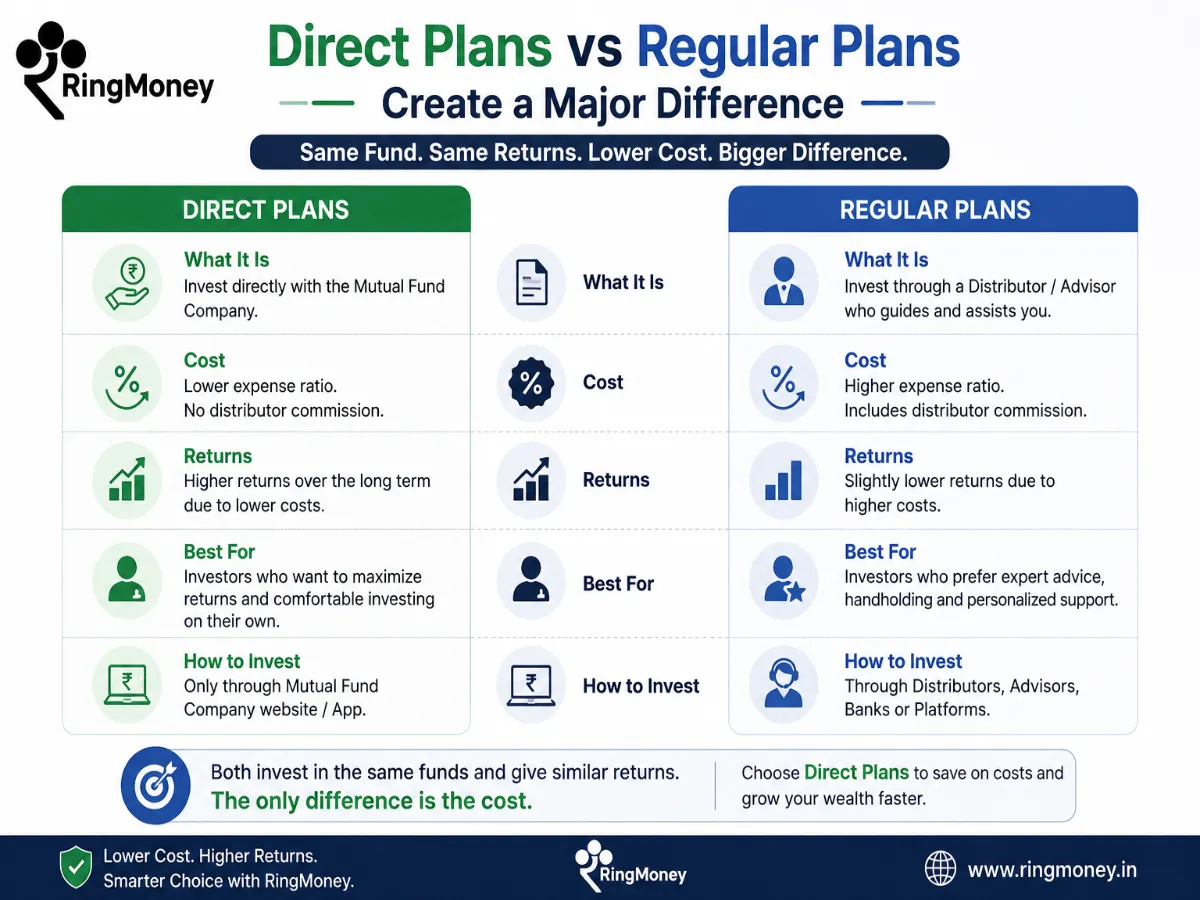
One of the biggest reasons behind unequal returns is the difference between Direct Plans and Regular Plans. Most investors underestimate how much this single factor affects long-term wealth.
Every mutual fund generally offers two versions of the same scheme:
Plan Type | How It Works | Expense Ratio | Long-Term Impact |
Direct Plan | Investment made directly with the AMC | Lower | Higher net returns |
Regular Plan | Investment routed through distributors or agents | Higher | Lower net returns |
The portfolio holdings remain the same in both plans. The fund manager is the same. The strategy is the same. The only major difference is cost.
Regular plans include distributor commissions inside the expense ratio. This commission is deducted silently every year from the investor’s money. Investors usually never notice it because the deduction happens internally before returns are reflected in the NAV.
At first glance, a 1% higher expense ratio may not seem meaningful. But compounding changes everything.
How Small Costs Become Big Losses
Suppose two investors each invest ₹20,000 every month for 20 years in the same fund.
- Investor A uses a Direct Plan, earning an effective 12% annual return.
- Investor B invests through a Regular Plan and effectively earns 11% after higher costs.
The final difference can easily exceed ₹20 lakh over the long term.
Nothing went wrong with the market. One investor simply experienced less friction.
This is exactly why modern investing platforms are becoming increasingly important. Platforms like RingMoney help investors access commission-free Direct Plans, ensuring more of their money stays invested instead of being lost to recurring intermediary costs.
Timing Changes the Number of Units You Accumulate
Another major reason investors earn different returns is timing. Even if two people invest the same amount, they may buy mutual fund units at completely different prices.
SIP Investing using NAVs, or Net Asset Values. This is essentially the price of one unit of the mutual fund.
When markets fall, NAVs decline. Lower NAVs allow investors to buy more units for the same amount of money. When markets rise later, those additional units create stronger long-term gains.
Consider a simple example:
Investor | Investment Amount | NAV at Purchase | Units Received |
Investor A | ₹10,000 | ₹100 | 100 units |
Investor B | ₹10,000 | ₹80 | 125 units |
Both investors invested the same amount in the same fund. However, Investor B purchased during a market correction and accumulated 25 extra units.
Years later, if the NAV rises to ₹200:
- Investor A’s portfolio value becomes ₹20,000
- Investor B’s portfolio value becomes ₹25,000
That entire difference came from timing and unit accumulation.
This is one of the most important concepts in mutual fund investing. Long-term wealth is not only about how much money you invest. It is also about how many units your money accumulates over time.
Even SIP Dates Can Influence Returns
Many investors assume SIP returns remain identical because investments happen automatically every month. In reality, even a small change in SIP date can create noticeable long-term differences.
For example, one investor may have an SIP on the 5th of every month, while another investor’s SIP executes on the 25th. Between those dates, markets may rise sharply or fall significantly due to economic announcements, global events, earnings seasons, or market corrections.
Over time, these small NAV differences influence the average cost at which investors accumulate units. One investor may consistently buy units slightly cheaper than the other.
The difference may appear insignificant in a single month. Across 15–20 years, however, it compounds into a meaningful return gap.
Lump Sum Investing and SIP Investing Behave Differently
Two investors may eventually invest the same total amount into a mutual fund, yet generate completely different outcomes because of the way the money entered the market.
Lump Sum Investing
A lump sum investment deploys the entire amount at once. If markets rise immediately afterwards, returns can be excellent. However, if markets decline soon after investment, recovery may take time.
SIP Investing
SIPs spread investments across multiple market cycles. This strategy helps investors average their purchase cost over time and reduce timing risk.
During market corrections, SIP investors accumulate more units because NAVs become cheaper. When markets eventually recover, those accumulated units can significantly boost long-term returns.
Neither method is universally superior. Outcomes depend heavily on market conditions, investment horizon, and investor discipline.
Investor Behaviour Has a Bigger Impact Than Most People Realise
The biggest difference between successful and unsuccessful investors is often not fund selection. It is behaviour.
Markets move through cycles of fear, optimism, panic, and recovery. During market declines, some investors continue their SIPs calmly while others stop investing or redeem their money completely.
This creates a massive divergence in long-term wealth creation.
The Impact of Panic Selling
Imagine two investors during a sharp market correction:
- Investor A continues monthly SIPs despite volatility.
- Investor B stops SIPs and exits investments due to fear.
When the market recovers, Investor A benefits from lower-cost unit accumulation during the downturn. Investor B misses the recovery entirely and may re-enter later at higher prices.
The mutual fund itself did not produce different returns. Investor behaviour did.
This is why emotional discipline is considered one of the most valuable investing skills.
Growth Option vs IDCW Option Also Matters
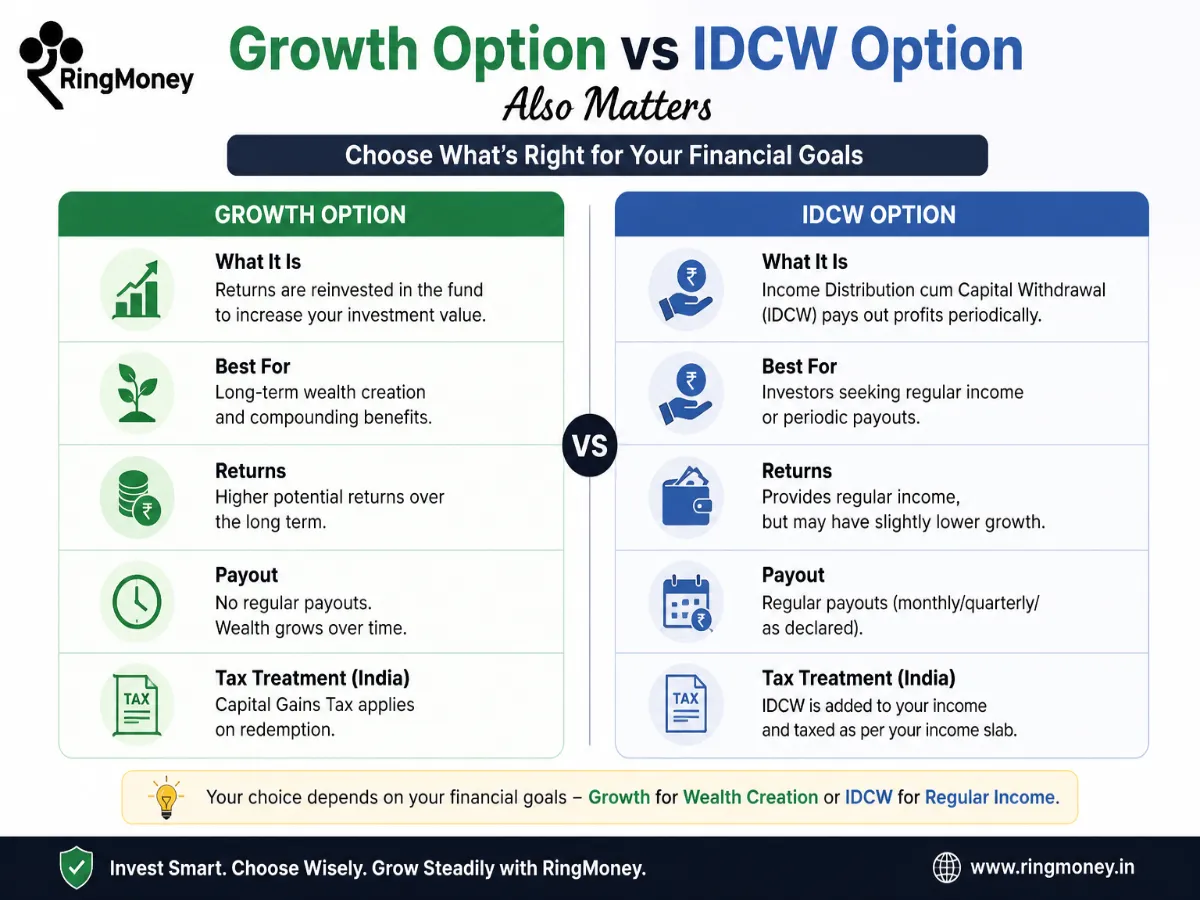
Mutual funds generally offer two payout structures:
Option | What Happens to Profits |
Growth Option | Profits remain invested and compound |
IDCW Option | Profits are periodically distributed |
In the Growth option, earnings automatically stay invested inside the fund. This allows compounding to work continuously over long periods.
In IDCW options, payouts are distributed instead of reinvested. As a result, the invested base grows more slowly.
Two investors may hold the same mutual fund, but if one selected the Growth option and the other chose IDCW, their final portfolio values can differ substantially over time.
For long-term wealth creation, the Growth option generally provides stronger compounding potential.
Exit Loads and Taxes Quietly Reduce Wealth
Many investors overlook the effect of exit loads and taxes while calculating returns.
Some mutual funds charge exit loads if investments are redeemed before a specified period, commonly within one year. Even a 1% deduction can reduce overall profitability, especially when investors make frequent withdrawals.
Taxes also influence the final take-home return.
Holding Period | Tax Type |
Less than 1 year | Short-Term Capital Gains Tax |
More than 1 year | Long-Term Capital Gains Tax |
An investor who frequently redeems investments may end up paying significantly more tax compared to someone who stays invested long term.
This means the portfolio value shown on the screen is not always the actual profit retained by the investor.
The Most Important Lesson for Investors
Most long-term wealth gaps are not created through dramatic mistakes. They are created through small differences repeated consistently over the years.
A slightly higher expense ratio, a panic-driven exit during a market crash, poor timing, unnecessary commissions, or interrupted SIPs may seem harmless individually. Together, they can alter long-term wealth creation dramatically.
Successful investing usually comes down to a few core principles:
- Keep costs low
- Stay invested consistently
- Avoid emotional decisions
- Allow compounding enough time
- Focus on discipline over prediction
Investors cannot control market movements, but they can control investment behaviour and unnecessary friction.
That is why choosing the right investing platform matters as much as choosing the right mutual fund. Platforms like RingMoney simplify investing through direct mutual fund access, helping investors avoid hidden distributor commissions while maintaining a smoother long-term investing experience.
Final Thoughts
Two people investing the same amount in the same mutual fund can absolutely end up with different returns. The difference usually has nothing to do with luck and everything to do with investing mechanics.
Costs, timing, SIP dates, taxes, holding periods, reinvestment choices, and investor discipline all influence the final outcome. Individually, these factors appear small. Over long periods, they become powerful.
In investing, wealth is rarely built through one perfect decision. It is built through hundreds of small, consistent decisions that quietly work together over time.
For regular investment tips, SIP updates, and simple money guidance, follow us on Instagram and explore the link in our bio to get started instantly.