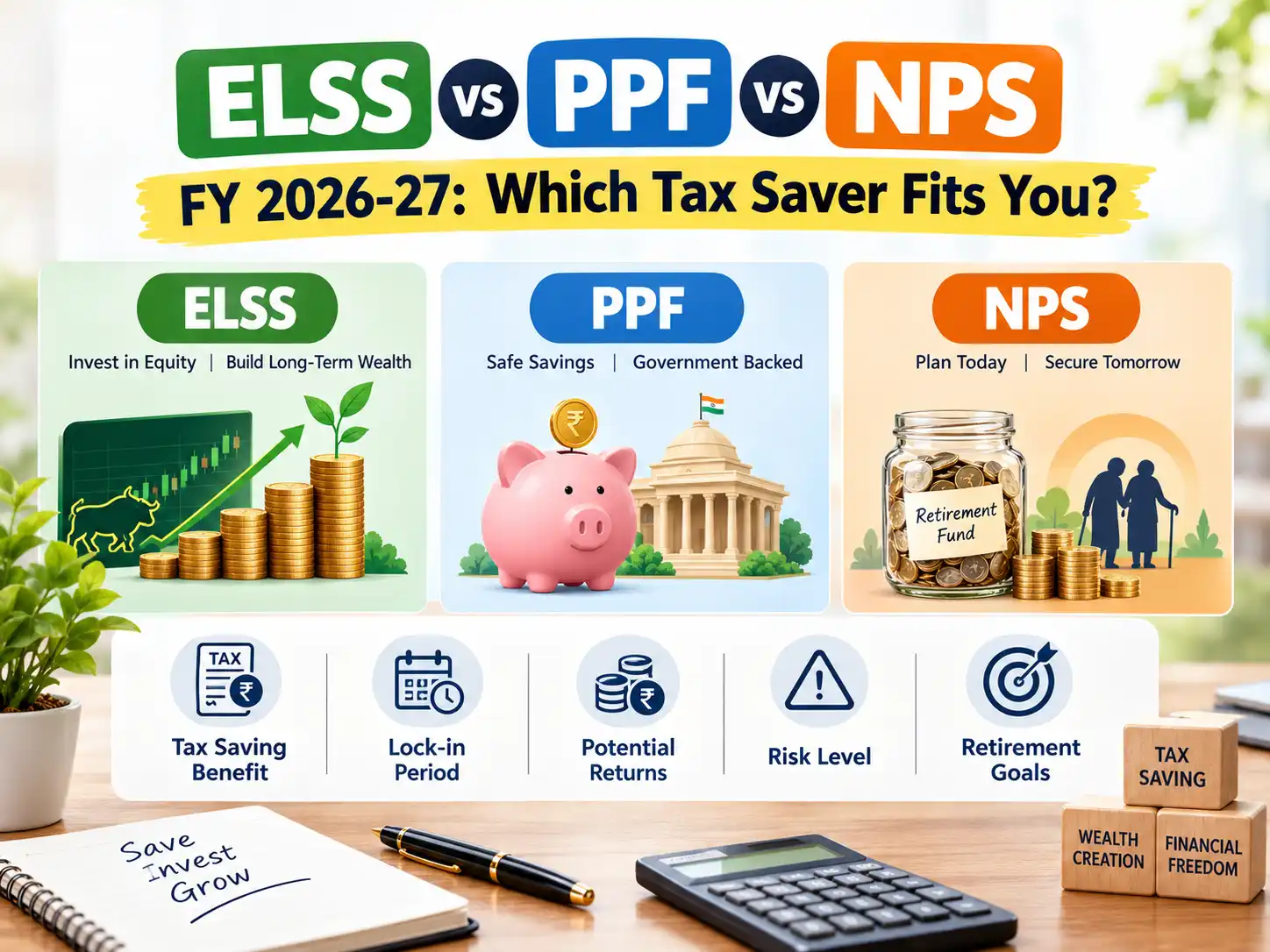
Quick answer: Choose ELSS if you want the highest growth potential and the shortest lock-in (3 years) and can handle market swings. Choose PPF if you want a guaranteed, tax-free return (7.1% for October–December 2026) and can lock money away for 15 years. Choose NPS if you’re building retirement savings and want an extra deduction. Under the new tax regime, none of these gets the ₹1.5 lakh deduction, so pick them for returns and discipline, not tax.
That last point surprises people every February. The new regime is the default now, and a lot of salaried investors still rush into ELSS for a deduction they can’t claim.
ELSS vs PPF vs NPS: side-by-side
ELSS (tax-saving mutual fund) | PPF | NPS (Tier I) | |
|---|---|---|---|
Lock-in | 3 years per instalment | 15 years (partial withdrawal from year 7) | Until 60 (limited partial withdrawals) |
Returns | Market-linked, not guaranteed | 7.1% (Oct–Dec 2026), reset quarterly | Market-linked: equity, corporate bond and government bond mix |
Risk | High (mostly equity) | Sovereign guarantee | Moderate, depends on your allocation |
Min / max per year | ₹500 / no cap (deduction capped) | ₹500 / ₹1.5 lakh | ₹1,000 / no cap |
Deduction (old regime) | Within ₹1.5 lakh | Within ₹1.5 lakh | Within ₹1.5 lakh + extra ₹50,000 |
Deduction (new regime) | None | None | Only on your employer’s contribution |
Tax at exit | 12.5% LTCG on gains above ₹1.25 lakh a year | Fully tax-free | Partly tax-free; part must buy an annuity (check PFRDA’s current withdrawal rules) |
Liquidity | Best of the three after 3 years | Poor | Poorest |
ELSS vs PPF: which is better?
They do different jobs, so “better” depends on yours.
ELSS wins on growth and liquidity. It’s an equity fund, so over 10+ years it has historically beaten PPF’s fixed rate by a wide margin, though not every year and not guaranteed. And the 3-year lock-in is the shortest of any 80C option.
PPF wins on certainty and tax. The 7.1% is tax-free, so for someone in the 30% slab it’s like earning about 10.3% pre-tax with zero risk. Nothing else in India offers that combination.
Let’s make it concrete. ₹1.5 lakh a year for 15 years:
PPF at 7.1% | ELSS at 10% (assumed) | ELSS at 12% (assumed) | |
|---|---|---|---|
Invested | ₹22.5 lakh | ₹22.5 lakh | ₹22.5 lakh |
Approx. value after 15 years | ~₹40.7 lakh | ~₹52.4 lakh | ~₹62.6 lakh |
Tax at exit | Nil | 12.5% on gains above ₹1.25 lakh a year (lower if you redeem gradually) | Same |
Certainty | Guaranteed at the prevailing rate | Not guaranteed | Not guaranteed |
Illustrative. PPF rates change quarterly. ELSS returns are assumptions, not projections.
Our usual answer: use both. PPF for the debt part of your portfolio, ELSS for part of the equity.
Where does NPS fit?
NPS is a retirement product first and a tax saver second. Two reasons it’s worth a look:
- The extra ₹50,000 deduction (old regime), on top of the ₹1.5 lakh limit.
- Your employer’s contribution stays deductible even under the new regime, up to the limit for your employer type. If your company offers NPS through payroll, it’s one of the few tax breaks the new regime still allows.
The catch is liquidity. The money is largely locked until 60, and part of the corpus must go into an annuity. Withdrawal rules have changed several times, so check PFRDA’s current rules before you commit. We compare it in more depth in Mutual Fund vs NPS.
Old vs new tax regime: does any of this still save tax?
Your situation | What to do |
|---|---|
New regime (most salaried people now) | No 80C deduction. Choose ELSS, PPF or NPS for returns and goals. Employer NPS still helps. |
Old regime, 80C not yet full | Fill it. EPF usually uses part of it, then ELSS or PPF for the rest. |
Old regime, 80C already full via EPF, home loan principal or school fees | Don’t buy ELSS just for tax. Consider the extra ₹50,000 NPS deduction. |
Not sure which regime you’re in? Look at your Form 16 or ask HR. It matters more than which product you pick.
Which should you choose? Three quick profiles
- Riya, 27, new regime, first job. No deduction either way. She starts a ₹5,000 SIP in a flexi cap fund (not ELSS, since she doesn’t need a lock-in) and puts ₹2,000 a month into PPF as her safe bucket.
- Arjun, 38, old regime, 80C half-used by EPF. He fills the remaining ₹75,000 with ELSS for growth and adds ₹50,000 to NPS for the extra deduction.
- Meena, 52, old regime, near retirement. PPF extension blocks (in 5-year periods) plus a modest ELSS allocation for some growth. Avoiding new 15-year lock-ins matters at her age.
Frequently Asked Questions
Is ELSS better than PPF?
ELSS has higher growth potential and a shorter lock-in. PPF is guaranteed and fully tax-free. Long-term investors often use both.
Can I claim ELSS under the new tax regime?
No. The ₹1.5 lakh deduction is only available under the old regime. You can still invest in ELSS, but there’s no deduction.
Which gives the highest return: ELSS, PPF or NPS?
Historically, ELSS (being mostly equity) has given the highest long-term returns, but it’s the only one with no floor. PPF is fixed by the government each quarter.
Can I withdraw ELSS after 3 years?
Yes. Each SIP instalment has its own 3-year lock-in, so a 12-month SIP unlocks month by month starting in year 4.
Is PPF interest taxable?
No. PPF contributions (old regime), interest and maturity are all tax-free.