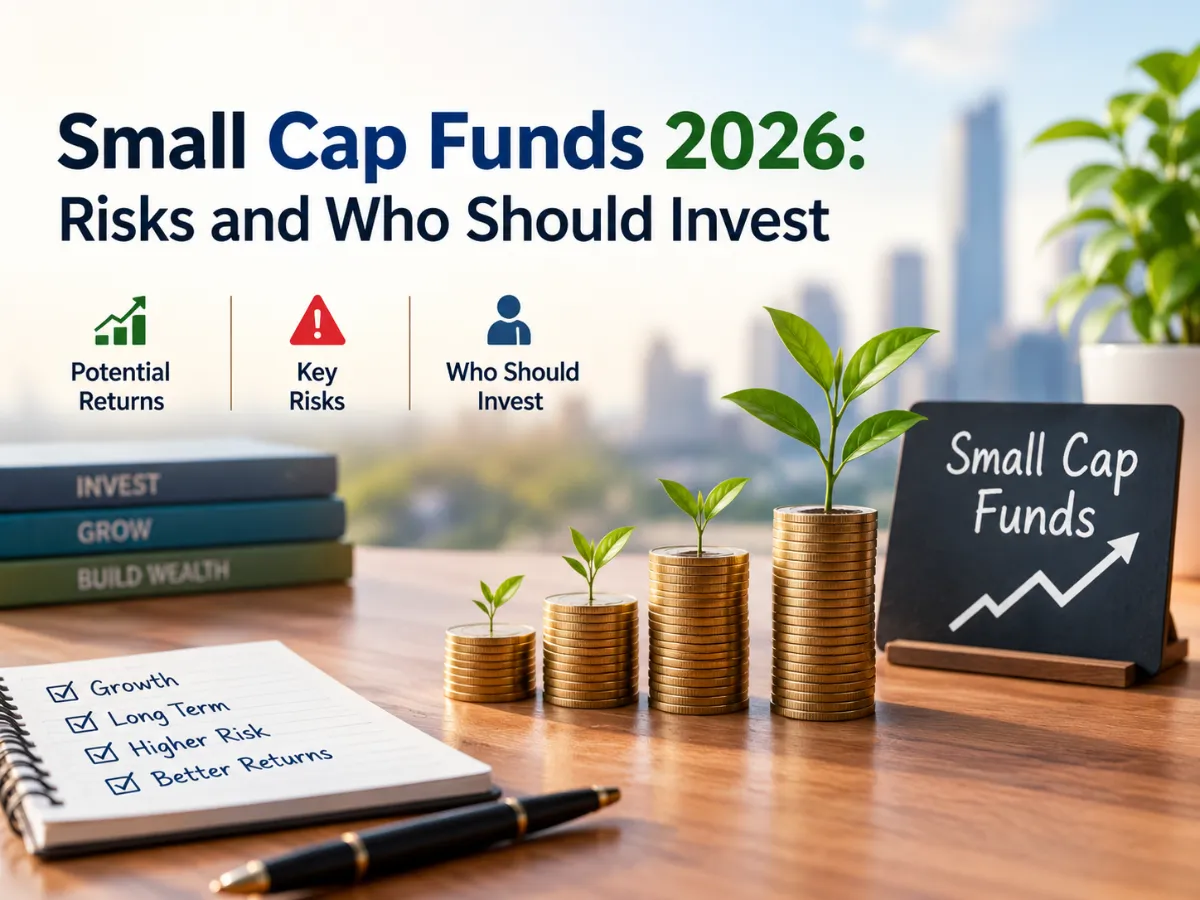
Quick answer: Small cap funds invest at least 65% in companies ranked 251st and below by market value. They’ve delivered some of the highest long-term returns in Indian equity, and some of the deepest falls. The Nifty Smallcap 250 TRI fell about 26% in the 2024–25 correction and roughly 60% from January 2018 to March 2020. Invest only money you won’t need for 7–10 years, keep it to 10–25% of your equity portfolio, and use a SIP, not a lump sum.
If you started a small cap SIP in late 2024, you’ve already lived through the hard part. The index fell about 23% between September 2024 and March 2026, then bounced back more than 20% from those lows. Anyone who stopped in early 2026 missed the rebound.
What are small cap funds?
SEBI ranks every listed company by market capitalisation: – Large cap: companies ranked 1–100 – Mid cap: 101–250 – Small cap: 251 and below
A small cap fund must keep at least 65% of its money in that third group. These are younger, smaller businesses, sometimes future market leaders, sometimes companies that won’t survive a downturn.
The returns and the falls
Period | What small caps did |
|---|---|
Jan 2018 → Mar 2020 | Fell roughly 60% peak to trough |
Feb → Mar 2020 (Covid) | Nifty Smallcap 250 TRI fell about 43% in a few weeks |
Mar 2020 → end 2021 | Rose more than 200% from the low |
2024–25 correction | Fell about 26% (vs ~15% for the Nifty 50 TRI) |
Sept 2024 → Mar 2026 | Fell ~23%, then rebounded 20%+ from the March 2026 lows |
Sources: index data compiled by Finplann and ICICI Direct. Past performance doesn’t guarantee future returns.
That’s the deal with small caps. The long-run returns have often been the best in Indian equity. To get them, you had to sit through falls that would make most people quit.
Who should invest in small cap funds?
Good fit: – Goals 10+ years away (retirement in your 30s or 40s, a child’s education when they’re a toddler) – You’ve already got a core of large cap, flexi cap or index funds – You’ve stayed invested through at least one 20%+ fall before
Poor fit: – Money needed within 5 years – Your first and only mutual fund – You’d check the app daily and panic at a 30% drop – You’re chasing last year’s returns (that’s often when valuations are stretched)
How much should you put in small caps?
Investor profile | Small cap share of equity portfolio |
|---|---|
Conservative / near goal | 0–5% |
Moderate, 10+ year horizon | 10–15% |
Aggressive, 15+ year horizon, experienced | 15–25% |
Beyond about 25%, the portfolio’s ups and downs start being driven by small caps alone. That’s rarely what investors intend.
SIP or lump sum in small caps?
SIP, almost always. Small caps can fall 25–40% within months, so spreading purchases over time helps. If you have a lump sum, park it in a liquid fund and move it in with a weekly or monthly STP over 6–12 months.
Don’t stop the SIP when small caps fall. Those months buy the cheapest units. That’s how SIP is meant to work (Mutual Fund Is Down 20%: Stop or Continue?).
How to choose a small cap fund
- Track record through a full cycle. Look for at least 7 years, covering 2018–20 and 2024–25.
- How far it fell vs the index in those corrections. Some funds fell 22%, others 31% in 2024–25.
- Fund size. Very large small cap funds can struggle to buy enough of tiny companies. Some AMCs have paused lump-sum inflows at times for this reason.
- Liquidity of holdings. Fund houses now publish stress-test results showing how many days it would take to sell part of the portfolio.
- Expense ratio.
Or skip manager risk with a Nifty Smallcap 250 index fund.
Small cap vs mid cap: which first?
If you’re new to the riskier end, start with mid caps. They’ve historically offered much of the growth with somewhat shallower falls. Add small caps once you’ve seen how you handle volatility. More in our equity funds guide.
Frequently Asked Questions
Is it a good time to invest in small cap funds in 2026?
Nobody can time small caps reliably. After the 2024–26 correction and rebound, a SIP over 10+ years is a more reliable approach than waiting for the “right” moment.
How much can small cap funds fall?
Historically, 40–60% from peak to trough in severe periods (2018–20 and early 2020), and around 25% in milder corrections like 2024–25.
Can I invest in small cap funds for 3 years?
Not recommended. Three years is short enough for a correction to leave you at a loss.
Are small cap index funds better than active small cap funds?
dex funds cost less and carry no manager risk. Some active funds have beaten the index by avoiding weak companies. A mix is reasonable.
What percentage of my portfolio should be in small caps?
For most long-term investors, 10–15% of the equity portfolio. Experienced investors with long horizons might go up to 25%.