Quick answer: Choose an FD for money you need on a fixed date within 1–3 years and can’t afford to see fall, even for a month. Choose debt or hybrid mutual funds when you want better liquidity and tax deferral. Choose equity mutual funds for goals 5+ years away, where FDs struggle to beat inflation after tax. With SBI paying 6.25–6.45% on 1–3 year FDs in October 2026, a 30%-slab investor keeps only about 4.5% after tax.
For decades, FDs were the default for Indian savers, and for good reason: they’re simple, safe and predictable. They still have a job. That job just isn’t building long-term wealth.
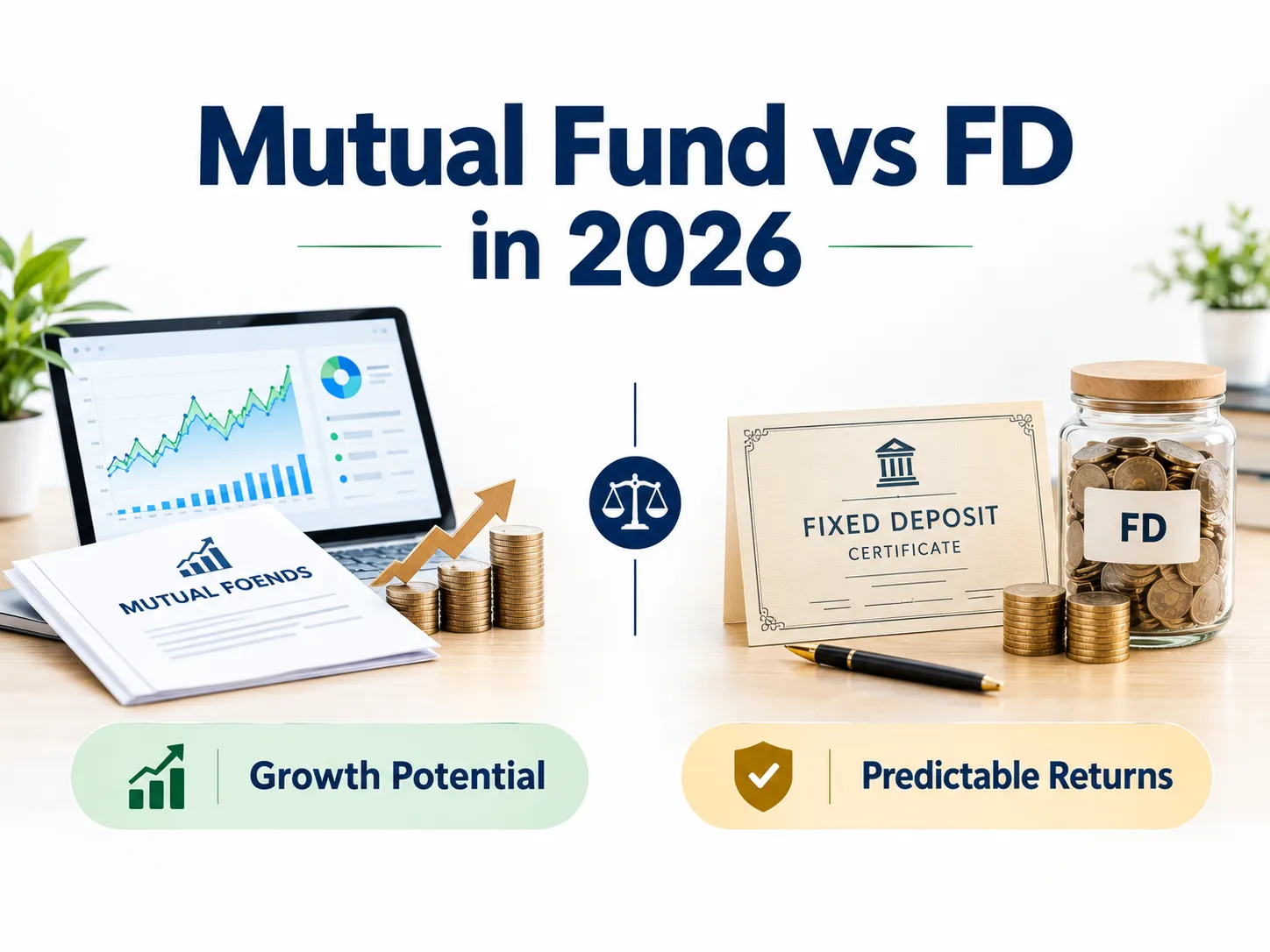
Mutual fund vs FD: side-by-side
| Feature | Bank FD | Debt Mutual Fund | Equity Mutual Fund |
|---|---|---|---|
| Returns | Fixed returns. SBI 1–3 year FD rates depend on the applicable tenure and rate card. | Market-linked returns, influenced by bond yields, interest rates and credit quality. | Market-linked returns with higher long-term growth potential and higher risk. |
| Risk | Generally low risk. Eligible deposits are covered by DICGC up to ₹5 lakh per depositor per bank, including principal and interest. | Low to moderate in many funds, but interest-rate and credit risks apply. | High short-term volatility; capital loss is possible. |
| Liquidity | Premature withdrawal may attract a penalty. | Typically redeemable on business days; settlement depends on the scheme. | Typically redeemable on business days; equity-oriented funds may have exit loads or settlement delays. |
| Tax | Interest is generally taxable at your applicable slab rate. TDS may apply. | Tax treatment depends on the fund’s portfolio and acquisition date. Tax generally arises on redemption. | For qualifying equity-oriented funds, STCG is generally 20%; LTCG is 12.5% on aggregate eligible gains exceeding ₹1.25 lakh per financial year, subject to applicable rules. |
| Best For | Predictable returns, fixed-date needs and capital stability. | Short-term goals and money parking, depending on fund risk and duration. | Long-term goals, typically 5+ years, for investors who can tolerate volatility. |
What does ₹5 lakh for 3 years actually earn after tax?
Assumptions: Investor in the 30% tax slab (31.2% including cess), with a 3-year investment period. Returns are illustrative, not guaranteed.
| Investment Option | Pre-Tax Value | Approx. Post-Tax Value | Effective Post-Tax Return |
|---|---|---|---|
| SBI FD at 6.45% | ₹6.06 lakh | ~₹5.71 lakh | ~4.5% a year |
| Debt Fund at 6.8% (assumed) | ₹6.09 lakh | ~₹5.75 lakh | ~4.8% a year |
| Equity-Oriented Hybrid at 10% (assumed) | ₹6.66 lakh | ~₹6.60 lakh | ~9.7% a year |
Important: Figures are illustrative and depend on tax rules, holding period, investment category and actual returns. Mutual fund returns are market-linked. Verify the tax treatment and calculations before publishing.
Illustrative. Mutual fund returns are assumptions, not guarantees, and the hybrid fund could also lose value over 3 years.
A few things this table shows:
- Debt funds and FDs end up close for a 30%-slab investor since the 2023 tax change. The debt fund’s edge is that you pay tax once, at the end, instead of every year. That’s worth more the longer you hold.
- The equity-oriented option keeps most of its return because of the ₹1.25 lakh LTCG exemption and the 12.5% rate. But it carries real risk. In a year like 2020 or 2022 it could be down when you need the money.
- In the 5% or 0% slab, FDs look a lot better. Senior citizens with low taxable income also get higher FD rates and a larger interest exemption. For them, FDs often remain a strong core holding.
When an FD is still the right choice
- Money needed on a fixed date within 1–2 years: a house down payment, school fees, a wedding.
- Your emergency fund backup, especially a sweep-in FD linked to your savings account.
- Retirees in low tax brackets who value certainty above everything.
- Anyone who will lose sleep over a temporary 5% fall.
When mutual funds win
- Goals 5+ years away. At 6.45% before tax and roughly 6% inflation, an FD’s real return for a taxpayer is close to zero or negative. Equity funds are the main tool that has historically beaten inflation over long periods.
- Regular monthly investing. A SIP is easier than opening a new FD every month.
- Flexibility. You can withdraw part of the money without breaking the whole investment.
- Higher tax brackets that want to defer or reduce tax.
FD vs SIP: what about monthly savings?
An RD (recurring deposit) is the FD version of a SIP. For a ₹10,000 monthly saving over 10 years, a SIP in a diversified equity fund has historically built a meaningfully larger corpus than an RD, but with ups and downs along the way. We’ll cover the full comparison in our upcoming SIP vs RD vs PPF guide. Meanwhile, SIP vs Lumpsum explains how SIPs smooth out market timing.
A simple split that works for most people
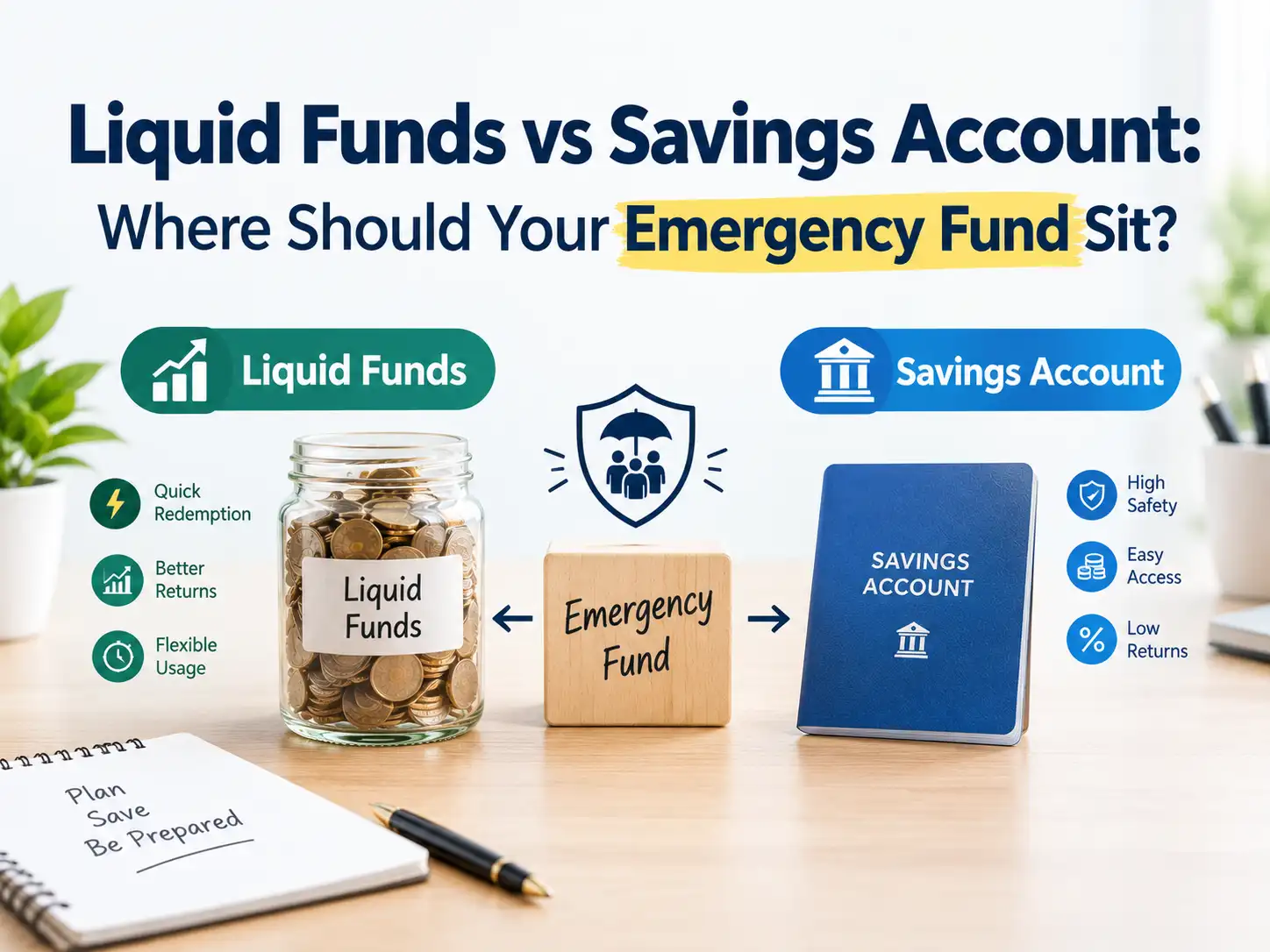
Emergency fund (6 months of expenses): savings account plus a sweep-in FD or liquid fund.
Goals in 1–3 years: FD or short-duration debt fund.
Goals in 3–5 years: hybrid funds.
Goals 5+ years away: equity funds through SIP.
It’s not either-or. The mistake is using one product for every goal.
Frequently Asked Questions
Which is better, FD or mutual fund?
FDs are better for short, fixed-date goals and for people who can’t tolerate any fall. Mutual funds, especially equity funds, are better for long-term goals where beating inflation matters.
Are mutual funds safer than FDs?
No. Bank FDs are among the safest options in India, with DICGC insurance up to ₹5 lakh per bank. Mutual funds carry market risk, though debt funds carry far less than equity funds.
Is debt fund taxation the same as FD now?
Mostly. Gains on debt funds bought after 1 April 2023 are taxed at your slab rate, like FD interest. The difference is timing: FD interest is taxed every year, debt fund gains only when you redeem.
Should I break my FD to invest in mutual funds?
Only if the money is meant for a goal 5+ years away and the premature withdrawal penalty is small. Money for short-term needs can stay in the FD.
Can I do a SIP instead of an FD?
Yes, for long-term goals. For goals under 3 years, an FD, RD or debt fund is usually more suitable.