
You may have heard a friend say, “I’ve been paying my LIC premium for years,” while someone else tells you, “Just invest in mutual funds.” Both sound convincing, especially when you’re trying to decide where your savings should go.
The answer depends on the job your money needs to do. Life insurance is primarily about financial protection, while mutual funds are investment products designed to help you build wealth. So, before comparing returns, look at your goal, time horizon, risk tolerance and need for insurance.
What Are You Actually Buying?
A traditional LIC savings or endowment policy can combine life insurance with savings. Depending on the policy, your family may receive a death benefit, while you may receive a maturity benefit if you survive the policy term.
The important detail is that not every amount shown in an insurance illustration has the same status. Some benefits can be guaranteed under the contract, while bonuses or other benefits may be non-guaranteed. You need to read the specific policy illustration rather than treat every LIC policy as identical.
A mutual fund is different. Your money is pooled with that of other investors and invested according to the scheme’s objective. An equity fund may invest primarily in shares, while debt and hybrid funds have different underlying assets and risks.
So, when you compare LIC with mutual funds, you are often comparing insurance-plus-savings with an investment vehicle.
LIC vs Mutual Funds: The Key Differences
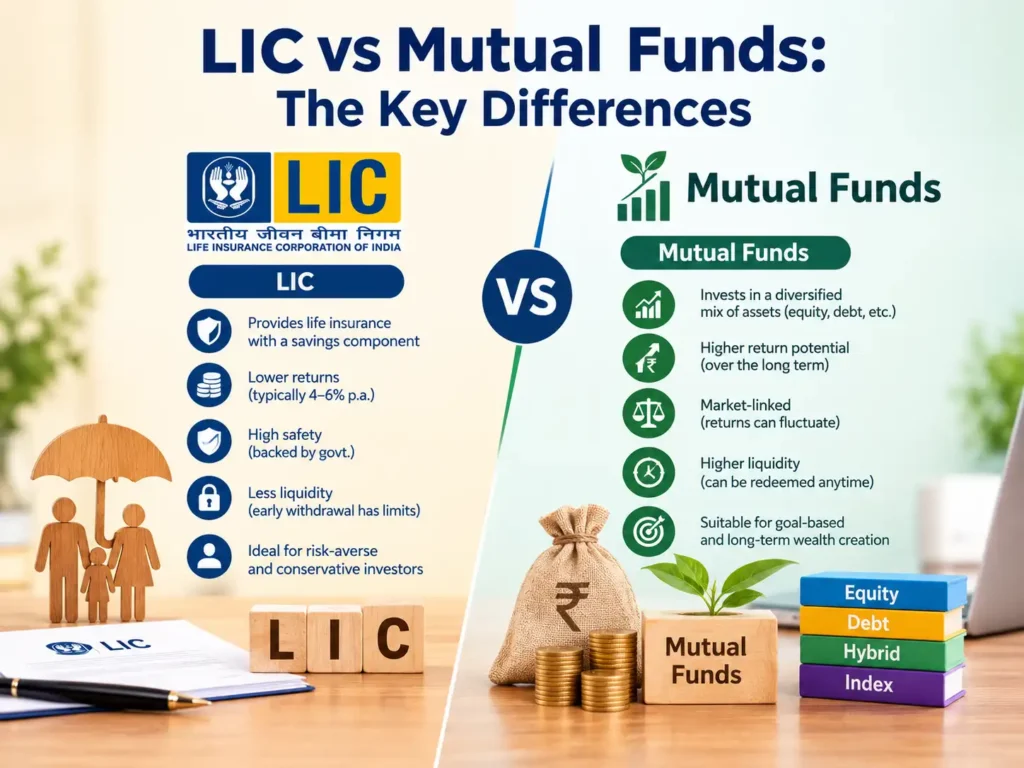
Factor | Traditional LIC savings policy | Mutual funds |
Main purpose | Insurance plus savings | Investment and wealth creation |
Life cover | Yes, according to policy terms | No inherent life cover |
Return | Depends on policy benefits and bonuses | Market-linked |
Capital value | More predictable under contractual benefits | Can rise or fall |
Liquidity | Usually more restrictive | Generally easier for open-ended funds |
Risk | Product and inflation risks | Market and underlying-asset risks |
Costs | Built into policy structure | Expense ratio and other applicable costs |
Best evaluated by | Benefit illustration and policy terms | Scheme objective, portfolio, costs and performance |
How Your Money Actually Grows
Suppose you pay ₹50,000 a year into a traditional insurance savings policy.
It would be misleading to assume that the entire ₹50,000 behaves like a pure investment contribution. The policy also provides insurance and has its own expenses and contractual structure. Your eventual benefit depends on the terms of that particular policy.
With a mutual fund, your investment buys units at the applicable NAV. The value of those units changes as the underlying investments change. An equity mutual fund can therefore deliver substantial growth over a long period, but it can also fall sharply during market declines.
That difference matters when you compare returns.
Instead of asking, “How much will I receive at maturity?”, ask:
- How much did I actually pay?
- For how many years?
- What amount is guaranteed?
- Which benefits depend on bonuses?
- What is the effective annualised return?
- What would the money be worth after inflation?
- What protection did I receive during the policy period?
For a series of insurance premiums and a final maturity payment, IRR/XIRR can provide a more meaningful return measure than simply dividing the maturity amount by the total premiums.
For mutual funds, CAGR can help you understand a lump-sum investment’s annualised growth, while XIRR is useful when you make multiple investments such as SIP instalments.
Don't Ignore Inflation
A large future number can look impressive until you translate it into today’s purchasing power.
For example, if you receive ₹20 lakh after 20 years and inflation averages 6% a year, that ₹20 lakh would have purchasing power of only about ₹6.2 lakh in today’s terms.
That does not make a traditional insurance policy automatically unsuitable. It simply shows why the maturity amount alone cannot tell you whether your money has grown sufficiently.
For long-term goals, you should always ask whether your investment has a reasonable chance of growing faster than inflation after considering taxes and costs.
What Are the Risks?
With mutual funds, the most visible risk is market volatility.
An equity fund can lose value during a market correction, sometimes substantially. You therefore need enough time and financial stability to remain invested instead of selling simply because the market has fallen.
Debt funds carry different risks, including interest-rate and credit-related risks. Hybrid funds combine exposures and therefore have their own risk profile.
Traditional insurance policies may appear more stable because their benefits are structured through a contract, but that does not mean there is no financial risk.
You still face:
- Inflation risk
- Opportunity cost
- The possibility of receiving lower-than-expected non-guaranteed benefits
- Liquidity restrictions
- Financial loss if you exit an unsuitable policy prematurely
In other words, “less volatile” and “better for every goal” are not the same thing.
Can You Take Your Money Out When You Need It?
This is an important question before signing any long-term insurance contract. If you stop paying premiums, the outcome depends on the policy terms, how long it has been active, and applicable surrender or paid-up provisions.
Under the IRDAI Master Circular on Life Insurance Products, 2024, newer non-linked policies can become eligible for a Special Surrender Value (SSV) after one full policy year, subject to the policy terms and conditions. But surrendering early does not mean you get back everything you paid, and the actual value depends on the policy.
Mutual funds generally offer more flexibility, as many open-ended schemes allow redemption, although exit loads, taxes and market value can affect the amount you receive.
So, don’t just ask, “Can I withdraw?” Ask, “How much will I receive if I need the money earlier than planned?”
What About the Costs?
Costs can look small when you view them for one year. Over 15 or 20 years, they can become meaningful.
For mutual funds, you should look at the scheme’s expense ratio and whether you are investing through a direct or regular plan. SEBI explains that direct plans do not include distributor commissions and therefore have a lower expense ratio than the corresponding regular plan.
Insurance costs are structured differently and are embedded within the policy’s overall economics rather than presented as a mutual-fund-style expense ratio.
This is why comparing only the visible charges can be misleading. Look at the complete cash flow and outcome, including insurance benefits.
Taxes Can Change the Calculation
Tax can change what you actually earn, so don’t compare products only on headline returns.
Life insurance benefits may qualify for exemption under Section 10(10D), subject to conditions. For non-linked policies issued on or after April 1, 2023, maturity proceeds are tax-exempt only when total annual premiums across eligible policies do not exceed ₹5 lakh. Death benefits remain exempt, subject to applicable conditions.
Mutual fund gains are generally taxed as capital gains, with treatment depending on the fund type, holding period and prevailing tax rules. So compare post-tax returns, and check the rules applicable to the financial year when you invest or redeem.
The Alternative: Separate Insurance and Investment
You don’t necessarily have to choose between LIC and mutual funds. A common approach is to handle the two jobs separately:
Life insurance for protection.
Term insurance is designed primarily to provide life cover, without combining it with a savings component.
Investments for wealth creation.
You can choose investments based on your goals, time horizon and ability to handle market fluctuations.
For example, with an annual budget of ₹50,000:
- Case A — Combined: ₹50,000 goes into a traditional endowment policy offering life cover and a maturity benefit. The actual cover and maturity value depend on the policy.
- Case B — Separated: Part goes towards term insurance with a larger sum assured, while the rest is invested through a mutual fund SIP. The premium and cover depend on factors such as your age, health, policy term and insurer.
Separating the two gives you greater clarity about how much goes towards protection and how much towards wealth creation. It also lets you evaluate each based on its actual purpose.
However, this approach isn’t right for everyone. If you prefer contractual savings, disciplined contributions, and understand the long-term commitment, a traditional insurance product may still suit your needs.
When Should You Look Closely at LIC?
A traditional LIC savings policy may deserve consideration if you:
- Want insurance and savings within one product
- Prefer contractual benefits over market-linked returns
- Value disciplined, long-term saving
- Understand that some benefits may be non-guaranteed
- Can comfortably maintain the premium commitment
- Have already considered whether the policy provides enough life protection for your dependents
Before buying, ask for the year-by-year benefit illustration. Look specifically at guaranteed benefits, non-guaranteed benefits, premium-paying term, maturity benefit, death benefit, and surrender values.
When Should You Consider Mutual Funds?
Mutual funds may fit when your main objective is investment rather than life protection.
They can be considered for goals such as:
- Retirement corpus
- Children’s education
- Long-term wealth creation
- Other goals several years away
Your mutual-fund category choice should match your time horizon and your ability to tolerate losses. An equity fund may be unsuitable for money you know you will need very soon simply because its historical returns attract you.
And remember: a SIP is a method of investing, not a guaranteed-return product.

Can You Have Both?
Yes.
Your financial plan does not have to choose one product for every purpose. You can have life insurance for family protection and investments for long-term goals.
A more useful way to organise your finances is:
Protection → Emergency fund → Goal-based investments → Regular review
This prevents you from expecting one product to solve every financial problem.
Questions to Ask Before You Invest
Before committing your money, ask yourself:
- Who financially depends on me?
- How much life cover do I currently have?
- What is this money supposed to achieve?
- When will I need it?
- Can I tolerate a temporary fall in value?
- What happens if I stop paying?
- What will I receive if I exit early?
- Which benefits are guaranteed?
- What are the total costs?
- What will taxes do to my final return?
- Will the future amount still have meaningful purchasing power after inflation?
These questions are often more useful than asking whether LIC or mutual funds are “better.”
Frequently Asked Questions
Is LIC better than mutual funds?
There is no universal answer because they serve different primary purposes. Compare the specific LIC policy with the specific mutual-fund category after considering insurance cover, risk, returns, liquidity, costs, taxes, and your time horizon.
Do mutual funds provide life insurance?
No. A mutual-fund investment does not create life-insurance cover. If your family depends on your income, you need to assess your insurance requirement separately.
Is SIP better than an LIC policy?
SIP and an LIC policy are not directly comparable. SIP is a way of investing periodically in a mutual fund, while an LIC policy may combine insurance with savings and contractual benefits.
Can you stop an LIC policy and invest the money in mutual funds?
You can explore surrender or paid-up options depending on your policy terms, but don’t stop a policy solely because someone promises higher investment returns elsewhere. First, calculate the surrender value, lost benefits, remaining premiums, and the effective return you would receive.
The Bottom Line
Think of your money as having a job to do. Before you put it into LIC or a mutual fund, ask: “Is this rupee here to protect my family, or to grow for a future goal?”
If it’s for protection, check your insurance needs. If it’s for wealth creation, look at the goal, time horizon, inflation and risk. For an LIC policy, check the benefit illustration, guaranteed benefits, bonuses, surrender terms and effective return. For a mutual fund, check the category, portfolio, costs, taxes and whether you can handle market ups and downs.
Don’t pick a product first. Give your money a job, then pick the tool.
Editorial note: Insurance, investment and tax rules can change. Check the latest policy documents and applicable regulations, or consult a qualified financial or tax professional before making a decision.