Your savings are sitting in your bank account. You have finally decided to start investing. Then you open a financial app and see the headline: Markets are at an all-time high.
Suddenly, investing today feels like a bad idea. What if you invest ₹1,00,000 and the market falls 15% next month? Wouldn’t you wish you had waited?
The honest answer is that the market could fall tomorrow. But an all-time high, by itself, is not a reliable signal that a crash is about to happen. Whether you should invest now depends far more on when you need the money, how much risk you can handle, and how you plan to enter the market.
An all-time high is a market fact, not an investment instruction.
Why Investing at a Record High Feels So Uncomfortable
The fear is understandable. When prices are already high, buying feels different from buying after a major decline.
You may think, “What if I’m the person who buys at the top?” That fear can be surprisingly powerful because you can immediately imagine the regret of seeing your investment fall soon after you invest.
But there is an uncomfortable reality: you never know in advance whether today’s high will become tomorrow’s low, or whether the market will continue making new highs.
That is why the decision becomes less about predicting the next few weeks and more about deciding whether your investment plan can survive normal market ups and downs.
What Does an All-Time High Actually Mean?

An all-time high simply means the market is trading at its highest recorded level. It does not automatically mean that stocks are overpriced or that a correction is imminent.
Markets can reach new highs as businesses grow, company earnings increase, productivity improves, and the economy expands. If the underlying value of businesses rises over time, an index can keep setting records.
Think about it this way. If a business earns more today than it did five years ago, it would not be surprising for investors to value that business more highly. The same basic idea applies to a broad market index containing many businesses.
Of course, valuations matter, and markets can become expensive. An all-time high alone simply doesn’t tell you enough to make that judgment.
What Happens If You Invest at a Record High?
This is where history becomes useful.
Markets have repeatedly reached record levels and subsequently experienced corrections, sometimes severe ones. But they have also continued rising after many previous records.
The important lesson is not that investing at an all-time high guarantees good returns. It doesn’t. The lesson is that a record high has not reliably predicted what happens next.
If you invest ₹1,00,000 today and the market drops 15%, your investment could temporarily fall to around ₹85,000. That’s a real decline, and you need to be comfortable with the possibility before investing.
But if your goal is 15 or 20 years away, that temporary decline has a very different meaning from a loss on money you need next year.
The key distinction
Your situation | What matters most |
Money needed within 1–2 years | Protecting the money from major market declines |
Long-term goal of 5+ years | Staying invested through temporary falls |
Nervous about investing a lump sum | Considering a gradual entry |
No emergency savings | Building your financial buffer first |
Investing because of market excitement | Reconsidering the reason for investing |
The exact time horizon isn’t a universal rule. Different investments carry different levels of risk, and your overall financial situation matters. But the principle is simple: money needed soon should generally not depend on the stock market behaving well at exactly the right time.
The Hidden Cost of Waiting for a Market Correction
Waiting for the market to fall can feel like the smart choice. You may think, “I’ll invest when prices drop by 10%.”
But what if the market rises 15% before it falls? If an index moves from 100 to 115 and then drops 10%, it is still around 103.5—higher than where you started waiting.
That’s the problem with trying to time the market. You need to guess not only when prices will fall, but also when they have fallen enough to buy.
And waiting can become a habit. You wait for 5%, then 10%, then 20%. Before you know it, you’re still holding cash and waiting for the “perfect” moment that may never come.
Starting Now Doesn't Mean Investing Everything Today
You don’t have to choose between putting all your money into the market today and keeping everything in cash.
Your entry strategy can depend on your circumstances.
Your situation | Possible approach | Main consideration |
You earn regularly and want to start investing | Invest a fixed amount regularly | Builds consistency without requiring perfect timing |
You have a large lump sum and feel uncomfortable investing it at once | Consider spreading the investment over several months | Reduces the psychological pressure of one entry date |
You have money needed soon | Keep it in appropriate lower-risk options rather than equities | A market fall could arrive before you need the money |
You have a long-term goal and can tolerate volatility | Short-term market movements become less important |
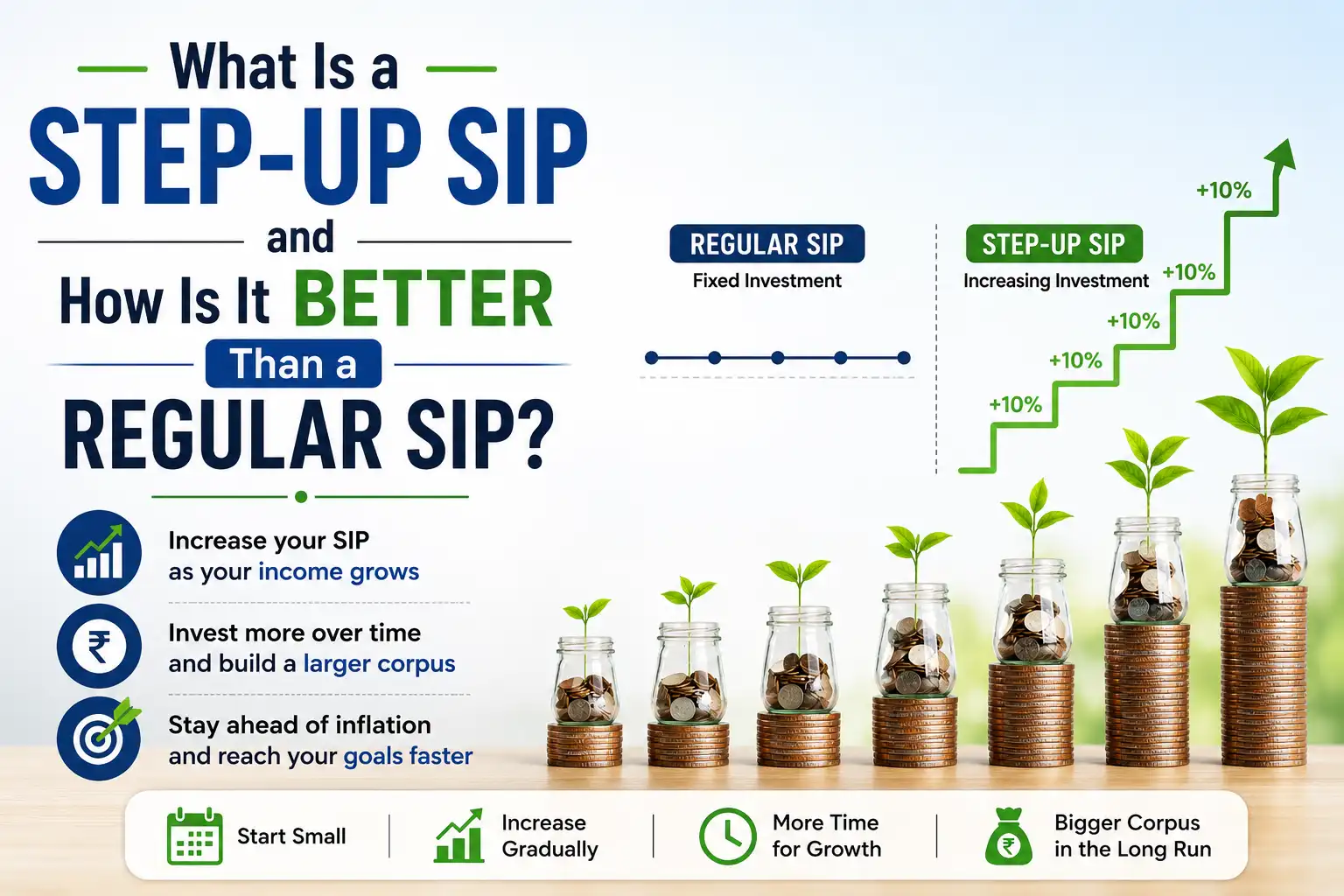
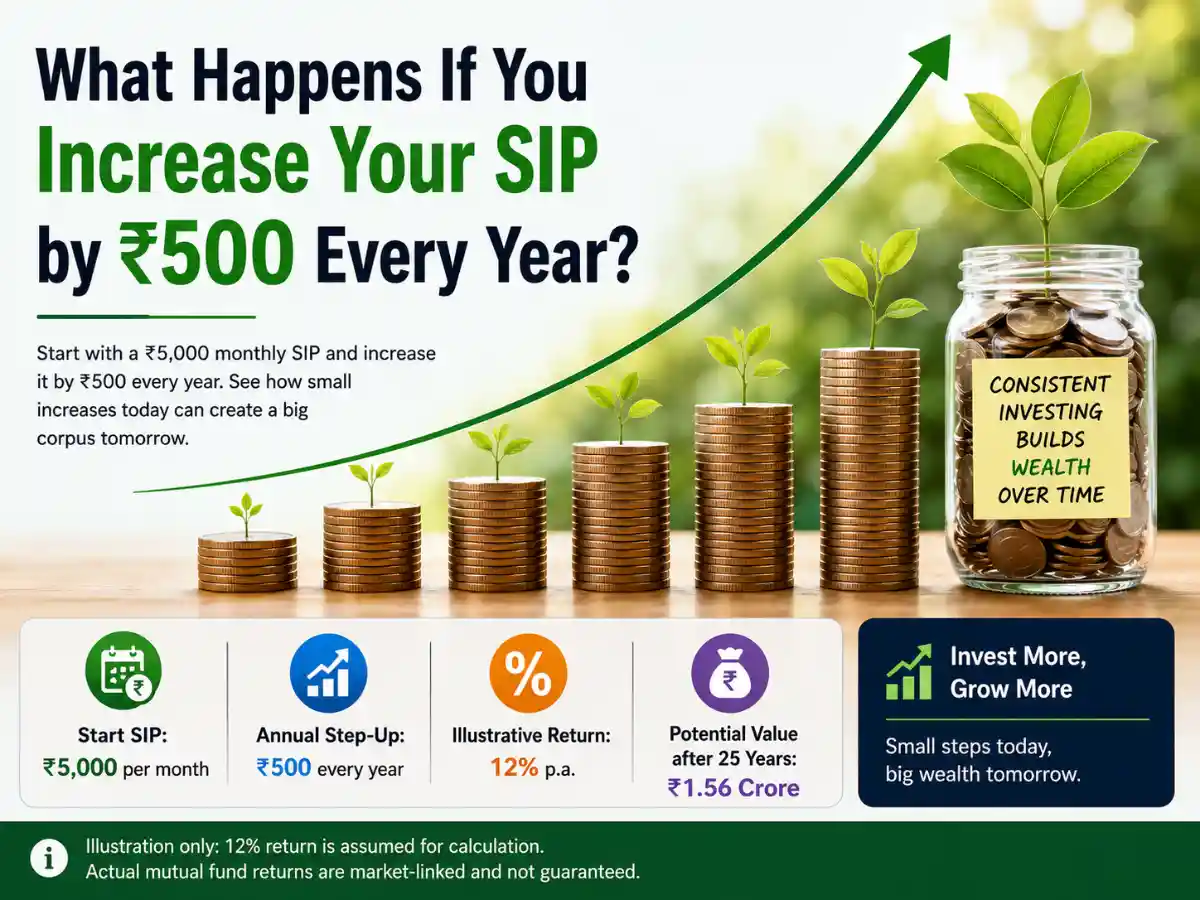
Regular investing, such as a monthly SIP, can make the process easier because you’re not making your entire investment decision on one particular day.
However, don’t treat SIPs as a way to eliminate risk. They don’t guarantee profits, and they can underperform a lump-sum investment if markets rise consistently while you’re gradually investing.
The benefit is primarily discipline and reduced dependence on picking one perfect entry point.
What If You Invest Today—or Keep Waiting for a Better Entry?
The market could fall soon after you invest. But waiting for the “right” correction carries its own risk: the market may keep rising while your money stays on the sidelines.
If seeing ₹1,00,000 temporarily fall to ₹85,000 would make you panic and sell, your bigger issue may not be market timing but choosing an investment approach that matches your risk tolerance. On the other hand, waiting indefinitely can leave you constantly second-guessing when to start.
You don’t need to predict the next market move. Instead, choose an investment amount and strategy you can stick with through both rising and falling markets.
The goal isn’t to find a perfect entry point. It’s to build a plan you won’t abandon when markets get uncomfortable.
5 Questions to Ask Before You Invest
Before putting your money into the market, step back from the headline and ask yourself these questions.
1. When Will You Need This Money?
If you need the money in the near future, protecting your capital may be more important than chasing potential market returns.
2. Do You Have an Emergency Fund?
Don’t invest money that may be required for rent, medical expenses, debt payments or other immediate needs. An emergency reserve gives your long-term investments room to stay invested when markets become uncomfortable.
3. Can You Handle a Significant Temporary Fall?
Imagine seeing your portfolio down 15%, 20% or even more. Your answer should influence how aggressively you invest.
4. Are You Investing for a Goal or Because of FOMO?
If your reason is “Everyone else is making money, so I need to get in,” slow down.
A long-term investment plan should be connected to your financial goals, not today’s market excitement.
5. Do You Have a Diversified Plan?
Putting your entire investment into one fashionable stock can make the question of market timing even more dangerous. Diversification can reduce the impact of any single company performing badly, although it cannot eliminate market losses.
4 Mistakes to Avoid When Markets Are at Record Highs
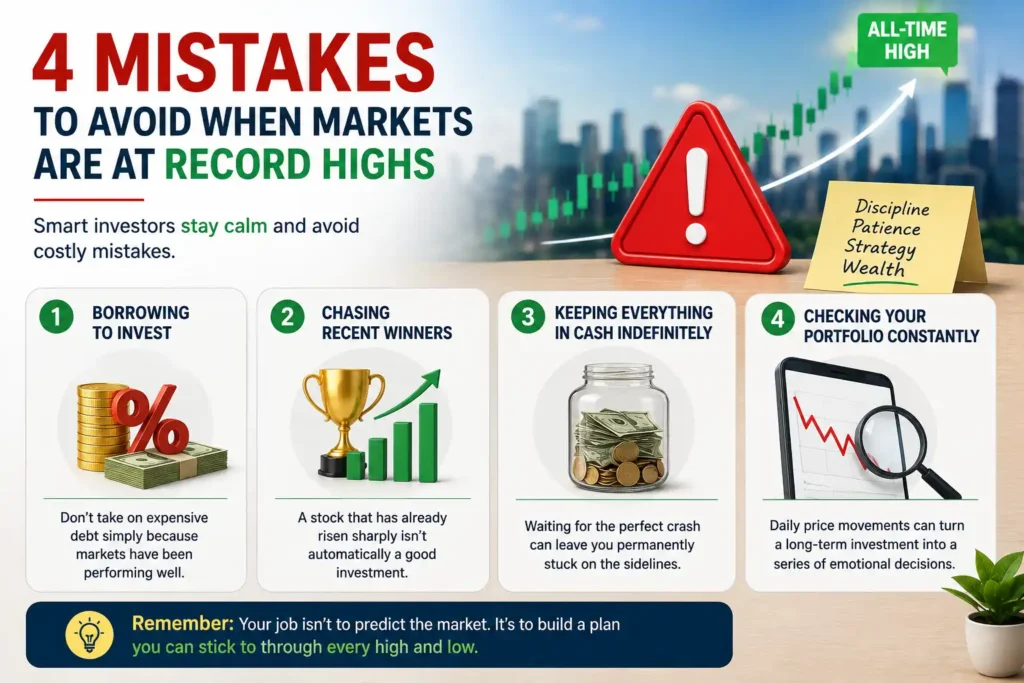
Borrowing to invest: Don’t take on expensive debt simply because markets have been performing well.
Chasing recent winners: A stock that has already risen sharply isn’t automatically a good investment for your circumstances.
Keeping everything in cash indefinitely: Waiting for the perfect crash can leave you permanently stuck on the sidelines.
Checking your portfolio constantly: Daily price movements can turn a long-term investment into a series of emotional decisions.
The biggest mistake is perhaps the simplest: confusing investing with prediction.
Your job isn’t to know what the market will do next Tuesday. Your job is to build a financial plan that doesn’t fall apart because the market had a bad Tuesday.
So, Should You Start Investing Now?
If you’re investing for a long-term goal, have an emergency buffer, don’t need the money soon and understand that markets can fall sharply, an all-time high alone isn’t a good reason to postpone investing indefinitely.
That doesn’t mean you should blindly invest everything today. If a large lump sum makes you uncomfortable, a structured, gradual approach may help you stay committed without obsessing over the perfect entry date.
On the other hand, if you need the money soon or don’t have your basic financial foundation in place, the question isn’t really whether the market is at a record high. The more important question is whether that money should be exposed to market risk in the first place.
You cannot control tomorrow’s market price. You can control how much you save, what the money is for, how long you can stay invested, how diversified you are and whether your strategy matches your ability to handle losses.
That’s a much stronger foundation than trying to guess the next market top.
Frequently Asked Questions
Is It Safe to Start a Monthly Investment When the Market Is at an All-Time High?
A monthly investment plan can help you avoid relying on a single entry point, but it does not remove market risk. Whether it is appropriate depends on your goals, time horizon, financial situation and the investments you choose.
Should You Sell When the Market Hits a Record High?
Not automatically. A record high is not, by itself, a signal that you should sell, particularly if you’re investing for a long-term goal and your original investment plan has not changed.
What If the Market Crashes After I Start Investing?
Short-term losses are possible and should be expected when you invest in equities. Before investing, make sure you have enough financial stability and a long enough time horizon to avoid being forced to sell simply because the market temporarily falls.
How Long Should You Stay Invested?
There is no single holding period that works for everyone. The appropriate timeframe depends on the investment, your financial goal and your ability to tolerate losses, but money needed in the near term generally shouldn’t be exposed to substantial equity-market volatility.
The Bottom Line
Don’t make your entire investment plan depend on predicting the next market move.
Markets can fall after an all-time high. They can also rise and reach another one. You won’t know which comes next until after it happens.
What you can know is why you’re investing, when you’ll need the money and how much uncertainty you can realistically handle. Build your strategy around those things, and an intimidating headline about a “record high” becomes much less important.
This article is for educational purposes and is not personalised investment advice. Past market performance does not guarantee future returns. Consider your financial circumstances and, where appropriate, consult a qualified financial professional before making investment decisions.