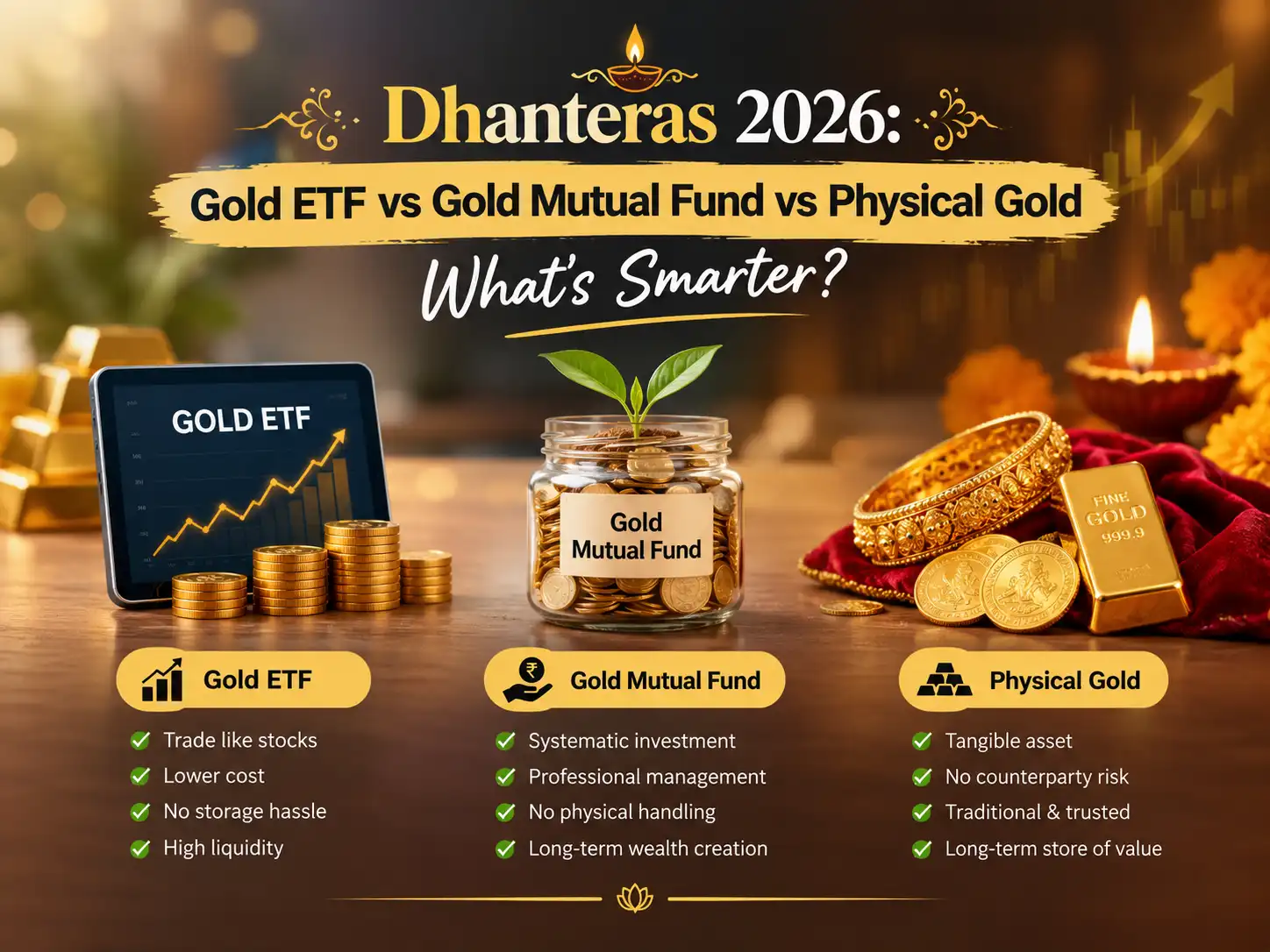
Quick answer: If you’re buying gold as an investment, a gold ETF (needs a demat account) or a gold mutual fund (no demat, SIP from ₹100–₹500) is cheaper, purer and easier to sell than jewellery or coins. You skip 3% GST and making charges, and the gold is backed by 99.5% purity bullion. Buy jewellery for wearing, not for returns. Keep gold to around 5–15% of your portfolio.
Dhanteras falls on Friday, 6 November 2026. Buying gold on the day is tradition, and that’s a perfectly good reason to buy. Just know what each form costs you.
Gold options compared
| Feature | Jewellery | Coins / bars | Gold ETF | Gold mutual fund (FoF) | Sovereign Gold Bond (secondary market) | Digital gold (apps) |
|---|---|---|---|---|---|---|
| Purity | Varies (22K usually) | 24K, 99.5–99.9% | Backed by 99.5% bullion | Invests in gold ETFs | Linked to 999 gold price | Claimed 24K |
| Extra costs at purchase | 3% GST + making charges (often 8–25%) | 3% GST + small premium | Brokerage + ~0.5–1% expense ratio a year | Expense ratio (fund + underlying ETF) | Brokerage | 3% GST + spread |
| Demat needed? | No | No | Yes | No | Yes | No |
| SIP possible? | No | No | Yes, through some brokers | Yes, from ₹100–₹500 | No | Yes |
| Long-term holding period for tax | 24 months | 24 months | 12 months | 24 months | 12 months (listed) | 24 months |
| Regulator | None | None | SEBI | SEBI | RBI / exchange | Not regulated by SEBI or RBI |
Why jewellery is the costliest way to invest in gold
Say you buy a ₹1 lakh gold chain this Dhanteras:
- Making charges at 12%: ₹12,000
- 3% GST on gold value, plus 5% GST on making charges
- When you sell or exchange, the jeweller often deducts for making, wastage or purity
Gold prices have to rise 15–20% just to get you back to where you started. That’s fine for a wedding gift you’ll wear for 30 years. It’s a poor investment.
Gold ETF vs gold mutual fund: which should you pick?
Pick a gold ETF if: – You already have a demat and trading account. – You want the lowest annual cost. – You’ll invest lump sums occasionally.
Pick a gold mutual fund if: – You don’t have, or don’t want, a demat account. – You want a monthly SIP that runs automatically. – You want it in the same app as your other mutual funds.
The tax difference: since April 2025, gold ETFs become long-term after 12 months, while gold mutual funds (fund of funds) need 24 months. Both are then taxed at 12.5% on gains. Short-term gains on either are taxed at your slab rate. If you might sell within 2 years, the ETF has the edge.
What about Sovereign Gold Bonds?
The government hasn’t issued new SGB tranches since February 2024, so today you can only buy existing bonds on the stock exchange.
The important change: from 1 April 2026, the tax-free redemption at maturity applies only to original subscribers who held from issue to maturity. If you buy SGBs on the exchange now, the gain at maturity is taxable (12.5% long-term). The 2.5% annual interest is still taxable at your slab rate. SGBs are still a solid product, but the tax magic is gone for new buyers.
Should you avoid digital gold?
Digital gold sold through apps isn’t regulated by SEBI or RBI. If the provider has problems, investor protection is limited. You also pay 3% GST and a buy-sell spread. For investment, a SEBI-regulated gold ETF or gold mutual fund does the same job with more oversight.
How much gold should you own?
Gold doesn’t produce income or earnings. It’s a hedge. It tends to do well when the rupee weakens, inflation spikes or stock markets panic. Over long periods it has been a useful diversifier rather than a primary wealth builder.
A sensible range for most investors is 5–15% of the portfolio:
- Lower end (5–10%): young investors with long equity horizons
- Higher end (10–15%): conservative investors, retirees, or those worried about currency risk
Already have a lot of family jewellery? It counts toward that allocation, even if you’ll never sell it.
We compare gold with silver in Gold Mutual Fund vs Silver Mutual Fund, and look at why younger investors increasingly favour SIPs in Why Are Young Indians Choosing SIPs Over Gold?
A Dhanteras plan that keeps tradition and makes sense
- Buy a small coin or piece of jewellery for the puja and the tradition. Keep it modest.
- Start a gold fund SIP on Dhanteras for the investment part. Even ₹1,000 a month builds steadily, and you avoid buying everything at a festive-season price.
- Review once a year so gold stays within your 5–15% band.
Frequently Asked Questions
Which is better: gold ETF or gold mutual fund?
Gold ETFs have slightly lower costs and become long-term after 12 months, but need a demat account. Gold mutual funds allow small SIPs without demat but need 24 months for long-term tax treatment.
Is it good to buy gold on Dhanteras 2026?
Buying a small amount for tradition is fine. For investment, spreading purchases through a SIP avoids paying a festive-season peak price for everything at once.
Is digital gold safe?
Digital gold isn’t regulated by SEBI or RBI, so investor protection is limited. Gold ETFs and gold mutual funds are regulated alternatives.
Are SGBs still tax-free at maturity?
Only for original subscribers who hold until maturity. SGBs bought on the stock exchange are taxable at maturity from 1 April 2026.
How much of my portfolio should be in gold?
Around 5–15%, depending on your age, risk appetite and existing jewellery holdings.
Mutual fund investments are subject to market risks. Read all scheme-related documents carefully. RingMoney is an AMFI-registered mutual fund distributor (ARN-320453). Tax rules as of October 2026; consult a tax professional.
Start a gold fund SIP on RingMoney · Related reading: Types of Mutual Funds in India · Investing in 2026: Portfolio Diversification