
Fact-checked for current mutual fund rules and practices: August 2026
You do not need a Demat account to invest in most regular mutual fund schemes in India. You can invest directly through a fund house, eligible mutual fund service platform, or other authorised channel, with your units recorded in a folio and account statement (SoA) format rather than in a Demat account. SEBI’s framework also permits mutual fund units to be held in Demat form, making Demat an alternative holding route rather than a universal requirement.
The important part is understanding the difference between the two. If you are planning to invest in conventional mutual funds through SIPs or lump-sum purchases, you can usually do so without opening a Demat account first.
Quick answer
- Demat required for most mutual funds? No.
- How are non-Demat units recorded? Through your mutual fund folio/account statement.
- Can you invest online? Yes, through eligible AMCs, RTAs, and mutual fund platforms.
- When does Demat become important? Particularly when you want to trade exchange-listed products such as ETFs.
What Is a Mutual Fund Folio?
A folio number is simply your mutual fund account number. Just like your bank gives you an account number to keep track of your savings, a mutual fund house gives you a folio number to keep track of the units you own.
When you invest without a Demat account, your mutual fund units are recorded electronically under this folio. You don’t get any paper certificate, and you don’t need a Demat account to prove that you own the investment.
For example, if you invest ₹5,000 in a mutual fund, the fund house records your units against your folio number. Whenever you invest more, redeem units or receive a transaction update, the details are linked to the same folio.
Folio vs Demat: What changes?
Feature | Folio / Account Statement | Demat |
Separate Demat account | Not required | Required |
Holding record | Mutual fund folio/SoA | Demat account |
Mutual fund servicing | AMC/RTA channels | Depository/broker ecosystem for demat holdings |
Suitable for | Investors focused on mutual funds | Investors who want securities consolidated in Demat |
ETFs | Not the usual exchange-trading route | Appropriate for exchange trading |
The choice is mainly about how your units are held and serviced, not whether your mutual fund investment is “real” or electronically recorded. Both are electronic forms of holding.

What You Need Before You Start
You don’t need a Demat account, but you still need to complete the normal investment requirements.
- Complete Your KYC
KYC (Know Your Customer) is mandatory for mutual fund investing. It verifies your identity and address, so check that your KYC status is complete before you invest.
- Have an Active Bank Account
You need a bank account to pay for your investment and receive redemption proceeds. Make sure the registered bank details are correct and up to date.
- Keep Your PAN and Contact Details Updated
Your PAN, mobile number and email ID are used for identification, OTPs, transaction alerts and statements. Keeping them updated also makes it easier to manage your investments.
3 Ways to Invest in Mutual Funds Without Demat
Once your KYC is complete, you can start investing in mutual funds without opening a Demat account. You have a few options, depending on how you prefer to manage your investments.
- Invest Directly Through the Fund House
You can invest through the mutual fund house’s official website or app. Choose your scheme, select the investment amount and complete the payment.
If you choose a Direct Plan, you invest without a distributor and typically pay a lower expense ratio than the corresponding Regular Plan.
Remember: Direct vs Regular and Folio vs Demat are two different things.
- Invest Through RingMoney
If you prefer managing your mutual fund investments in one place, RingMoney lets you invest in mutual funds without needing a Demat account.
You can choose your fund, invest through the available payment options and manage your investments through the platform, while your eligible mutual fund units can be held in folio/account-statement form.
- Use Other Eligible Investment Platforms
You can also use other authorised platforms that support non-Demat mutual fund investments. Before investing, check how your units will be held and make sure you’re using the platform’s official app or website.
The key point: You don’t need a Demat account just to start investing in eligible mutual funds.
How to Start a SIP Without a Demat Account
A SIP is simply a method of investing a predetermined amount at regular intervals. You don’t need a Demat account merely because you want to invest every month.
A typical process looks like this:
- Choose an eligible mutual fund scheme based on your goal, time horizon and risk tolerance.
- Select SIP and enter the amount and preferred date.
- Choose the appropriate plan and option. If you choose a Direct Plan, understand that you are taking responsibility for selecting the fund without distributor assistance.
- Set up the payment mandate using the payment methods offered by the platform, such as an eligible UPI or e-mandate facility.
- Save your folio number and transaction confirmation once the SIP is registered.
Your SIP instalments will be associated with the relevant folio. You can continue tracking them through the applicable AMC/RTA or mutual fund servicing platform.
How Should You Choose the Mutual Fund?
Not having a Demat account is the easy part. Choosing a fund requires more thought.
Before you invest, look at:
- Your goal: Know why you are investing and when you may need the money.
- Time horizon: Equity-oriented funds can behave very differently from short-term debt-oriented investments.
- Risk: Don’t select a scheme simply because its recent return looks attractive.
- Investment strategy: Read what the scheme actually invests in.
- Costs: Compare the applicable expense ratio and understand other charges such as exit load.
- Past performance: Use it to understand the fund’s history, not as a promise of future returns.
You should also read the scheme documents before investing. Mutual funds are market-linked products; neither a SIP nor a particular past return guarantees that you will make money.
How to Track Mutual Funds Without a Demat Account
One concern you may have is simple: “If my mutual funds aren’t in a Demat app, how will I see them?”
You still have several ways to track them.
Your folio/account statement records your holdings and transactions. You can also use applicable AMC and RTA services, while the Consolidated Account Statement (CAS) can provide a combined view of eligible mutual fund transactions across fund houses.
AMFI describes CAS as a consolidated statement covering financial transactions across mutual funds and, where applicable, securities held in Demat mode. It is generated using identifiers such as PAN for eligible folios/accounts.
So, no Demat account does not mean no online tracking.
How to Withdraw Your Money Without Demat
You can redeem mutual fund units held in folio/account-statement form without first opening a Demat account.
The basic process is:
Log in → Select the mutual fund → Choose Redeem → Enter units/amount → Confirm → Proceeds transferred to the registered bank account
The exact interface depends on where you hold the investment. Your redemption value will depend on the applicable NAV and scheme rules, and an exit load may apply if the scheme has one.
Under the current framework, redemption proceeds are generally required to be dispatched within three working days, subject to applicable exceptional circumstances and requirements.
When Do You Actually Need a Demat Account?
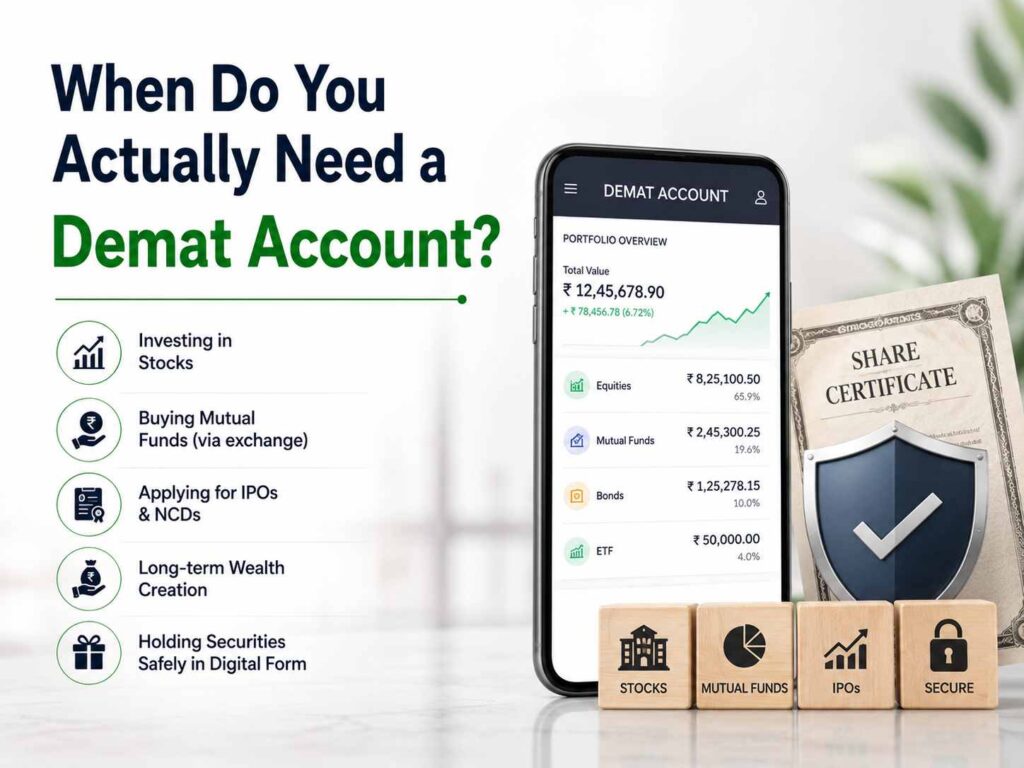
You don’t need a Demat account for most conventional mutual funds. But the requirement changes when you buy exchange-traded products.
When you need a Demat account
- ETFs: If you want to buy and sell an ETF on a stock exchange, you generally need a trading and Demat account.
- Stocks and other securities: A Demat account is also used when you want to hold shares and other exchange-traded securities in one place.
Want ETF-like exposure without a Demat?
You still have alternatives. Instead of buying a direct ETF, you can consider:
- Index Mutual Funds: Track a market index without being traded on the exchange.
- ETF Fund of Funds (FoF): Invest in a mutual fund that, in turn, invests in ETFs.
Both can generally be invested in through the mutual fund route, allowing you to hold the units in folio/account-statement form.
Bottom line: If you’re investing in conventional mutual funds through SIPs or lump sums, you generally don’t need a Demat account. If you want to trade ETFs or stocks on an exchange, a Demat setup becomes relevant.
A Simple Example
Suppose Priya wants to invest ₹5,000 every month in a diversified equity mutual fund. She completes KYC, selects her investment route, sets up her SIP and receives a folio number. She can track and redeem the investment without having a Demat account.
Now consider Rahul, who wants to buy an ETF during market hours through a stock exchange, alongside shares in his portfolio. His requirements are different because he is trading an exchange-listed product.
Neither approach is inherently “better.” The right setup depends on what you are buying and how you want to manage it.
Is Investing Without a Demat Account Safe?
Yes, investing in mutual funds without a Demat account can be safe. Mutual funds operate within the regulatory framework of SEBI, which sets rules for investor protection and fund management.
Your safety depends more on choosing a legitimate platform, understanding the scheme and keeping your account credentials secure—not on whether you have a Demat account.
Frequently Asked Questions
Is a Demat account mandatory for an SIP?
No. You can generally start an SIP in eligible mutual funds through a folio/account-statement route without opening a Demat account.
Is investing without a Demat account safe?
Yes. Not having a Demat account doesn’t make mutual funds less safe. What matters is using a legitimate investment platform, understanding the scheme and keeping your account details secure.
Is a folio the same as a Demat account?
No. A folio is your mutual fund investment record with the fund house, while a Demat account is used to hold securities in dematerialised form.
Does a Direct Plan mean you don't need a Demat account?
Not necessarily. Direct vs Regular refers to how you invest, while Folio vs Demat refers to how your units are held. They are two separate choices.
Can you invest in ETFs without a Demat account?
Not if you want to trade the ETF on a stock exchange. However, you can get similar market exposure through an Index Mutual Fund or ETF Fund of Funds (FoF) without needing a Demat account.
The Bottom Line
You don’t need a Demat account to start investing in eligible mutual funds. You can invest, track your folio and redeem your units through the mutual fund route.
So, before opening another account, ask yourself one simple question: “What am I investing in?” If it’s mutual funds and SIPs, a folio may be all you need. If you want to trade stocks or ETFs, a Demat account becomes useful.
This article is for educational purposes only. Mutual fund rules, taxation and processes may change, so check the latest official information before investing.