No, a 20% market dip is usually not a reason to stop your SIP. In fact, market corrections are often the most effective phase for SIP investing because your fixed investment amount buys more mutual fund units at lower prices. Continuing your SIP during volatility helps reduce your average cost, maintain compounding, and position your portfolio for long-term recovery.
A 20% fall in your mutual fund portfolio can still feel uncomfortable. Watching markets decline daily naturally creates fear and uncertainty, especially when news headlines amplify panic around crashes, recession risks, or economic slowdown. Many investors immediately think about pausing SIPs until markets “stabilise.”
However, history shows that stopping SIPs during corrections often damages long-term wealth creation more than the market fall itself. SIP investing is built specifically to handle volatility through disciplined investing and rupee cost averaging.
The key is understanding that a market decline becomes a real loss only when investments are stopped or redeemed in panic.
Why a 20% Market Dip Feels More Dangerous Than It Actually Is
A market correction triggers what behavioural finance calls loss aversion. Investors tend to feel the pain of losses more strongly than the satisfaction of gains. A 20% decline, therefore, feels emotionally larger than it mathematically is.
However, equity markets have always moved in cycles. Corrections, bear markets, and temporary declines are a normal part of long-term investing. Whether it was the 2008 financial crisis, the 2020 pandemic crash, or multiple corrections in between, markets eventually recovered and moved toward new highs over time.
The investors who benefited the most were not necessarily the smartest market timers. They were the ones who stayed invested while others panicked.
A falling market tests patience more than intelligence.
What Actually Happens When You Continue Your SIP During a Market Crash
When markets decline, the NAV (Net Asset Value) of mutual funds also falls. Many investors interpret this as “losing money.” But for SIP investors, lower NAVs create a powerful long-term advantage.
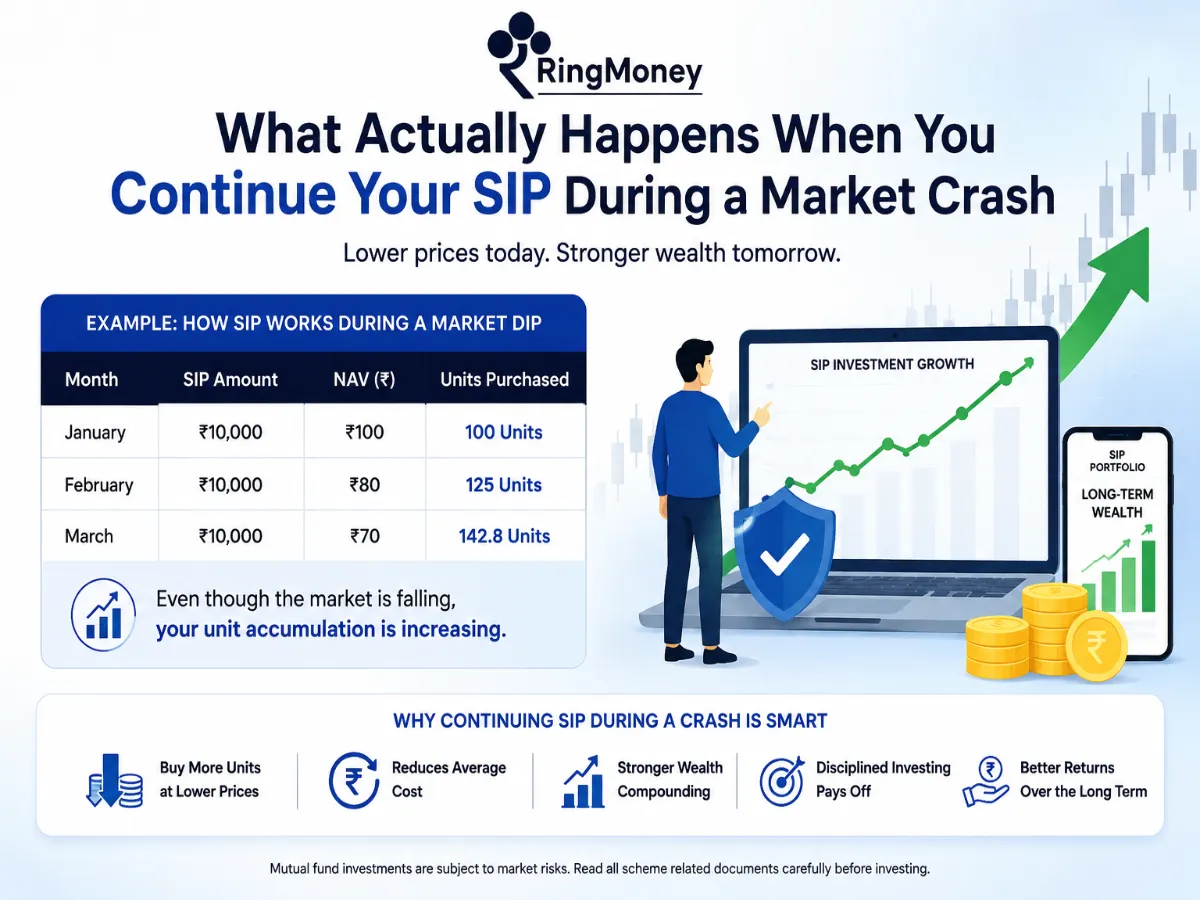
Your SIP amount remains fixed, but lower prices allow you to accumulate more units.
Example: How SIP Works During a Market Dip
Month | SIP Amount | NAV | Units Purchased |
January | ₹10,000 | ₹100 | 100 Units |
February | ₹10,000 | ₹80 | 125 Units |
March | ₹10,000 | ₹70 | 142.8 Units |
Even though the market is falling, your unit accumulation is increasing rapidly.
This process is called rupee cost averaging. Over time, it reduces your average purchase cost and improves the potential for stronger returns when markets recover.
A correction is uncomfortable emotionally, but mathematically it helps disciplined SIP investors accumulate future wealth at discounted prices.
The Biggest Mistake Investors Make During Market Volatility
Most investors do not lose money because markets fall. They lose money because they stop investing or redeem investments at the wrong time.
There is a major difference between:
- Notional Loss — your portfolio value temporarily falls
- Realised Loss — you actually sell your investments during the decline
Stopping SIPs during a correction interrupts the compounding process. It also creates another problem: investors rarely know when to restart.
By the time markets “feel safe” again, recovery has often already begun.
This is known as the V-Recovery Trap. Markets typically recover faster than emotions do.
Why Timing the Market Usually Fails
Waiting for the “perfect time” to restart investing sounds logical, but in reality, market timing is extremely difficult.
No investor consistently predicts:
- the exact market bottom
- the recovery phase
- the best entry point
Even professional fund managers struggle to time markets perfectly.
Long-term wealth is generally built through:
- consistency
- discipline
- staying invested through cycles
Not through trying to predict every correction.
This is exactly why SIP investing works well for retail investors. It removes emotional decision-making from the process.
A 20% Correction Is Not Unusual in Equity Investing
One important perspective investors often miss is that volatility is normal in equity markets.
A 15–20% correction can happen every few years, especially in equity-oriented mutual funds and indices like the NIFTY 50 or Sensex.
That does not automatically mean your investments are broken.
In fact, long-term investors often benefit from volatility because it allows them to buy more units at lower prices before the next recovery cycle begins.
The hardest part of investing is not selecting funds.
It is staying disciplined when markets become uncomfortable.
Should You Increase Your SIP During a Dip?
For investors with stable income and strong emergency savings, a market correction can also become an opportunity to increase investments gradually.
This strategy is commonly called a SIP top-up.
Instead of stopping your SIP:
- Continue your existing SIP
- Increase the amount slightly if financially comfortable
- Consider a staggered lump sum investment
Buying during corrections historically improves long-term return potential because investors accumulate more units at lower valuations.
However, this should only be done if:
- Your emergency fund is already in place
- There are no short-term cash requirements
- Your investment horizon remains long-term
When Does Stopping SIP Actually Make Sense?
While continuing SIPs is usually the better decision, there are exceptions where pausing investments may be justified.
Situations Where Reviewing SIPs Makes Sense
1. Financial Emergency
If income has reduced significantly or there is an unavoidable emergency expense, preserving liquidity becomes more important.
2. Wrong Fund Selection
If a fund has consistently underperformed its benchmark and category peers for a long period, reviewing or switching the fund may be necessary.
3. Short-Term Investment Goal
If your financial goal is less than 2–3 years away, equity exposure may need reassessment regardless of market conditions.
4. Portfolio Misalignment
Sometimes investors accidentally take excessive risk through sector-heavy or overly aggressive funds. Market corrections expose those mistakes.
The important point is this:
Reviewing your mutual fund strategy is healthy. Reacting emotionally to market declines is not.
The Psychological Side of Investing Most People Ignore
Financial decisions are rarely just mathematical. They are emotional.
When portfolios fall:
- fear increases
- patience declines
- investors seek certainty
Unfortunately, markets never provide certainty.
Successful investors are often those who can stay calm during uncertainty, while others panic.
This is why investing platforms that simplify tracking and reduce noise become important during volatile periods. We believe investing should feel clear, not overwhelming. Platforms like RingMoney help investors monitor portfolios, SIPs, and long-term goals without unnecessary complexity, making it easier to stay focused on strategy rather than short-term market panic.
The best investment decisions are usually boring, disciplined, and consistent.
What Smart Investors Focus on During a Market Crash
Instead of checking daily portfolio declines, experienced investors usually focus on a few critical questions:

Checklist During Market Corrections
- Is the original financial goal still valid?
- Has the investment horizon changed?
- Is the fund fundamentally strong?
- Does the portfolio remain diversified?
- Is emergency cash available separately?
If the answers remain positive, short-term volatility alone is rarely a reason to stop SIPs.
SIP Investing Is About Time, Not Timing
One of the biggest misconceptions about mutual fund investing is that wealth is created only during bull markets.
In reality, a large portion of long-term wealth creation happens during market declines because investors accumulate units cheaply during those periods.
The returns become visible later during recovery phases.
This is why disciplined investors often treat market crashes differently. Instead of asking:
“Why is the market falling?”
They ask:
“How many more units am I accumulating at lower prices?”
That perspective shift changes everything.
What History Consistently Shows
Every major market decline in history has eventually been followed by recovery.
The timeline differs. The volatility differs. But long-term equity markets have historically rewarded disciplined investors who remained invested through cycles.
Investors who stopped SIPs during panic periods often faced three problems:
- fewer accumulated units
- missed recovery rallies
- delayed compounding
Meanwhile, those who continued investing benefited from lower purchase costs and stronger long-term growth potential.
Patience may not feel rewarding immediately, but it compounds significantly over time.
Final Verdict: Stop SIP or Continue?
For most long-term investors, a 20% market decline is not a reason to stop SIPs.
It is a phase where SIP investing becomes more effective.
Continuing your SIP during corrections helps:
- accumulate more units
- reduce average investment cost
- maintain compounding momentum
- avoid emotional investing mistakes
Stopping SIPs may provide temporary emotional relief, but it often damages long-term wealth creation.
Markets recover. Discipline is what determines whether investors benefit from that recovery.
For regular investment tips, SIP updates, and simple money guidance, follow us on Instagram and explore the link in our bio to get started instantly.
Key Takeaways
- A 20% mutual fund decline is painful, but historically normal in equity investing.
- SIPs work best during volatile periods because they accumulate more units at lower prices.
- Stopping SIPs during market crashes can interrupt compounding and reduce long-term returns.
- Review your financial goals and fund quality before making emotional decisions.
- Using a simple and reliable platform like RingMoney can help investors stay disciplined and focused on long-term investing goals.
Disclaimer
Mutual fund investments are subject to market risks. Read all scheme-related documents carefully before investing. This article is for informational purposes only and should not be considered personalised financial advice.
Frequently Asked Questions
Is a 20% market fall considered a bear market?
Yes, a 20% decline from recent highs is commonly called a “Technical Bear Market.” While the term sounds serious, it is a normal part of equity market cycles and has historically been followed by eventual recovery over the long term.
Should investors switch to debt funds during a market crash?
Shifting completely to debt funds during panic phases can lock in losses and reduce future recovery potential. Asset allocation should depend on your financial goals, risk tolerance, and investment horizon — not short-term fear.
How long does it usually take for mutual funds to recover after a correction?
Recovery timelines vary depending on market conditions, economic factors, and fund categories. Some corrections recover within months, while larger bear phases can take longer, but long-term equity markets have historically moved upward over extended periods.
Is it better to invest a lump sum during a 20% dip or continue SIPs?
For most investors, continuing SIPs remains the safer and more disciplined approach. However, investors with surplus cash, strong emergency savings, and long-term goals may consider staggered lump sum investments during corrections.
How can investors avoid panic during market volatility?
Avoid checking portfolio values daily and focus on long-term financial goals instead of short-term price movements. Using a simplified investment tracking platform like RingMoney can also help investors stay focused on progress rather than market noise.