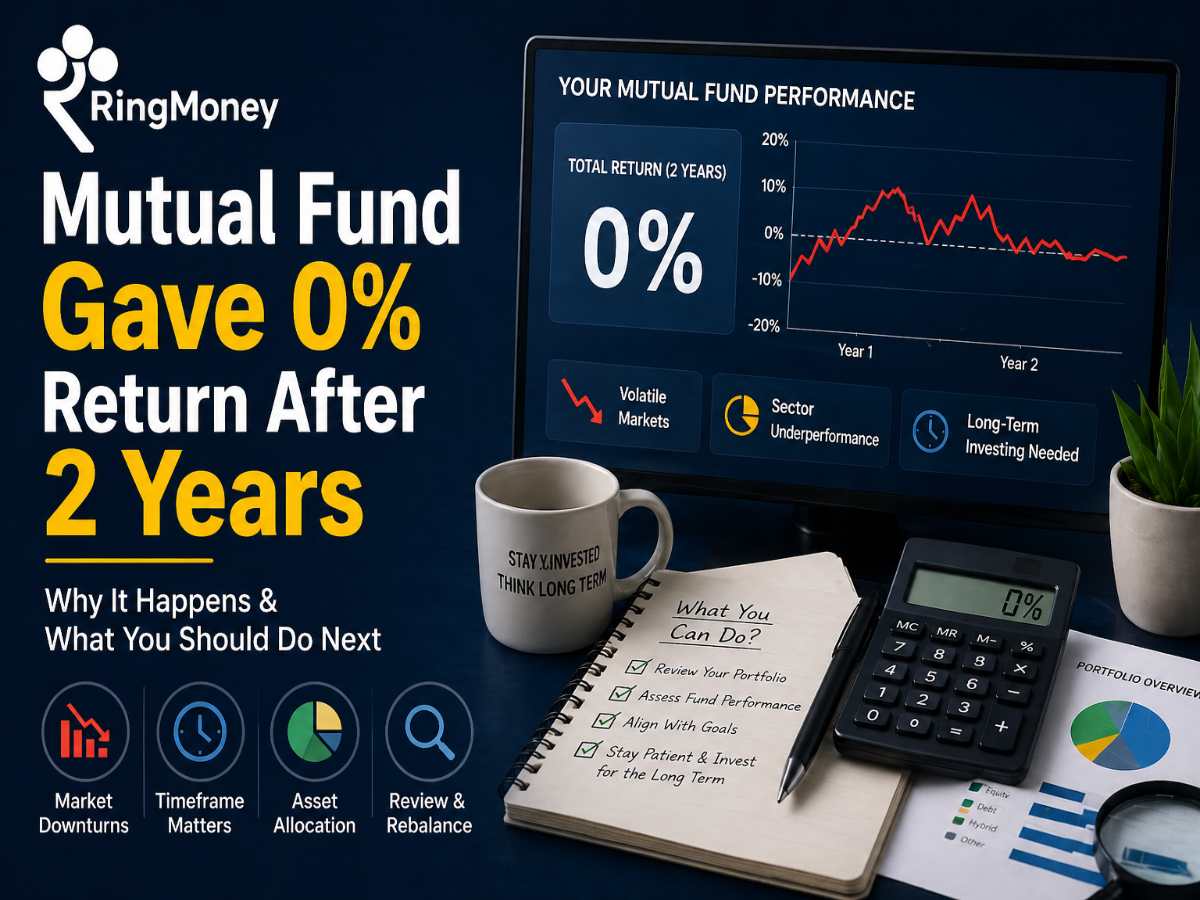
If your mutual fund SIP shows 0% returns after two years, it usually doesn’t mean the investment has failed. In most cases, it happens because a large portion of your money was invested recently and hasn’t had enough time to grow—especially if the market has been flat in the last few months.
You followed the discipline. Every month, the SIP went through without fail. And then one day, you checked your portfolio—only to find it sitting at 0% returns, or something very close to it. It feels confusing, even discouraging. But a flat return after two years is far more common than most investors expect—and more importantly, it’s often misunderstood.
This is not necessarily a sign that your investment failed. In many cases, it’s simply how the math and markets interact in the early years of a SIP.
A Quick Reality Check
Before diving deeper, here’s what a 2-year, 0% return usually indicates:
What You See | What It Actually Means |
0% or low return | Recent investments haven’t matured yet |
No visible growth | The market likely moved sideways recently |
Doubt about the fund | Often a timing illusion, not a selection error |
The key is to understand why this happens—because the explanation changes how you respond to it.
The Math Behind the “Zero Return” Illusion
A SIP is not a one-time investment. It’s a series of investments made at different points in time, and each instalment behaves differently.
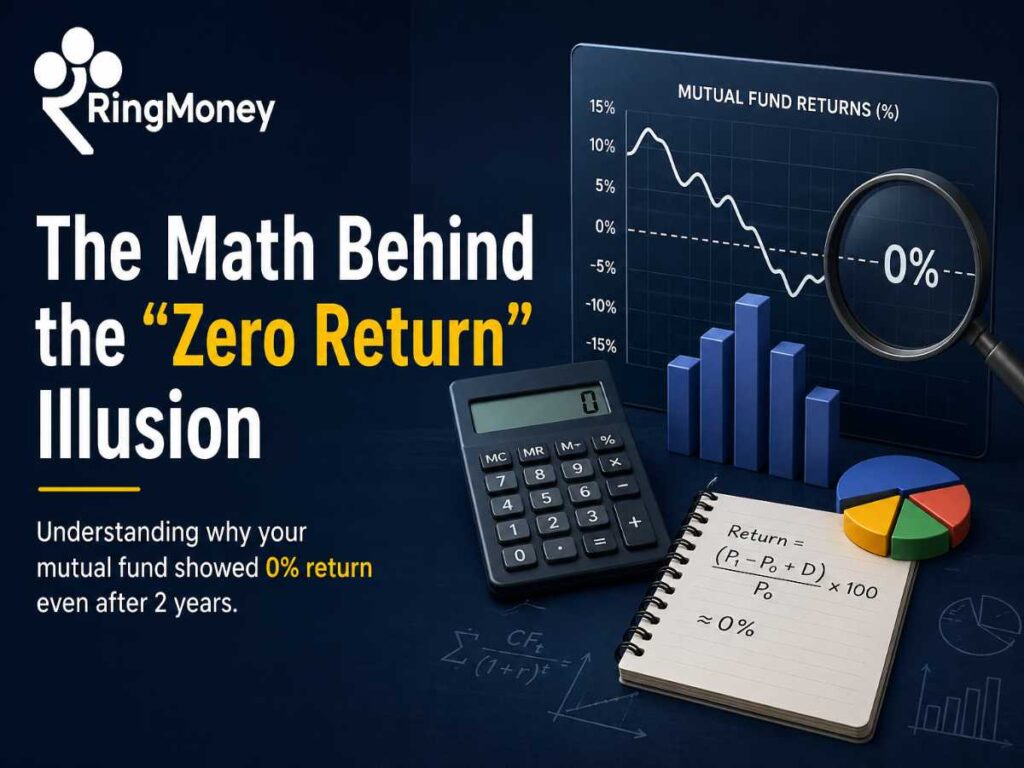
In a 24-month SIP, a significant portion of your money is relatively new. The last 6–12 months alone can account for a large share of your total invested amount.
The Timing Effect
Think of your SIP like building a structure:
- The earlier investments are the foundation—they’ve had time to grow.
- The recent investments are still “fresh”—they haven’t had time to generate returns.
If the market has been flat in recent months, these newer installments show little to no growth. And because they form a large portion of your portfolio, they pull down the overall return.
This is where metrics like XIRR come into play. XIRR gives more weight to recent investments, which means short-term stagnation can overshadow earlier gains.
The “Young Portfolio” Trap
Two years may feel like a long time, but in equity investing, it’s still considered early.
Returns in the stock market don’t come in a straight line. They tend to follow what professionals often describe as a “J-curve” pattern:
- Initial years: Slow or flat performance
- Later years: Accelerated growth as compounding kicks in
During the first phase, your portfolio is still accumulating units. Growth becomes visible only when these units start compounding over time.
This is why evaluating a SIP at the 2-year mark often leads to misleading conclusions.
When the Market Itself Takes a Pause
Not every period is a growth phase. Markets go through cycles, and sometimes they simply move sideways.
If broader indices haven’t delivered strong returns over the last 12–18 months, mutual funds—especially diversified ones—will reflect that.
What a Sideways Market Looks Like:
- Frequent ups and downs with no clear direction
- Minimal net growth over months
- Short bursts of gains followed by corrections
In such conditions, expecting high returns is unrealistic. A 0–3% return may actually mean your fund is performing in line with the market, not underperforming.
Fund Type and Allocation Matter
Another important factor is where your money is invested.
Different categories of mutual funds behave differently across market cycles:
- Large-cap funds tend to be stable but may deliver moderate returns in flat markets
- Mid-cap and small-cap funds can be volatile and may take longer to recover after corrections
- Sectoral or thematic funds depend heavily on specific industries, which may go through slow phases
If your portfolio is heavily tilted toward one category—especially riskier segments—it can amplify the impact of market stagnation.
Common Investor Mistakes That Add to the Problem
Sometimes, the issue is not just the market or the math—it’s also how the portfolio is managed.
Frequent pitfalls include:
- Starting at market highs: Entering during peak valuations often leads to a period of low or negative returns
- Over-diversification: Holding too many funds creates overlap and reduces overall efficiency
- Chasing recent performers: Switching funds based on short-term rankings often locks in losses
- Stopping too early: Exiting during a flat phase prevents recovery and compounding
These decisions are usually driven by short-term performance anxiety rather than long-term strategy.
XIRR vs Absolute Returns: What Should You Track?
Many investors rely on the “current gain/loss” figure, but that doesn’t tell the full story in a SIP.
Here’s the difference:
Metric | What It Shows | Limitation |
Absolute Return | Total gain or loss | Ignores the timing of investments |
XIRR | Annualised return considering cash flow timing | Can look low in early years |
XIRR is the more accurate measure—but even it can appear suppressed in a young portfolio.
When reviewing your investments on platforms like RingMoney, focusing on XIRR gives a clearer picture of how your money is actually performing over time.
Should You Be Concerned?
A 0% return after two years is not ideal—but it’s not alarming either.
What matters is context.
Ask these questions:
- Is your fund performing in line with its category?
- Has the broader market been flat during this period?
- Is your investment horizon aligned with equity (3–5+ years)?
If the answers suggest normal conditions, then there is usually no immediate need to act.
1. Continue Your SIP
Stopping now can turn a temporary phase into a permanent outcome. Flat markets are often the best time to accumulate more units at lower prices.
2. Compare With Category, Not Fixed Returns
Equity funds should be evaluated against similar funds—not fixed deposits or savings accounts.
3. Review at the Right Timeframe
A meaningful evaluation window for equity investing is at least 3 years. This allows your portfolio to experience different market phases.
4. Simplify Your Portfolio
If you hold too many funds, consider consolidating. A focused portfolio is easier to track and manage.
The Cost of Quitting Too Early
One of the biggest risks at this stage is not market volatility—it’s investor behaviour.
Exiting after a flat period means:
- You stop accumulating units when prices are reasonable
- You miss potential recovery phases
- You lock in underwhelming returns
In contrast, staying invested allows your earlier investments to compound and your newer investments to benefit when the market turns upward.
Seeing the Bigger Picture with the Right Tools
Clarity plays a major role in decision-making. When investors only see a flat number, it’s easy to assume something is wrong.
This is where having the right platform makes a difference.

At RingMoney, we focus on helping investors look beyond short-term noise. By offering a clear view of XIRR, category comparisons, and portfolio structure, we make it easier to understand whether your investment truly needs action—or just time.
It’s not about reacting faster. It’s about reacting correctly.
Final Perspective: Time Is the Missing Ingredient
A 2-year SIP showing 0% returns is often a phase—not a verdict.
It reflects a combination of recent market conditions, portfolio timing, and the natural behaviour of compounding investments. The real shift typically begins beyond this period, when accumulated units start working together to generate visible growth.
Patience in this phase is not passive—it’s strategic.
Key Takeaways
- A 0% return after 2 years is usually a mathematical and market-driven effect.
- Recent SIP instalments have a larger influence on short-term returns
- Market cycles can temporarily suppress performance
- Evaluating too early often leads to incorrect decisions
- Staying invested through flat phases is critical for long-term growth
Disclaimer: Mutual fund investments are subject to market risks. Past performance does not guarantee future results. This content is for informational purposes and should not be considered financial advice.
Frequently Asked Questions
Is 0% return after 2 years a loss?
Not necessarily. If your invested value is intact or slightly fluctuating, it reflects temporary stagnation, not a realised loss unless you redeem.
Can a mutual fund recover after a flat phase?
Yes, many funds go through slow periods before delivering strong returns when market conditions improve and growth cycles resume.
Should you add more money during low-return periods?
Investing during slow phases can be beneficial, as you accumulate more units at lower prices, improving long-term return potential.
How do you know if your fund choice was right?
Check if the fund is consistent with its strategy and not deviating from its objective, rather than judging only short-term performance.
Does SIP guarantee positive returns over time?
No investment guarantees returns, but SIPs help manage market volatility and improve the probability of better outcomes over longer durations.